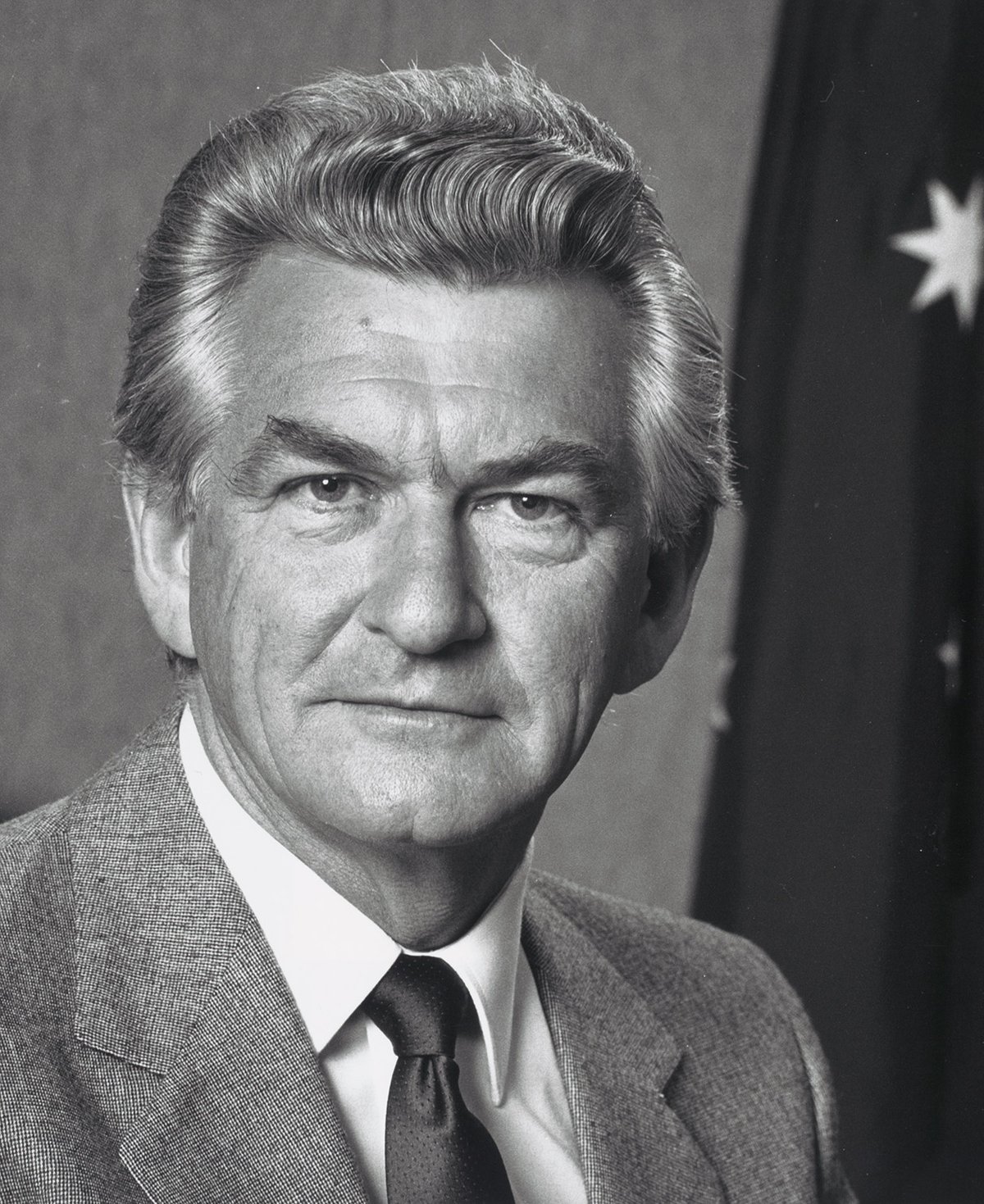
Bob Hawke AC, GCL
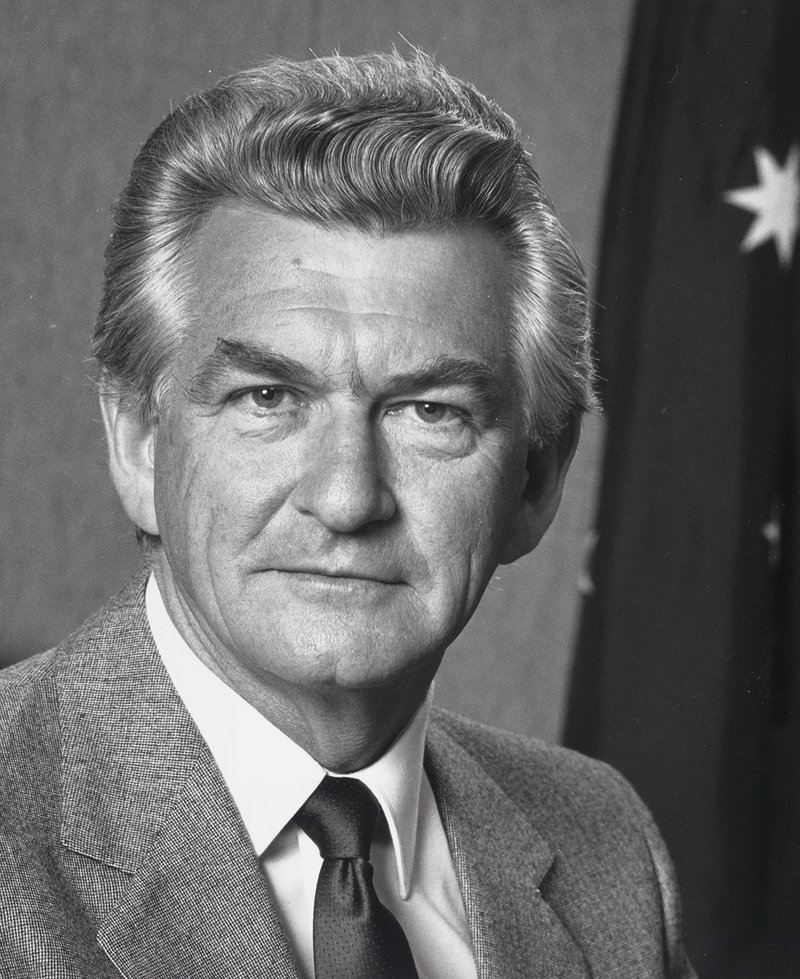 Click to enlarge image
© National Library of Australia
Readers note: This is an excerpt from the 200 Treasures exhibition catalogue, developed in 2017. This content was written as a brief biography on why this person was included in the exhibition.
1929 - 2019
Robert James Lee (Bob) Hawke was born in Bordertown, South Australia, in 1929, and at the age of ten his family moved to Perth.
Hawke attended the University of Western Australia where, as president of the Student Representative Council, he got his first taste of politics. He graduated with an arts/law degree in 1953 and was awarded a Rhodes scholarship at Oxford University, where he wrote a thesis on the history of wage fixing in Australia.
At Oxford, Hawke gained notoriety for his drinking speed and capacity, a talent that would later endear him to many voters: he had the gift of parlaying his human weaknesses into political gold.
When Hawke returned to Australia in 1956, he married Hazel Masterton and the newlyweds headed for Canberra, where Hawke enrolled in a doctoral program at the Australian National University (ANU), which he never completed. Instead, he became a researcher with the Australian Council of Trade Unions (ACTU) in 1958.
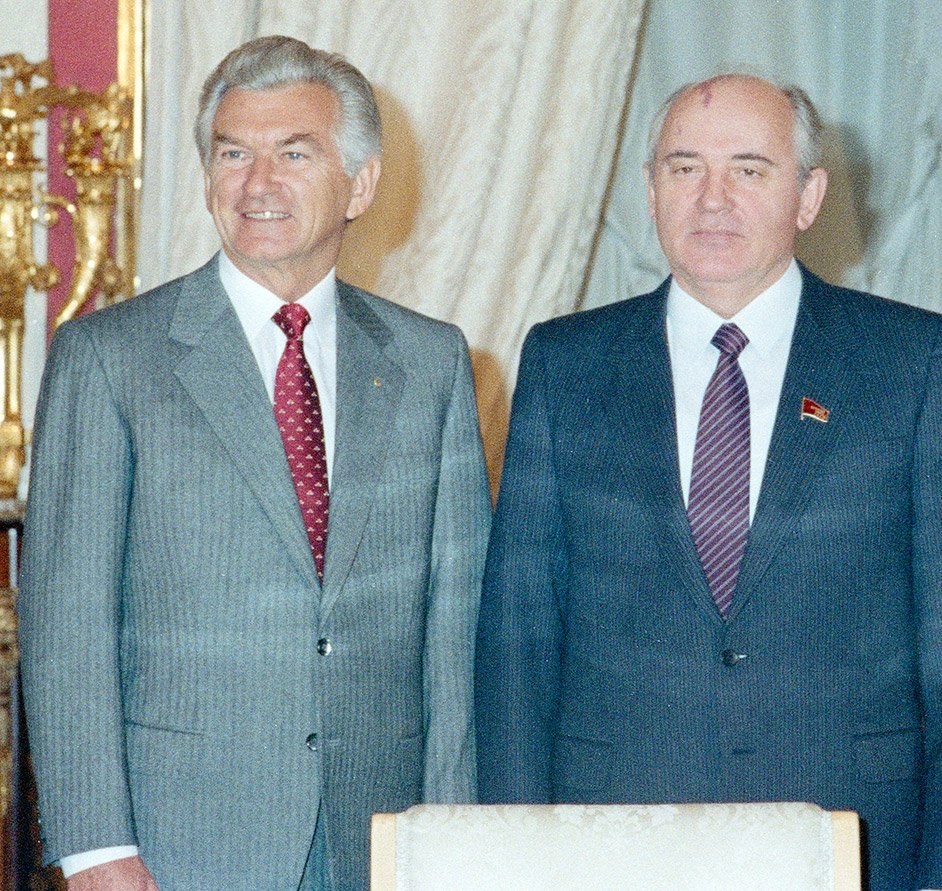
© Department of Foreign Affairs and Trade
Eleven years later, his importance to the organisation was recognised when he became ACTU president, an office he held until 1980. Hawke was always close to the Labor Party but cemented his connections in 1973, when he was elected the party’s federal president. His prominence grew both within Australia and overseas. Even before he formally entered the political arena when pre-selected for the Melbourne seat of Willis in 1980, he outstripped other contenders as many people’s preferred prime minister. Within three years he was prime minister, an office he held until ousted by Paul Keating in a leadership ballot in 1991.

Hawke’s government is most remembered for introducing Medicare, floating the dollar, developing Asia- Pacific Economic Cooperation (APEC), and privatising numerous public assets such as Qantas. Despite his long history with the left, Hawke moved the Labor Party to the right but retained the high regard of many of Labor’s ‘true believers’.