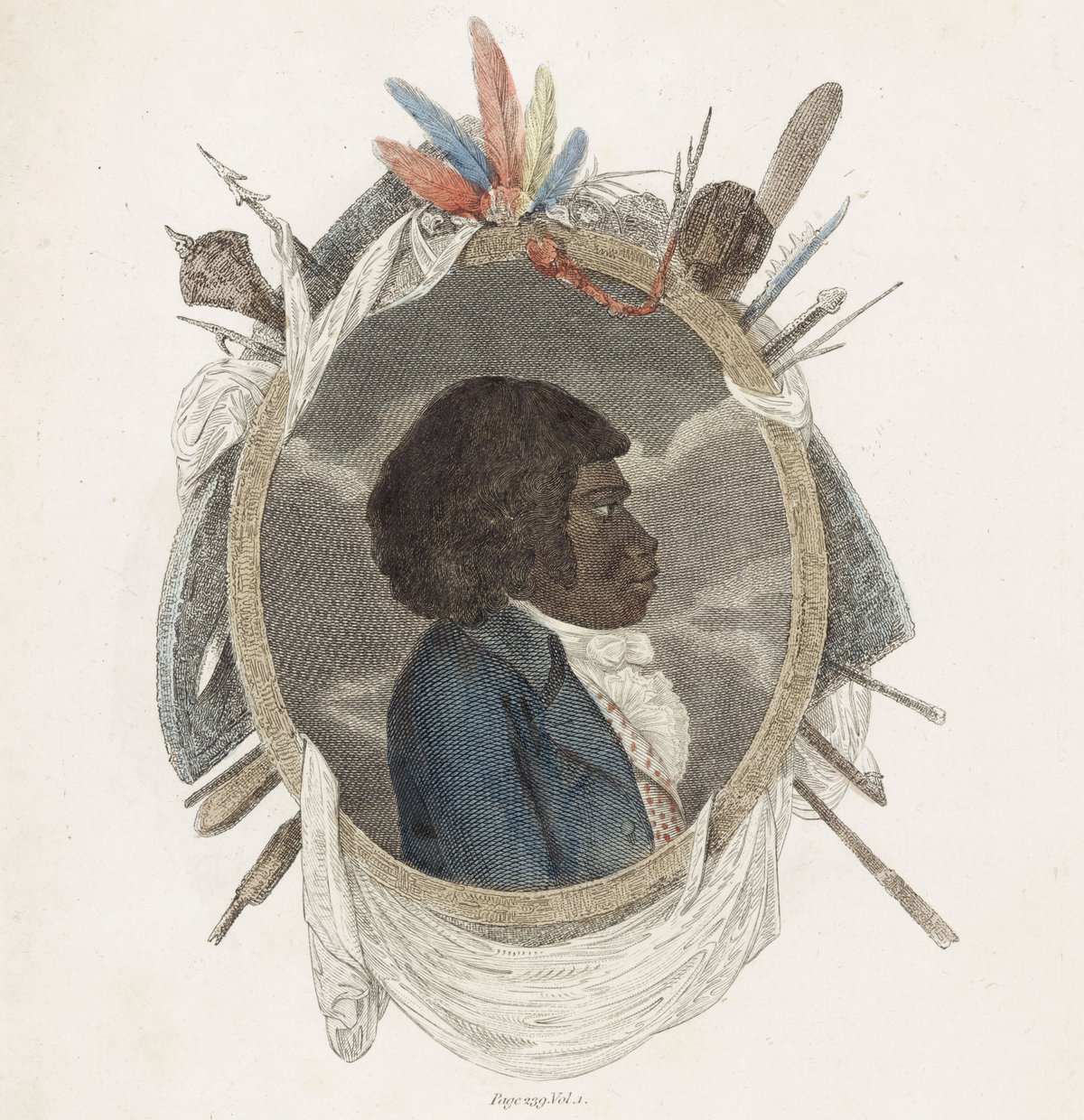
Woollarawarre Bennelong
 Click to enlarge image
© National Library of Australia
Readers note: This is an excerpt from the 200 Treasures exhibition catalogue, developed in 2017. This content was written as a brief biography on why this person was included in the exhibition.
1764? - 1813
Woollarawarre Bennelong was a prominent figure in the settlement of Port Jackson and the first Aboriginal man to visit Europe and to return. He was a Wangal man born around 1764 on the southern shores of the Parramatta River.
Bennelong came to the notice of colonists when the colony was nearly two years old and was enduring numerous stresses, not least of which was poor relations with local Eora people. Governor Arthur Phillip resorted to capturing Eora in order to open a dialogue. In November 1789, two men were captured; one was 25-year- old Bennelong. Bennelong was in leg irons when he formed a vital friendship with Governor Phillip. His leg irons were then removed and Bennelong escaped and was not seen until a meeting at Manly in September, when Phillip was wounded with a spear. After this attack, which was likely retribution for Phillip’s acts that contravened Aboriginal law, relations improved. Bennelong was a brilliant man, who made a deep impression on the colonists. He learned English and acted as a go-between. In appreciation, Phillip had a small house built for him on what is now Bennelong Point, where the Opera House stands. When Phillip returned to England at the end of his term in 1792, he took Bennelong with him, as well as his friend Yemerrawanne. They were presented to King George III and visited museums and attractions. The two men themselves became an attraction as the latest human curiosities to visit London from the empire. After a year, Yemerrawanne died of a chest infection and Bennelong became homesick.

When he finally returned to Sydney in September 1795, he at first maintained his ‘European’ ways, but in time returned to traditional life. This choice condemned him in the eyes of some colonists and historians, who told a sad tale of destitution and decline until his death in 1813. But Bennelong’s life after being a colonial celebrity was rather one of assuming his place as an elder in his Indigenous world.