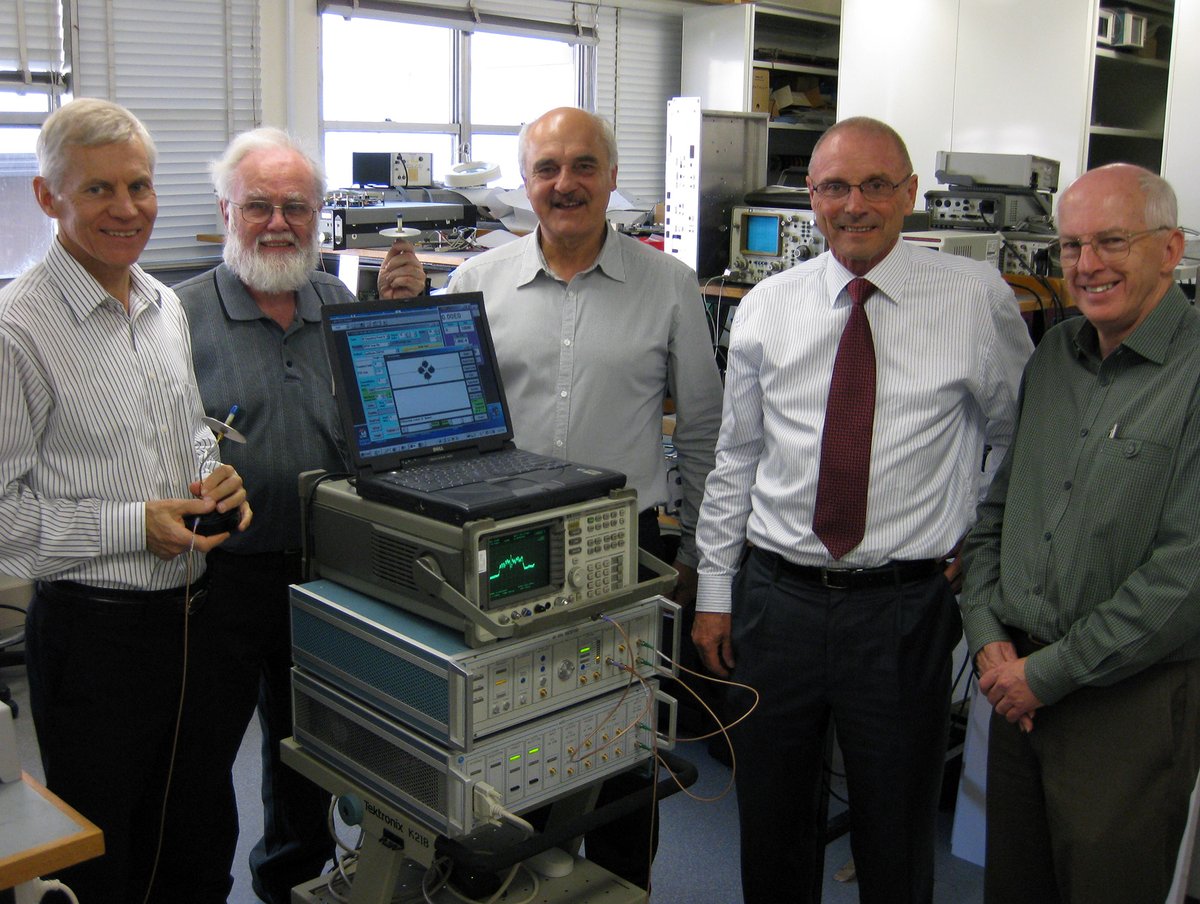
CSIRO WLAN Team
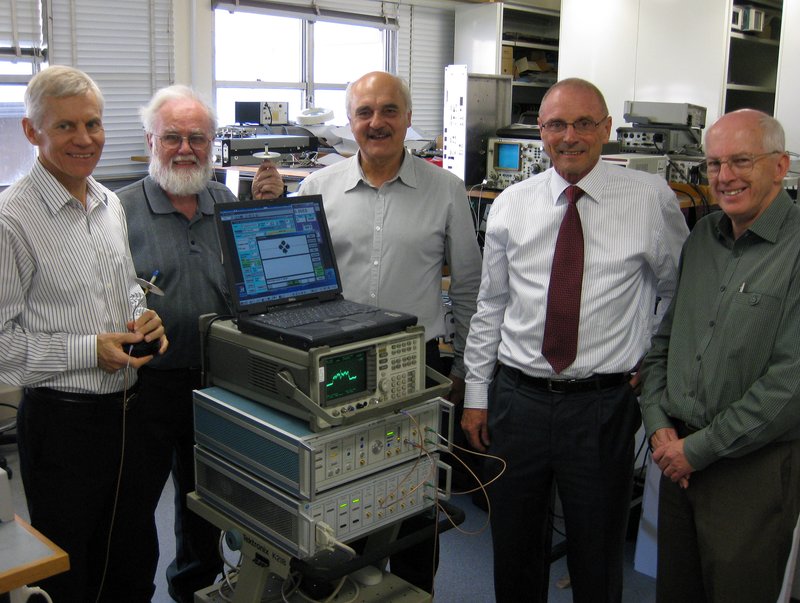 Click to enlarge image
© CSIRO
Readers note: This is an excerpt from the 200 Treasures exhibition catalogue, developed in 2017. This content was written as a brief biography on why this person was included in the exhibition.
Dr John O’Sullivan (1947–present), Dr Terry Percival (1955–present), Mr Diethelm Ostry (1948–present), Mr Graham Daniels (1948–present), Mr John Deane (1949–2020)
Former US vice president Al Gore was famously misquoted in 1999 claiming he invented the internet. However, a group of Australian scientists can rightly claim a major invention that transformed the internet and altered the world’s relationship with computer technology.
The internet began to impact our lives in the late 1980s, and we gradually gained greater access to the worldwide web and the wealth of knowledge and networks it enabled. But we were tethered by cables to wall outlets. As laptops and hand-held devices emerged in the 1990s, a group of Australian scientists based at the Commonwealth Scientific and Industrial Research Organisation (CSIRO) was working on a visionary project: they wanted to enable portable, wireless access at speeds 50 times greater than was then available.
In 1991, Dr John O’Sullivan created and led a Wireless Local Area Network (WLAN) research team at the CSIRO Division of Radiophysics. Key members were Dr Terry Percival and Graham Daniels, who, with O’Sullivan, were University of Sydney electrical engineering graduates who had worked on the university’s Fleurs radio telescope and other radio telescopes around the world. Also in the team were computer scientist John Deane, who had a Bachelor of Arts degree from Macquarie University, and physicist Diethelm Ostry, a graduate of the University of Newcastle and the Australian National University. Working with the WLAN team was David Skellern, Chair of Electronics at Macquarie University. Together, the team brought to the project 100 years of combined experience in radio system design developed through radar, radio astronomy and satellite communications.
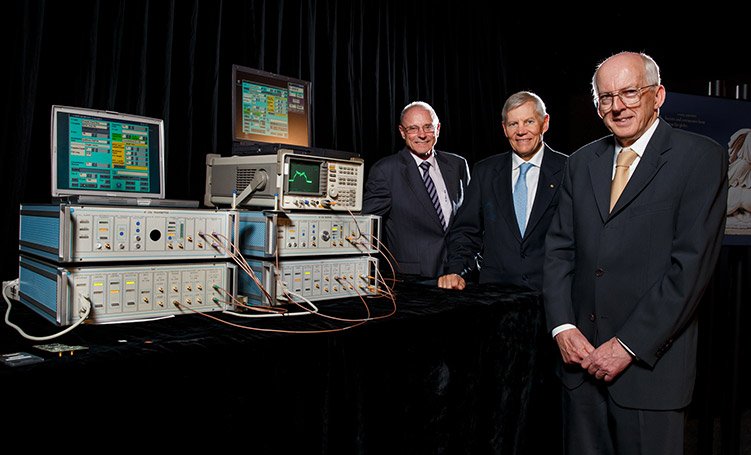
© National Museum of Australia
In 1992, the team invented a new method of wirelessly transmitting high-speed data in the presence of radio multipath interference, and in 1993, built a prototype that worked at more than 100 megabits per second. A provisional patent was lodged in 1992, and a US patent granted in 1996.
In 1999, the Institute of Electrical and Electronic Engineers (IEEE) issued a new standard for high-speed WLANs, called 802.11a. This and all subsequent standards that are now known collectively as Wi-Fi are based on the CSIRO radio invention.
By 2016, the CSIRO had licence agreements worth more than $500 million with 28 companies worldwide. Now cafés and libraries are mobile offices; we have smart phones, wireless printers and game consoles. In fact, by 2015 more than 10 billion devices that use the CSIRO-invented wireless technology had been sold worldwide.

The WLAN team has received many accolades for its work, including the 2009 CSIRO Chairman’s Medal, the Academy of Technological Sciences and Engineering’s Clunies Ross Award, the 2012 European Inventor Award and the IEEE Consumer Electronics Society’s 2017 Ibuka Award. In 2016, Dr O’Sullivan and Dr Percival were the fifth and sixth people granted the World IT Service Association’s (WITSA) Eminent Persons Award.