
Moai Hoa Haka Nana'ia: Stolen Friend
- Pasifika
- Rapa Nui
On this page...
Hoa Haka Nana’ia means “stolen or lost friend". The original moai was taken from Rapa Nui in 1868 and eventually placed in the British Museum where it stands today. This replica of Moai Haka Nana'ia was carved by Rapa Nui master carver Pau Hereveri and his student Victor Pakomio, and forms part of an ongoing cultural engagement and partnership between the Australian Museum and the Rapa Nui community.
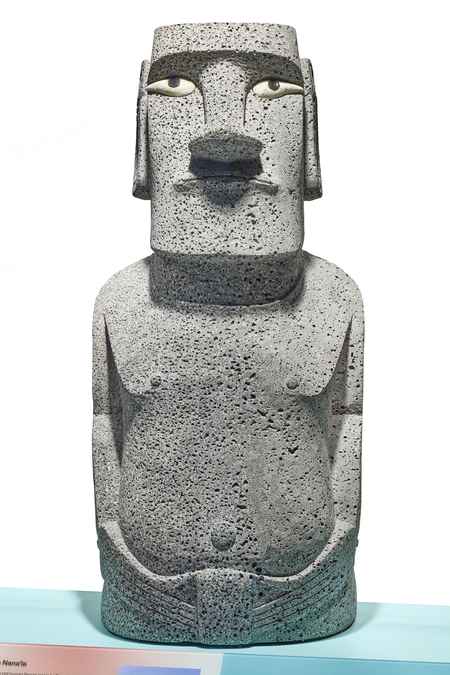
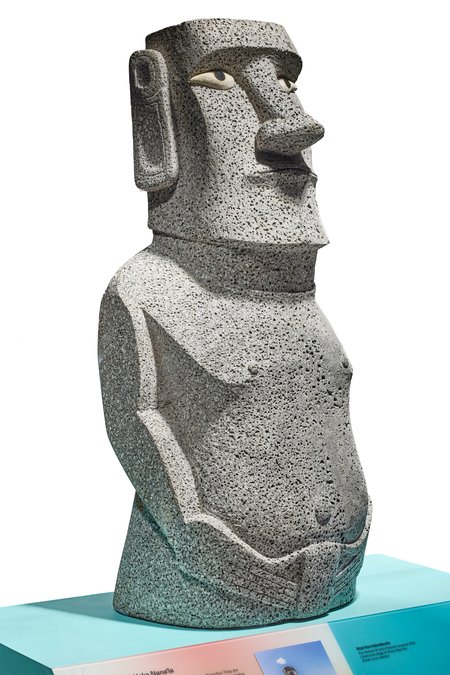
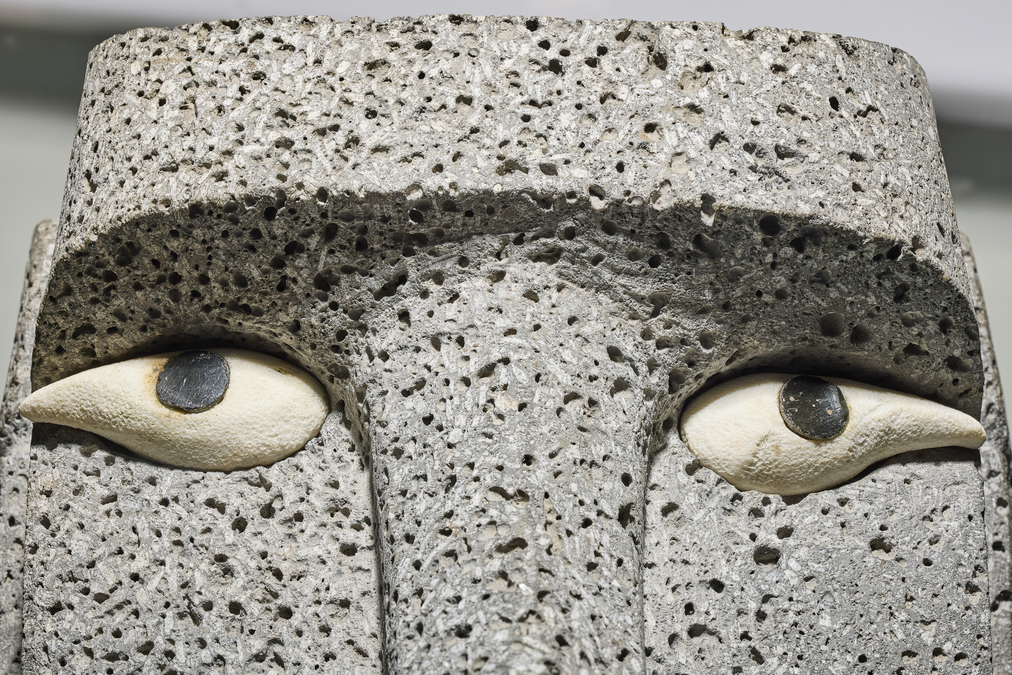
Moai are the monumental stone human figures iconic to Rapa Nui, representing both extraordinary feats of engineering and enduring expressions of cultural identity. Carved from basalt and volcanic tuff sourced from the Rano Raraku crater, they were erected atop ahu (ceremonial platforms) around the island's coastline. Many are topped with a pukao, a cylindrical red stone headdress manufactured at the Puna Pau quarry, with many examples surviving on the island today. Moai production is thought to have begun around 1000 CE, flourishing alongside the construction of ahu across the island, and continuing until approximately 1600 CE. Among the most significant of these figures is Hoa Haka Nana'ia (Stolen or Hidden Friend), the 2.5-metre-tall original now held in the British Museum. Hoa Haka Nana'ia was found standing upright and facing northwest, away from the sea, inside Taura reŋa (also known as Ko Tau Re Reŋa O Miru), a stone house in the ceremonial village of Oroŋo.
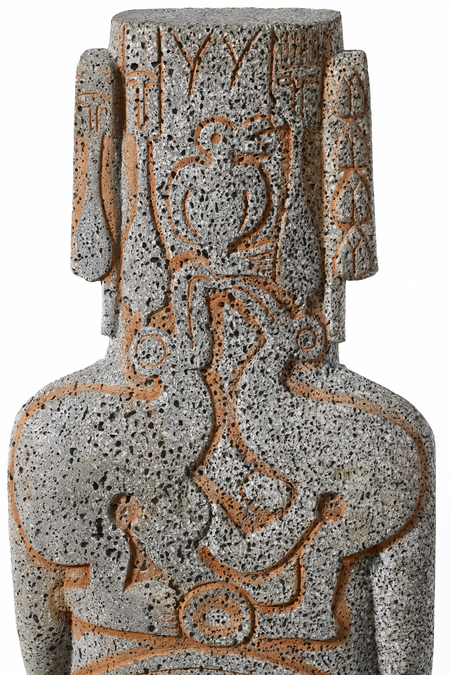
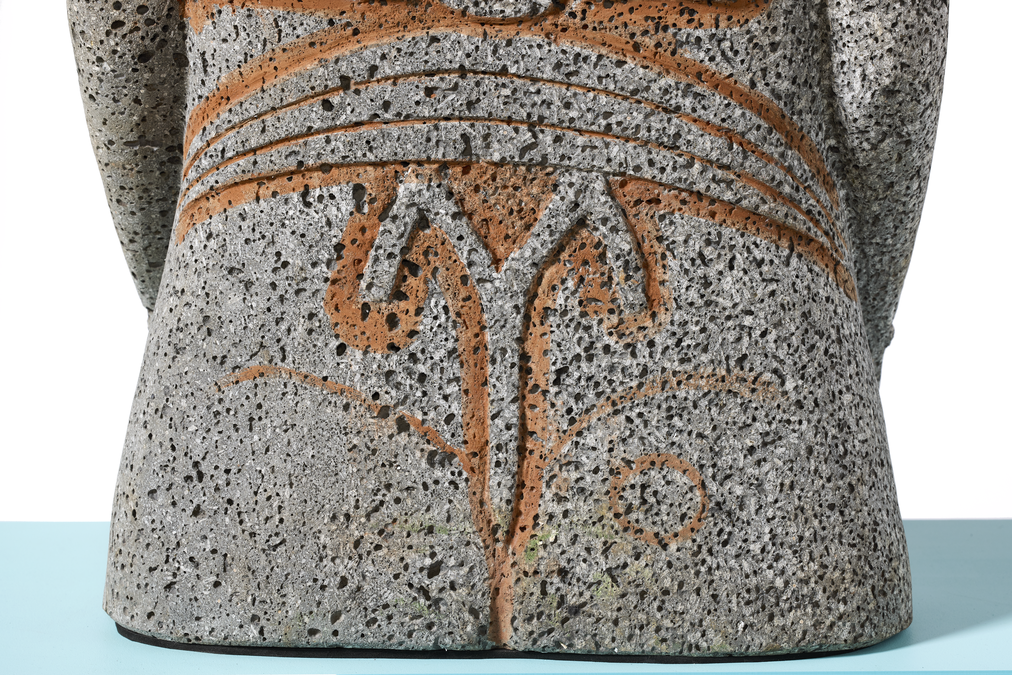
Although Hoa Haka Nana'ia shares the general form of other moai, several distinctive features set it apart. The Y-shaped marking on the chin and carved clavicles are considered to be late stylistic developments, while its basalt composition distinguishes it from the volcanic tuff more typical of moai across the island. What further distinguishes Hoa Haka Nana'ia is the richness of its pakiopa, the carved petroglyphs found on the backs of select moai, of which this figure is among the most elaborately decorated. While retaining the classic moai form, Hoa Haka Nana'ia bears detailed petroglyphs (see interactive below). Oral traditions record the pakiopa as representing the emergence of a new social order and inter-clan unity amid a period of conflict. Rapa Nui artist Vaitiare Pakarati interprets the carving as embodying key cultural values, including gender duality, communal strength, and unity, as expressed through the Taŋata Manu (Bird-man) ceremony. According to the Rapa Nui, Hoa Haka Nana'ia is strongly believed to have held a significant role within the Taŋata Manu governance system prior to its removal from Rapa Nui.
The living ancestors: The sacred and cultural significance of Moai to Rapa Nui People
Moai are known in Rapa Nui as Aringa Ora or the Living Faces, each understood to embody specific ancestor or high-status individual. Rather than functioning as abstract commemorative monuments, each figure was believed to carry the mana (spiritual power) of the ancestor it represented, functioning as a living connection between the living community and their predecessors. When erected, moai were oriented to face inland rather than toward the sea, their gaze directed over the communities they were charged with protecting. In this way, these ancestral figures functioned as both guardians and lineage symbols and their placement affirmed the genealogical ties of descent groups to their land while expressing and reinforcing the authority and continuity of those groups over time.
It is believed that Hoa Haka Nana’ia was oriented to face northwest toward the land of the Miru, the island's ruling clan, further illustrating the role of moai as expressions of territorial and ancestral connection. The ahu, the ceremonial platforms on which moai stand, were the sites where these relationships were enacted, giving material form to the centrality of ancestry and lineage in Rapa Nui spiritual practice. For the Rapa Nui, moai remain active ancestral representations; made permanent in stone, who continue to uphold the spiritual strength and cultural continuity of the community across generations.
Arohanui, Iorana, hello, hola to everyone, kōrua ta'ato'a. I'm Victor Jaramillo Pakomio.
The Moai Hoa Haka Nana'ia is very important for the Rapa Nui culture, because it marks the time when the Rapa Nui people resolved ongoing tribal conflicts caused by the overuse of resources. At this point, the people began to add inscriptions to the moai, giving it a unique significance in addition to its traditional value. As we know, they represent the living face of our ancestors, and for us, they are both a physical and a spiritual element.
Basically, what differentiates the Moai Hoa Haka Nana'ia and other moai is the petroglyphs on its back and the context in which it was taken.
The Moai Hoa Haka Nana'ia was removed from the island in 1869 by HMS Topaze, to fulfill a request from the Queen of England at that time. It was extracted from a house called Taura Reŋa in Oroŋo, a ceremonial village that is located on the Rano Kau volcano. The Moai is currently located in the center of the British Museum.
I believe in many ways this Moai could help educate the population in Sydney about the history of Rapa Nui, both ancient and contemporary, which is very relevant. The removal of the original Moai Hoa Haka Nana'ia is another example of the unwelcome visits the Rapa Nui people experienced on our island.
Unlike some scientific theories, the Rapa Nui people can demonstrate that we never collapsed. When the Europeans arrived on our island (1700s) there were thousands of people. It's not true that only a few remained; those who were taken as slaves (in the 1800s) returned with illnesses, but many people survived. Therefore, it is very important for us that the true story is told today: that the Rapa Nui, like many Polynesian peoples, experienced unwelcome visits.
The absence of the Moai causes us great pain, because it's the only one. We have about a thousand moai on Rapa Nui today, and they are all important. However, only this one has a pakiopa, or petroglyph, that it has on the back. In fact, no other moai has ever been inside a house. All of those elements are important to show to the people of Sydney, to help them to understand the Rapa Nui worldview. A worldview that believes that what our ancestors did cannot be forgotten.
And that what happened to Indigenous peoples, not just those of Rapa Nui, cannot be forgotten. The story is kept alive when you look at the drawings on its back and observe the figures represented. Only we know the secret, but I'll share a little about it. It represents life itself, the reproduction of the human being, the blessing that God gives us to create humans. Our ancestors understood this and wanted to represent it.
Just like all Indigenous peoples, our respect for our ancestors continues to this day. We perform ceremonies to our ancestors, our parents, our grandparents, and the moai participates as well. Every time we see it, even from afar, we remember it. And we know that if he is here in Sydney, at least a copy, it still has mana (power), as my teacher Pau Hereveri Teao, the great master carver of Rapa Nui, one of the best moai stone carvers, has said. Yesterday I sent him a message thanking him for helping me bring this Moai, because we need to continue our efforts so that people know our history, and so that one day we can see Rapa Nui's dream fulfilled: that Hoa Haka Nana'ia will return to its island where it should never have left.
Behind the face: Unlocking the secret narrative of the Moai Hoa Haka Nana’ia
The petroglyphs or 'Pakiopa' on the back of the Moai tell a story of creation and how the Taŋata Manu (Birdman) competition was intertwined in Rapa Nui's system of governance.
Explore the interactive below to take a closer look.
The Tapati Rapa Nui Festival - Echoes of the Taŋata Manu Ceremony
Hoa Haka Nana'ia holds deep spiritual significance as it is linked to the origins of the Taŋata Manu (Bird-man) tradition, which emerged following a period of inter-tribal conflict. The Taŋata Manu ceremony provided a unifying alternative to inherited leadership and is celebrated today through the annual Tapati festival.
From around 1500CE, Rapa Nui experienced a significant transformation in its religious and political organisation, as the Taŋata Manu (Bird-man) ceremony gradually displaced the earlier tradition of ancestor veneration and monumental moai construction. The marked expansion of Bird-man iconography in the island's petroglyphic and sculptural record reflects this transition, as well as the broader contest over political authority and sacred legitimacy during this period. The Taŋata Manu ceremony introduced a meritocratic model of leadership, in which authority was determined through ritual competition rather than inherited status alone. Religious and ceremonial focus shifted to Rano Kau, where the clifftop village of Oroŋo (Orongo) functioned as the ritual centre of the ceremony, under the patronage of the Miru -the island's royal lineage.
Each September, clan leaders from across Rapa Nui gathered at Oroŋo for a sacred competition in honour of the creator deity Makemake. The ceremony centred on the arrival of the manutara (sooty tern) to the nearby islet of Motu Nui. Rather than competing themselves, clan leaders each appointed a hopu manu (competitor), chosen to act on their behalf. The hopu had to descend the 200m cliffs of Rano Koa, swim through shark inhabited waters to Motu Nui and return with the season's first manutara egg. The winner announced his victory, and the chief of that clan was then proclaimed Taŋata Manu, and the embodiment of Makemake on earth. He held the title, along with its associated mana (sacred power), for one year, residing at Mataveri near Rano Kao during that time. Beyond the religious significance, the ceremony offered a structured means of resolving the inter-clan rivalries that had long destabilised Rapa Nui society. It was practiced until 1867.
The Tapati Rapa Nui is a living thread between the past and the present, where the voices of the Tupuna still resonate in every song, dance and celebration. Vaitiare Pakarati
The Tapati Rapa Nui Festival emerged in the late 1960’s as a revival of traditional practices. It brings together music, dance, language, and athletic disciplines rooted in ancestral knowledge, and has grown into the most prominent expression of living Rapa Nui cultural identity. Several of the festival’s athletic competitions are understood as the contemporary expression of the Taŋata Manu Bird-man ceremony. Held annually over two weeks, the festival brings together competitions in traditional music, dance, and athletic disciplines — a living continuity with the past, sustained by the voices of their Tupuna (Ancestors).
Where the original annual Taŋata Manu ceremony operated to legitimise political authority, Tapati Rapa Nui reshapes that ceremonial framework around collective participation and the active transmission of Rapa Nui cultural identity. This is not the preservation of a static tradition but a communal act, one that reflects a shared feeling held across the community and renewed with each gathering. Tapati Rapa Nui endures because the community sustains it, and in doing so continues to assert the vitality of Rapa Nui heritage on their own terms.
Acknowledgement
Information was generously shared by indigenous cultural knowledge holders from Rapa Nui - Johnny Tuki, Victor Pakomio and Vaitiare Pakarati.
