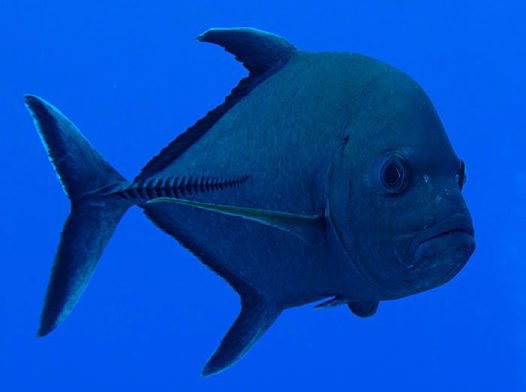
Black Trevally, Caranx lugubris (Poey, 1860)
Scientific name: Caranx lugubris
 Click to enlarge image
A Black Trevally, Caranx lugubris, at a depth of 5m, Marotiri Rocks, Austral Islands, southern French Polynesia.
Image: Ian Skipworth
© Ian Skipworth
© Ian Skipworth
Fast Facts
-
Classification
- Genus
- Caranx
- Species
- lugubris
- Family
- Carangidae
- Class
- Actinopterygii
- Subphylum
- Vertebrata
- Phylum
- Chordata
- Kingdom
- Animalia
-
- Size Range
- The species grows to 80 cm in length.
Introduction
The Black Trevally is generally a solitary fish and can be found on outer reef slopes and deep drop-offs.
Identification
The Black Trevally is a compressed fish with a steep forehead, long curved pectoral fins and a forked tail. It is brownish or grey to black, with a black spot on the upper margin of the operculum. There are black scutes on the rear of the body.

A Black Trevally at a depth of 12 m, Bougainville Reef, Coral Sea, December 2000.
Image: Schlögl, Erik
© Schlögl, Erik
© Schlögl, Erik
Habitat
The Black Trevally is a pelagic species.
Distribution
It occurs in tropical marine waters worldwide.
In Australia it is known from north-western Western Australia and from the Great Barrier Reef, Queensland.
The map below shows the Australian distribution of the species based on public sightings and specimens in Australian Museums. Source: Atlas of Living Australia.
This map shows species occurrence observations from data recorded in the Atlas of Living Australia.
References
- Allen, G.R. 1997. Marine Fishes of Tropical Australia and South-east Asia. Western Australian Museum. Pp. 292.
- Randall, J.E., Allen, G.R. & R.C. Steene. 1997. Fishes of the Great Barrier Reef and Coral Sea. Crawford House Press. Pp. 557.
- Kuiter, R.H. 1996. Guide to Sea Fishes of Australia. New Holland. Pp. 433.