
The 2026 Australian Museum Eureka Prize winners announced
More than 500 guests attend the glittering ceremony at Sydney Town Hall to celebrate 19 winners of the 2026 Australian Museum Eureka Prizes
Sydney, 3 September 2026: A marine heatwave forecasting system, a solar panel recycling solution, research helping remove the stigma from a common women’s health condition and a melanoma breakthrough were among the outstanding winners announced at the 2026 Australian Museum Eureka Prizes tonight.
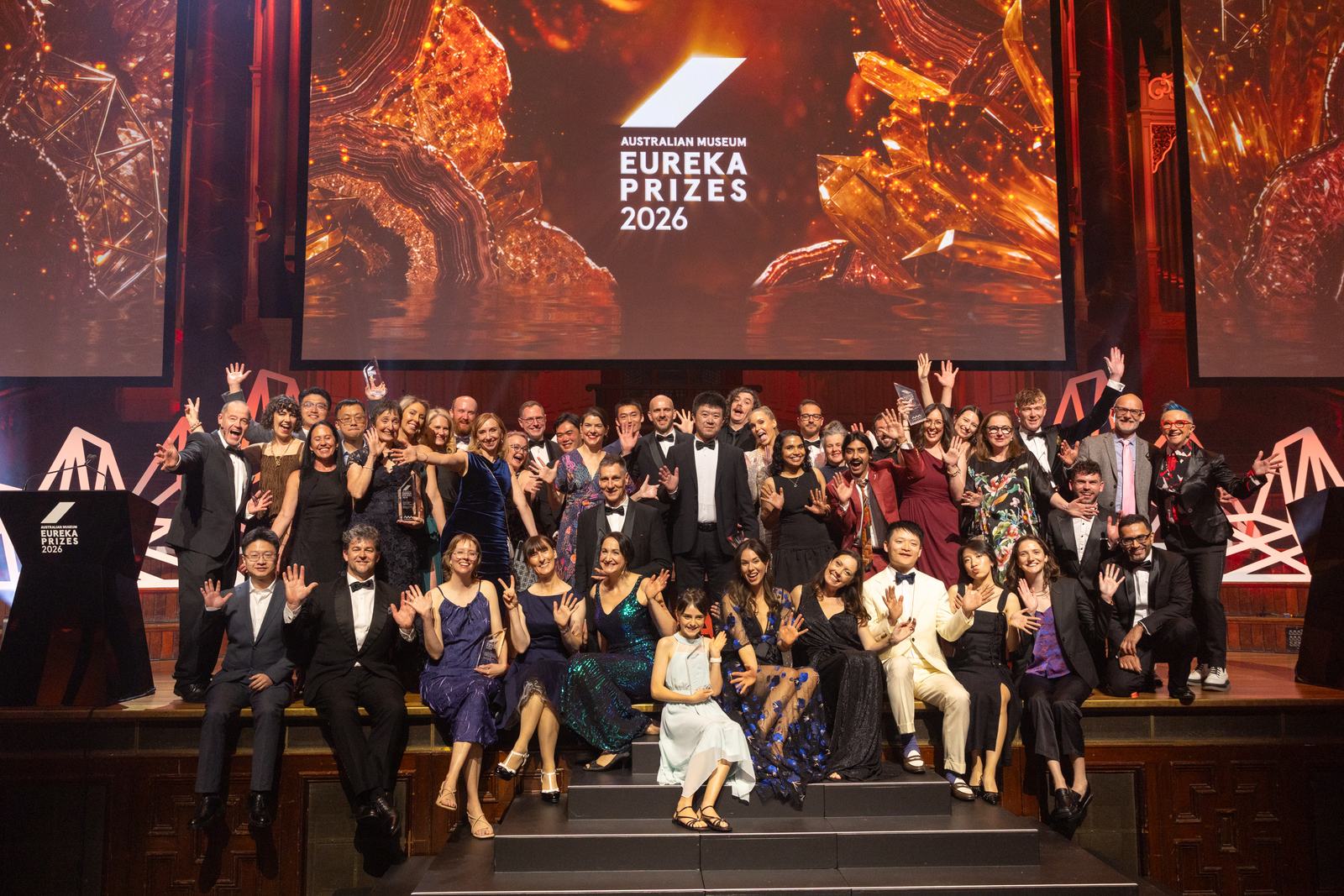
2026 Eureka Prizes Award Ceremony
Image: Tim Levy© Australian Museum
Presented at Sydney Town Hall, the annual awards, now in their 36th year, recognised outstanding achievement across scientific research, innovation, leadership, science engagement and school science.
Winners include:
- Professor Georgina Long AO, The University of Sydney and Melanoma Institute Australia, for pioneering melanoma research that has transformed treatment and survival outcomes.
- Dr Jane Tiller, Monash University, for research and advocacy helping end genetic discrimination in life insurance.
- Associate Professor Helen Paterson, The University of Sydney, for advancing how courts and police understand victim-survivor testimony in domestic and family violence cases.
- Liam Mannix and William Davis for investigative articles revealing major scientific misconduct at leading research institutions.
Australian Museum Director and CEO Kim McKay AO said the 2026 AM Eureka Prize winners showed how scientific excellence can turn bold ideas into practical benefits for all Australians.
“Outstanding science begins with curiosity, but its greatest impact is realised when investment in discovery improves lives. This year’s winners are tackling some of our greatest challenges: protecting our environment, advancing healthcare, informing public policy and inspiring the next generation of scientists,” Ms McKay said.
“World-changing discoveries do not happen overnight. They are built on years of dedication, collaboration and sustained investment. As we celebrate these remarkable Australians, we must also continue supporting the scientific capability that drives our prosperity, wellbeing and resilience as a nation.”
This year’s awards also highlighted the extraordinary contribution of women in Australian science, with 11 Eureka Prizes awarded to individual women or teams made up entirely or predominantly of women. The result recognises leadership and discoveries improving health, equity and scientific understanding, and underscores the importance of continuing to encourage women in STEM.
Distinguished Professor Maree Teesson AC was recognised twice, receiving both the University of Sydney Eureka Prize for Leadership in Science and the UNSW Eureka Prize for Societal Impact in Science as part of the OurFutures Vaping Program team.
Professor Georgina Long AO was awarded the Eureka Prize for Scientific Research, for her work in pioneering neoadjuvant immunotherapy and transforming melanoma care. She was awarded Australian of the Year in 2024, alongside Professor Richard Scolyer AO, making her the fifth Australian of the Year to have received a Eureka Prize, including Professor Tim Flannery AO, Professor Ian Frazer AC, Professor Alan Mackay-Sim AM and Professor Michelle Simmons.
Australian Museum researcher Dr Frank Köhler received the 2026 Australian Museum Research Institute Medal for his internationally significant work documenting Australia’s mollusc diversity.
“Dr Frank Köhler’s remarkable work revealing Australia’s mollusc diversity exemplifies the world-class research taking place at the Australian Museum. He has described more than 100 new species of land snail, expanding scientific understanding of Australia’s biodiversity and is a Principal Research Scientist at AMRI,” McKay said.
Now in its 36th year, the Australian Museum Eureka Prizes continue to recognise Australia’s most outstanding scientific achievements. Since it began, the Australian Museum has awarded more than $5 million in prize money while celebrating hundreds of the nation’s leading scientists, researchers, communicators and innovators, many of whom have achieved international success.
The 2026 AM Eureka Prize winners
Research & Innovation
NSW Department of Climate Change, Energy, the Environment and Water Eureka Prize for Environmental Research
Marine Heatwave Forecasts, CSIRO and Bureau of Meteorology (TAS)
Marine Heatwave Forecasts delivered Australia’s first operational long-range forecasts for unusually warm ocean temperatures. Developed by the Bureau of Meteorology and CSIRO from 2020 to 2025, the service gives marine industries, conservation managers and coastal communities weeks to months of warning, helping them to prepare early and protect vulnerable ecosystems.
Australian Research Data Commons Eureka Prize for Excellence in Data Platforms
EcoCommons Australia, QCIF Digital Research (QLD)
EcoCommons Australia integrates thousands of environmental datasets from different institutions into an easy-to-use, cloud-based platform to help tackle climate change, species loss and ecosystem management. Finding hidden populations of endangered species and helping more than 2,000 researchers and government agencies make faster decisions about conservation priorities are two key benefits.
University of Technology Sydney and Australian Federal Police Eureka Prize for Excellence in Forensic Science
Associate Professor Helen Paterson, The University of Sydney (NSW)
Associate Professor Helen Paterson is advancing how police and courts understand victim-survivor testimony in domestic and family violence cases. Her research shows how repeated abuse and coercive control affect memory, informing improved interviewing practices, credibility assessment and legal interpretation to support more accurate investigations and fairer justice outcomes.
Eureka Prize for Excellence in Interdisciplinary Scientific Research
Professor Ivan Kassal and Associate Professor Ting Rei Tan, The University of Sydney (NSW)
Achieving a step change in the way quantum computers can simulate complex molecular function, Professor Ivan Kassal and Associate Professor Ting Rei Tan improved quantum resource efficiency by more than a million-fold, leading to advances in materials, energy and drug discovery. They use one of Australia’s most powerful quantum devices.
Australian Infectious Diseases Research Centre Eureka Prize for Infectious Diseases Research
Women’s Microbiome Innovation Group, Melbourne Sexual Health Centre; Monash University; and Alfred Health (VIC)
Women’s Microbiome Innovation Group challenged the prevailing dogma that bacterial vaginosis is a bacterial imbalance and proved it is sexually transmitted. The StepUp trial showed treating male partners improves bacterial vaginosis cure and is cost-effective. Partner treatment is transforming global clinical practice for an infection affecting one in four women.
Eureka Prize for Innovative Use of Technology
C2X, RMIT University (VIC)
C2X integrates CO₂ capture and conversion into a single process, reducing the cost, energy loss and engineering complexity of traditional systems. This practical and novel pathway to lower-emission fuels and value-added chemicals has been demonstrated with Victorian industry partners, including major industrial emitters and biogas manufacturers.
Macquarie University Eureka Prize for Outstanding Early Career Researcher
Dr Aidan Cashin, UNSW and Neuroscience Research Australia (NSW)
Dr Aidan Cashin is changing chronic pain care by determining which treatments help, why they work and how to deliver them widely. His research clarified whether back pain medicines help or harm, developed a non-drug program that improves recovery and is now shaping clinical training, digital care and international trials.
Department of Defence Eureka Prize for Outstanding Science in Safeguarding Australia
Professor Vincent Gramoli, The University of Sydney and Redbelly Network (NSW)
Professor Vincent Gramoli researched and designed the Redbelly Blockchain, commercialising it with Redbelly Network. The cybersecurity software innovation enables users to exchange assets more securely, safeguarding Australia’s financial resilience. It is one of the fastest blockchains in production and was selected by the Reserve Bank of Australia to participate in the Project Acacia research initiative.
UNSW Eureka Prize for Scientific Research
Professor Georgina Long AO, The University of Sydney and Melanoma Institute Australia (NSW)
Professor Georgina Long transformed melanoma care by pioneering neoadjuvant immunotherapy, given before surgery, and leading international drug development. Her research reduced recurrence or death risk by 68%, lifted survival 10-fold in stage IV disease and 24-fold in brain metastases, and created tools to identify patients needing new approaches.
Eureka Prize for Sustainability Research
Professor Yansong Shen, UNSW (NSW)
Professor Yansong Shen has developed a low-cost, scalable, portable process to recover valuable metals and silicon from used solar panels. With an estimated 60–78 million tonnes of panels requiring recycling by 2050, this end-to-end technology could recover valuable metals, including silver, and support more sustainable solar waste management.
Leadership
University of Sydney Eureka Prize for Emerging Leader in Science, Technology and Engineering
Dr Jane Tiller, Monash University (VIC)
Dr Jane Tiller led a research-driven campaign that in 2026 helped ban Australian life insurers from using genetic test results to discriminate in underwriting. By uniting researchers, clinicians, patient groups and policymakers, she removed a major barrier to potentially life-saving genomic testing, expanding opportunities for equitable access to preventive medicine.
University of Sydney Eureka Prize for Leadership in Science
Distinguished Professor Maree Teesson, The University of Sydney (NSW)
Distinguished Professor Maree Teesson is an international leader in mental health and substance use research, especially the overlap between these disorders. As Director of the Matilda Centre, the largest research centre of its kind, she has advanced prevention and treatment, including school-based programs reaching 300,000 students in Australia and overseas.
University of Technology Sydney Eureka Prize for Outstanding Mentor of Researchers
Associate Professor Karen Lamb, The University of Melbourne (VIC)
Associate Professor Karen Lamb has ensured Australian statisticians’ careers are enriched by mentorship. She created the Statistical Society of Australia’s national mentoring program, supporting more than 200 statisticians, and assisted mentoring program development in the UK, New Zealand and Canada. Her inclusive approach builds confidence, leadership and belonging in STEM.
Science Engagement
Department of Industry, Science and Resources Eureka Prize for Innovation in Citizen Science
Miyawaki Forest Program, Murdoch University (WA)
Since 2021, the Miyawaki Forest Program has brought more than 5,200 participants together to plant 22 fast-growing forests in schools and communities. Through planting, nurturing, observation and experiments, participants have greened local landscapes and reconnected with nature, while the forests have increased biodiversity and reduced local temperatures.
Celestino Eureka Prize for Promoting Understanding of Science
Dr Lila Landowski, University of Tasmania and Science and Technology Australia (TAS)
Dr Lila Landowski makes neuroscience accessible through her TEDx talk, viral videos and media appearances. She has appeared in hundreds of stories, reaching more than 46 million people in the past year, translating brain science, combating misinformation as a World Health Organization Fides ambassador and inspiring diverse audiences into STEM.
Australian Museum Eureka Prize for Science Journalism
Follow the Mice, Liam Mannix, The Age and William Davis, Brisbane Times (VIC, QLD)
After four years of research, Liam Mannix and William Davis published their investigative articles revealing major scientific misconduct at leading research institutions, including the fabrication of animal experiments for drugs in development. Read by more than 130,000 people, the articles revealed science’s dark underbelly and led to calls for reform.
Published in The Age on Saturday 26 July 2025 and Sunday 27 July 2025.
UNSW Eureka Prize for Societal Impact in Science
OurFutures Vaping Program, The Matilda Centre for Research in Mental Health and Substance Use, University of Sydney; University of Queensland; Curtin University; Monash University; UNSW; and the University of Newcastle (NSW, VIC, WA, QLD)
OurFutures Vaping Program empowers adolescents to avoid vaping through evidence-based digital lessons co-designed with students and teachers. Trialled in 40 schools, it reduced the odds of vaping by 65% after one year. It has now reached more than 300,000 students, providing practical health and wellbeing education nationwide.
Department of Industry, Science and Resources Eureka Prize for STEM Inclusion
Science Gallery Melbourne (VIC)
Through co-design, free access and inclusive practices, the University of Melbourne’s Science Gallery empowers underrepresented communities in STEM. Blending science, creativity and culture, its exhibitions and programs have attracted 350,000 people since 2021 and achieved inspiring levels of engagement with young women, diverse and disadvantaged audiences.
Australian Museum School Science Eureka Prize — Primary and Secondary
How the Brain Processes Patterns, Poppy H., Homeschool Perth, WA
Poppy’s delightful, humorous film How the Brain Processes Patterns focuses on her love of optical illusions, including one on a wall near her dance studio, and the neuroscience behind them. She conducted a study to see whether adults or children are more likely to be deceived by these illusions.
Freshwater Turtle Nesting: From Patterns to Protection, Millie B., Homeschool Karrinyup, WA
In Freshwater Turtle Nesting: From Patterns to Protection, 13-year-old Millie explains that freshwater turtles follow predictable patterns when choosing nest sites. As an official Turtle Tracker volunteer in Perth, she reveals how these patterns can predict nesting hotspots with 90% accuracy and guide local protection measures, such as turtle-safe roads.
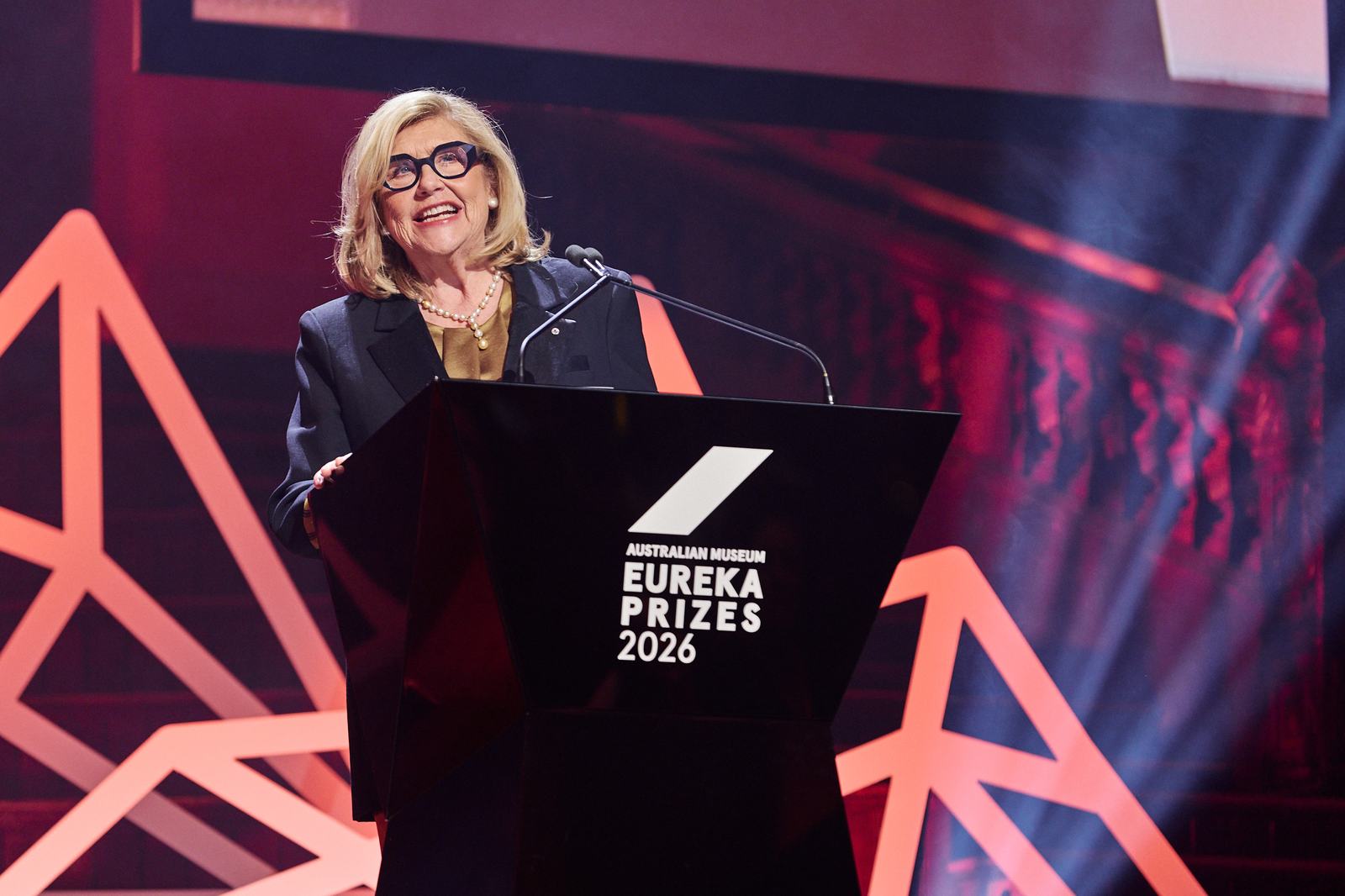
Kim McKay AO, Director and CEO of the Australian Museum welcomes guests to the 2026 Eureka Prizes Awards Ceremony
Image: Rocket Weijers© Australian Museum
Download the media release
Interviews available with winners
Images from the awards ceremony available HERE from 4 September
#EurekaPrizes Bluesky: @eurekaprizes.bsky.social X: @eurekaprizes LinkedIn: @eureka-prizes Facebook: @eurekaprizes
MEDIA ENQUIRIES
Matt Fraser E: matt@moxee.au M: 0401 326 007
Vyvy Yong E: vyvy@moxee.au M: 0412 090 372
About the Australian Museum
The Australian Museum (AM) was founded in 1827 and is the nation’s first museum. In 2027 it will mark its 200th anniversary. It is internationally recognised as a natural science and culture institution focused on Australia and the Pacific. The AM’s mission is to ignite wonder, inspire debate and drive change. The AM’s vision is to be a leading voice for the richness of life, the Earth and culture in Australia and the Pacific. The AM commits to transforming the conversation around climate change, the environment and wildlife conservation; to being a strong advocate for First Nations cultures; and to continuing to develop world-leading science, collections, exhibitions and education. With 22 million objects and specimens and the Australian Museum Research Institute (AMRI), the AM is not only a dynamic source of reliable scientific information on some of the most pressing environmental and social challenges facing our region, but also an important site of cultural exchange and learning. Visit www.australian.museum
