
Drop Bear
 Click to enlarge image
© Australian Museum
Fast Facts
-
Classification
- Genus
- Thylarctos
- Species
- plummetus
-
- Size Range
- 120kg, 130cm long, 90 cm at the shoulder.
-
- Habitats
- closed forest, tall closed forest, tall open forest, tall open shrubland
-
- Feeding Habits
- carnivorous
-
View Fossil Record
- Fossil Record
- Quaternary Period
(1.8 million years ago - present)
The Drop Bear legend tells of a large, arboreal, predatory marsupial related to the Koala that 'drops' on its prey.
What do Drop Bears look like?
Identification
Around the size of a leopard or very large dog with coarse orange fur with some darker mottled patterning (as seen in most Koalas). The creature is told as a heavily built animal with powerful forearms for climbing and holding on to prey. It lacks canines, using broad powerful premolars as biting tools instead.
Where do Drop Bears live?
Habitat
Closed canopy forest as well as open woodland on the margins of dense forest. Never encountered near roads or human habitation.
Distribution
Drop Bears can be found in the densely forested regions of the Great Dividing Range in South-eastern Australia. However there are also some reports of them from South-east South Australia, Mount Lofty Ranges and Kangaroo Island.
What do Drop Bears eat?
Feeding and diet
Stories of kill sites and examination of scats suggest mainly medium to large species of mammal make a substantial proportion of the animal's diet. Often, prey such as macropods are larger than the Drop Bear itself.
Drop Bears supposedly hunt by ambushing ground dwelling animals from above, waiting up to as much as four hours to make a surprise kill. Once prey is within view, the Drop Bear will drop as much as eight metres to pounce on top of the unsuspecting victim. The initial impact often stuns the prey, allowing it to be bitten on the neck and quickly subdued.
If the prey is small enough Drop Bears will haul it back up the tree to feed without harassment from other predators.
Are Drop Bears dangerous to humans?
Danger to humans
The urban legend focuses on bush walkers being 'dropped on' by Drop Bears, resulting in injury including mainly lacerations and occasionally bites. Most attacks are considered accidental and there are no stories of incidents being fatal.
There are some suggested folk remedies that are said to act as a repellent to Drop Bears, these include having forks in the hair or Vegemite or toothpaste spread behind the ears. There is no evidence to suggest that any such repellents work.
A real life Drop Bear in the Australian Museum collections?
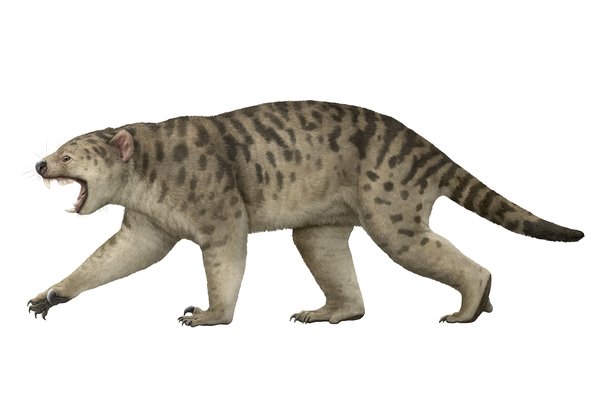
The Drop Bear may be a myth, but the Australian Museum holds the remains of an eerily similar creature. Thylacoleo carnifex, the largest carnivorous marsupial on record, was twice the weight of an average human and built for power and surprise. Though mostly ground‑dwelling, evidence shows it could climb, potentially using the tree canopy to launch ambushes from above. With long forearms, retractable thumb claws, and a bite built for crushing, it would have rivalled today’s top ambush predators. And despite being related to gentle wombats and koalas, its ancestrally‑herbivorous teeth had evolved into fearsome tools for stabbing and slicing.
Specimen in our collection
Structured light scans, seen below as a 3D model, pair a partial cranium (AM F.4661) with partial mandibles (AM F.109727) from different individuals in our Palaeontology Collection to demonstrate the overall form of a complete Thylacoleo carnifex skull. Missing elements from each fossil specimen have been digitally estimated and are shown in red.
Support the Australian Museum
Your donation supports the exceptional work of our inspiring scientists, explorers and educators as they help to protect Australia’s vital natural and cultural heritage for generations to come.
Donate now
