
The Ragan History of Science Collection
From 16th‑century zoology to modern evolutionary biology, this remarkable donation of rare books reveals how scientists have sought to understand the natural world for over 500 years.
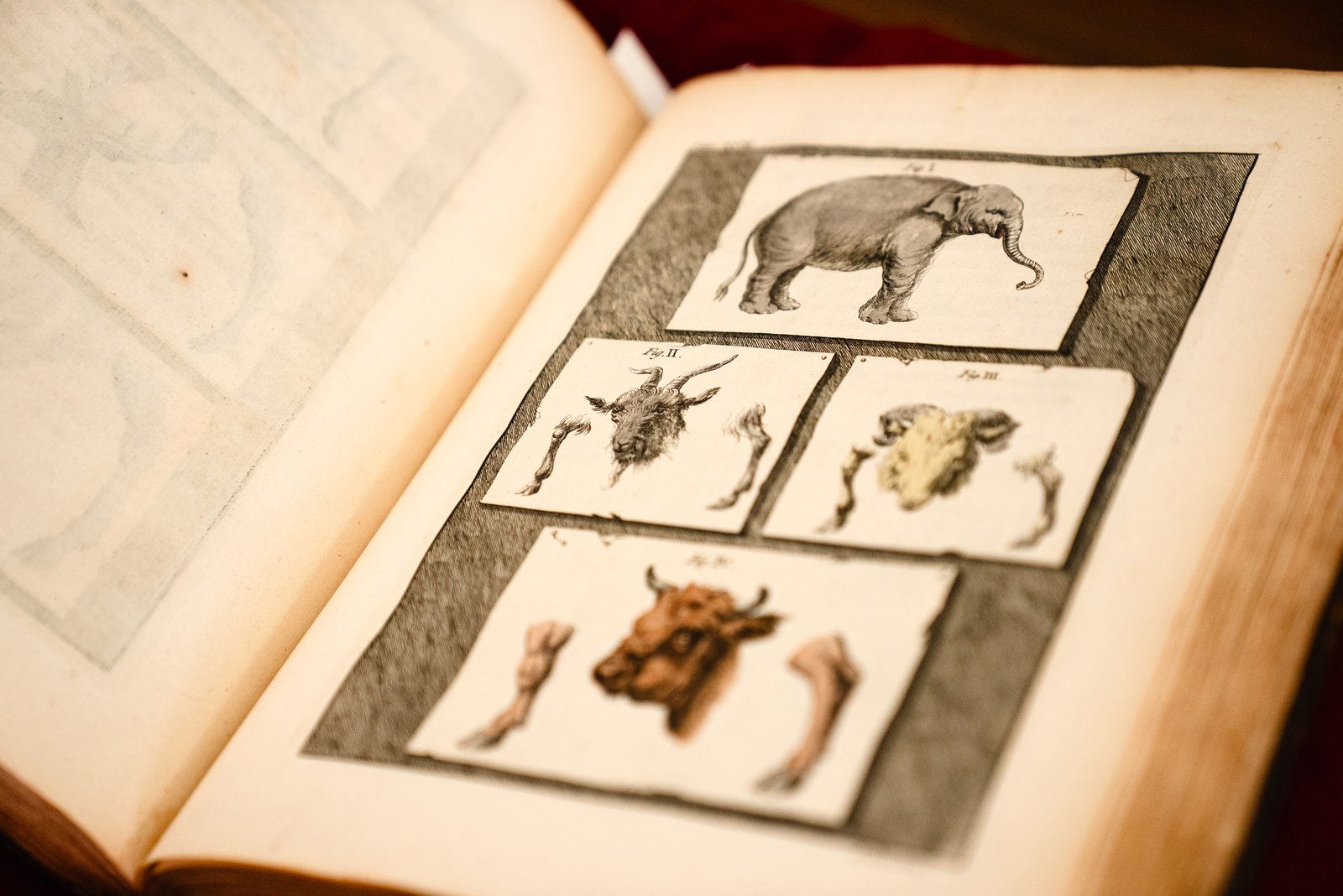
In 2025, the Australian Museum Research Library received a remarkable donation of over 600 rare and significant history of science books from Mark Ragan, Emeritus Professor at the University of Queensland.
The donation adds 180 rare books from the 16th to the 20th century to the Research Library, as well as hundreds of important modern scientific titles. Together, these works expand the coverage of the Research Library's collection across time and space for the benefit of both museum researchers and the wider public.
Inside the donation
Explore the incredible donation through the eyes of Mark Ragan (Emeritus Professor at the University of Queensland) and Anina Hainsworth (Library Technician at the Australian Museum).
I think physical books are important in different ways, in different ways to different people. Some people, such as my father, just enjoyed the feel and the smell. With others, it's a link into the provenance. Is there a previous owner's signature in the front? Where exactly did I buy it? What are the stamps? Who has made marginal annotations? Was this the version that has the extra three pages at the back?
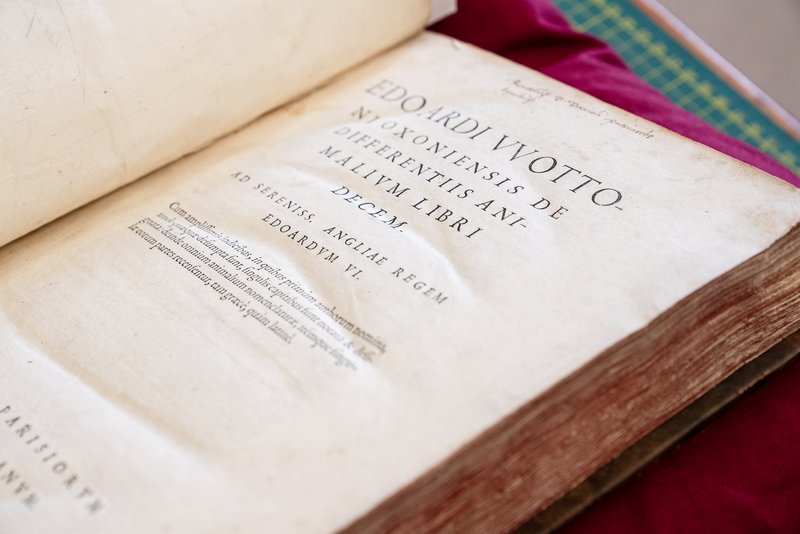
So the oldest book in the collection is Edward Wotton's book on the differences among animals. It's in Latin. De Differentiis Animalium. Published in Paris in the year 1552, which makes it, what, 470 something years old?
Twilight of Evolution is probably the most influential work making the case that creationism - the idea that organisms were created - is not simply a throwback or a literal reading of the Bible, but has science behind it. And it's all utterly mad stuff. But they did, and they are still attempting to make this case.
I was quite drawn to this book simply by the wonderful embossed dinosaurs on the cover, and they are quite spectacular. This is actually a popular book on - I think it's called The Marvels of Geology or something like that. Grew himself, like many of us, cared deeply about, like the museum itself in fact, having a mission to explain and help interpret nature for the public.
Probably the favourite part of my role is to care for the rare books and introduce library visitors to them when we do tours.
This one appealed to me because it's got some really early colour wash in the plates, which is quite unusual. One of the things I love about it is it is completely original in its binding - we call this a contemporary binding. Books that were published at the time were issued without a board cover. It would just be the text-block that you would purchase, and then you would take your book to your local binder, and you would then be able to specify exactly how you wanted it to look. Whether it was a full leather binding, what sort of tooling - we've got some gold tooling around the edges here. And what was quite popular at the time, it has what we call a speckled edge.
Producing a book was quite an expensive and time-consuming task, so often an author would offer the book as a subscription, and people would sign up and commit to purchasing the book when it was published. Often the names of the subscribers would be recorded in the book, and I was just paging through and I noticed that Sir Isaac Newton is actually recorded as a subscriber.
This is a block-printed paper cover. It's quite unusual - we don't have any other examples in our collection. This would have been a less expensive alternative. And so you've got the quarter leather binding, and then this decorative paper. They had blocks of either metal or wood that had this design on it. But they are all different, and you would think if it was a wooden block you would have more uniformity. So yeah, this is a bit of a mystery at this stage. And I guess that's what these bindings do - they make the item unique.
Our role is to preserve scientific material. It does get used by our scientists even nowadays, and it provides a record of scientific thought over the years, and it is still used in contemporary study.
Rare Book highlights
The oldest book in the Research Library
At the heart of Ragan's donation is Edward Wotton’s De differentiis animalivm (1552), now the oldest book held by the Australian Museum. Before the donation, the Museum’s oldest book dated to 1553, making Wotton’s 1552 volume a new chronological cornerstone for the collection.
Published in the mid‑16th century, De differentiis animalivm was a landmark work in early zoology. It was one of the first European books that sought to understand and classify the differences between animal species, making it an early precursor to modern evolutionary science. It was also the first known printed work of natural history written by an Englishman.
An early title on natural history beyond Europe
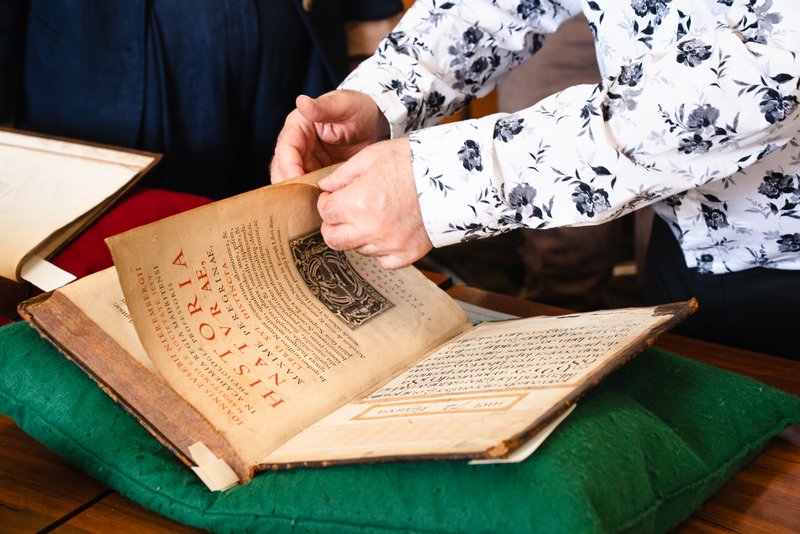
Juan Eusebio Nieremberg’s Historia naturae, maxime peregrinae (1635) was one of the most important early attempts to systematically describe the natural world beyond Europe. Written by a Spanish Jesuit scholar, the work brings together accounts of animals, plants, minerals and natural phenomena from the Americas and other regions visited by missionaries.
The presence of this work in the Research Library extends the geographic coverage of its Rare Books Collection. It also illustrates how early scientific knowledge was shaped by colonial encounters and the exchange of information across continents: themes that continue to inform research at the museum today.
- Grew N, The anatomy of plants. With an idea of a philosophical history of plants... (1682)
- Lucretius Carus T, De rerum natura libri sex (1712)
- Bradley R, A philosophical account of the works of nature… (1721)
- Bacon F, Opera omnia, quatuor voluminibus comprehensa… (1730)
- Donati V, Della storia naturale marina dell’Adriatico (1750)
- Ellis J, An essay towards a natural history of the Corallines… (1755)
- Pallas PS, Charakteristik der Thierpflanzen, worin von den Gattungen derselben allgemeine Entwürse… (1787)
- Anonymous, A new system of the natural history of quadrupeds, birds, fishes, -- and insects (1791-1792)
- Treviranus GR, Biologie, oder Philosophie der lebenden Natur … (1802-1822)
- Turner D, Fuci sive plantarum fucorum generi a botanicis ascriptarum icones descriptiones et historia (1808-1819)
- Anonymous. Botanical sketches of the twenty-four classes in the Linnean system, with fifty specimens of English plants, taken from nature (1824)
- Ehrenberg CG, Die Infusionsthierchen als vollkommene Organismen… (1838)
- Oken L, Elements of physiophilosophy. From the German by A. Tulk (1847): with two different bookplates of Sir Thomas Brisbane
- Chatton E, Titres et travaux scientifiques 1906-1937 (1938)
Significance of the donation
The Ragan History of Science Collection was assembled over more than fifty years, shaped by a lifetime of scientific research and curiosity. From the outset, Ragan wanted to build a working research collection, focused on ideas, evidence and the development of scientific thought rather than decorative display.
As such, the collection has an outstanding intellectual coherence. Early modern works on animals, plants and microscopic life sit alongside foundational 19th‑ and 20th‑century texts, allowing readers to trace how scientific ideas and methods have evolved over time. Ultimately, this long‑term, purposeful approach has resulted in a collection of rare books that is particularly well-suited to the Research Library and its ongoing commitment to support the scientific and educational activities of the Australian Museum and the wider public.
My family and I hope that our donation will help enrich scholarship, support advocacy of natural history and public institutions, foster understanding and stewardship of the natural world, and provide inspiration and pleasure to everyone who engages with these books. Mark Ragan, Emeritus Professor at The University of Queensland.
