
Working at the interface of discovery: A Q&A with Professor Salah Sukkarieh
In sponsoring the new Eureka Prize category of Emerging Leader in Science, Technology and Engineering, the University of Sydney is helping the Eureka Prizes open to an even more diverse and cross disciplinary pool of talented researchers.
We spoke to Professor Salah Sukkarieh from the University of Sydney to explore why recognising leadership across disciplines is essential for turning research into scalable, practical impact. Drawing on his experience working at the interface of discovery and deployment, he reflects on what types of projects deserve greater visibility and how strong leadership can shape Australia’s ability to innovate on the global stage.
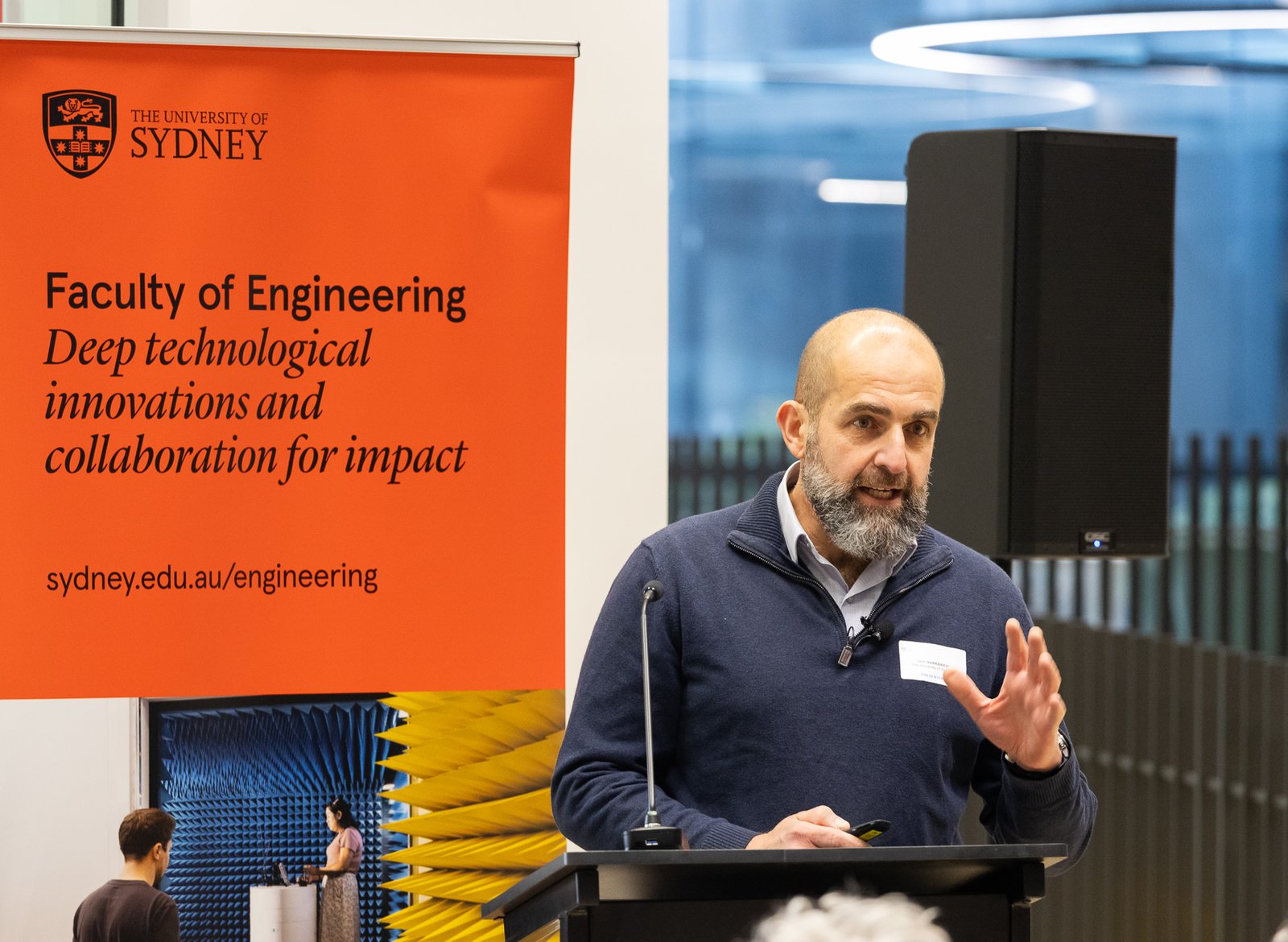
Professor Salah Sukkarieh
Image: University of Sydney© University of Sydney
The Eureka Prize for Emerging Leader in Science has been awarded since 2011. This year, the prize is being renamed to the Eureka Prize for Emerging Leader in Science, Technology and Engineering. The boundaries between science, technology and engineering are increasingly blurred. In your own work, how have these disciplines intersected – and why do you think it’s important to recognise leadership across all three?
In my work, the boundaries between science, technology and engineering tend to disappear as soon as you move into real world deployment. In controlled settings, you can separate theory, algorithms and systems. In the field, particularly where autonomous systems need to operate in areas such as agriculture, mining, first response and the environment, those elements have to operate together under uncertainty, scale and constraint.
Working closely with industry reinforces this. The question is not whether a piece of research or technology innovation works in principle, but whether it works to the needs of the end user and does reliably, safely and continuously in an operational context. That requires scientific insight, strong engineering, and the ability to integrate technology into existing systems.
Recognising leadership across all three is important because impact sits at that intersection. Many of the most important challenges now are not about discovery alone, but about translating capability into systems that are usable, scalable and trusted in practice.
The boundaries between science, technology and engineering tend to disappear as soon as you move into real world deployment.
The Eureka Prize for Emerging Leader in Science, Technology and Engineering is one of the most varied prizes in the award program, and previous winners have worked on projects ranging from kelp forest restoration and artificial vision technologies to infectious diseases research and the discovery of new physics phenomena. What are the kinds of projects – or approaches – that you feel deserve greater visibility in the years ahead?
I would like to see more visibility given to work that operates under real world conditions and delivers sustained impact. This includes research and projects that move beyond proof of concept and are deployed over time, across varying environments, and at scale.
In many cases, the challenge is not demonstrating a single breakthrough but integrating multiple research elements and technical components into a system that is reliable and usable - or at least repeatable to demonstrate its capability under different conditions. This often involves close collaboration with the end user (industry, operators, government etc), where constraints around operational effectiveness, safety, cost and performance shape the innovation.
This type of work can be less visible because it is harder to present as a single result. However, it is where much of the real impact lies. Highlighting these efforts would also encourage more engineering researchers and technologists to engage, particularly those working at the interface between research and application.
I would like to see more visibility given to work that operates under real world conditions and delivers sustained impact.
Good leadership is crucial to putting Australia on the world stage across the science, technology and engineering sectors. Why do you think recognising leadership in science, technology and engineering matter so much – not just for individual researchers, but for Australia’s ability to lead, collaborate and innovate on the global stage?
Recognising leadership in science, technology and engineering matters because it signals what is valued and shapes behaviour across the system. It highlights not only technical excellence, but also the ability to bring people together, work across disciplines and deliver outcomes that persist beyond individual projects.
For Australia, this is particularly important. We have strong research capability, and our impact depends on how effectively we connect that capability with industry and real-world application. Leadership at this interface is critical to turning knowledge into outcomes that create economic, environmental and societal value.
Awards such as this help make that leadership visible. They encourage participation, strengthen collaboration and reinforce the importance of work that moves from discovery through to deployment. This is central to Australia’s ability to lead and innovate at a global level.
The Australian Museum Eureka Prizes are the country’s most comprehensive national science awards, honouring excellence across the areas of research & innovation, leadership, science engagement, and school science.
