
Sophie M: how pendulums protect skyscrapers during seismic events
Who Sophie M.
What In Swing Smart to Stand Tall, 15-year-old Sophie explains how a giant pendulum helps stabilise a skyscraper during earthquakes and typhoons. Through clear narration and straightforward diagrams, she explores how engineering can protect lives above ground from seismic forces that originate below – bridging physics, design and the mechanics behind towering structures.
Winner of the 2025 University of Sydney Sleek Geeks Science Eureka Prize – Secondary.
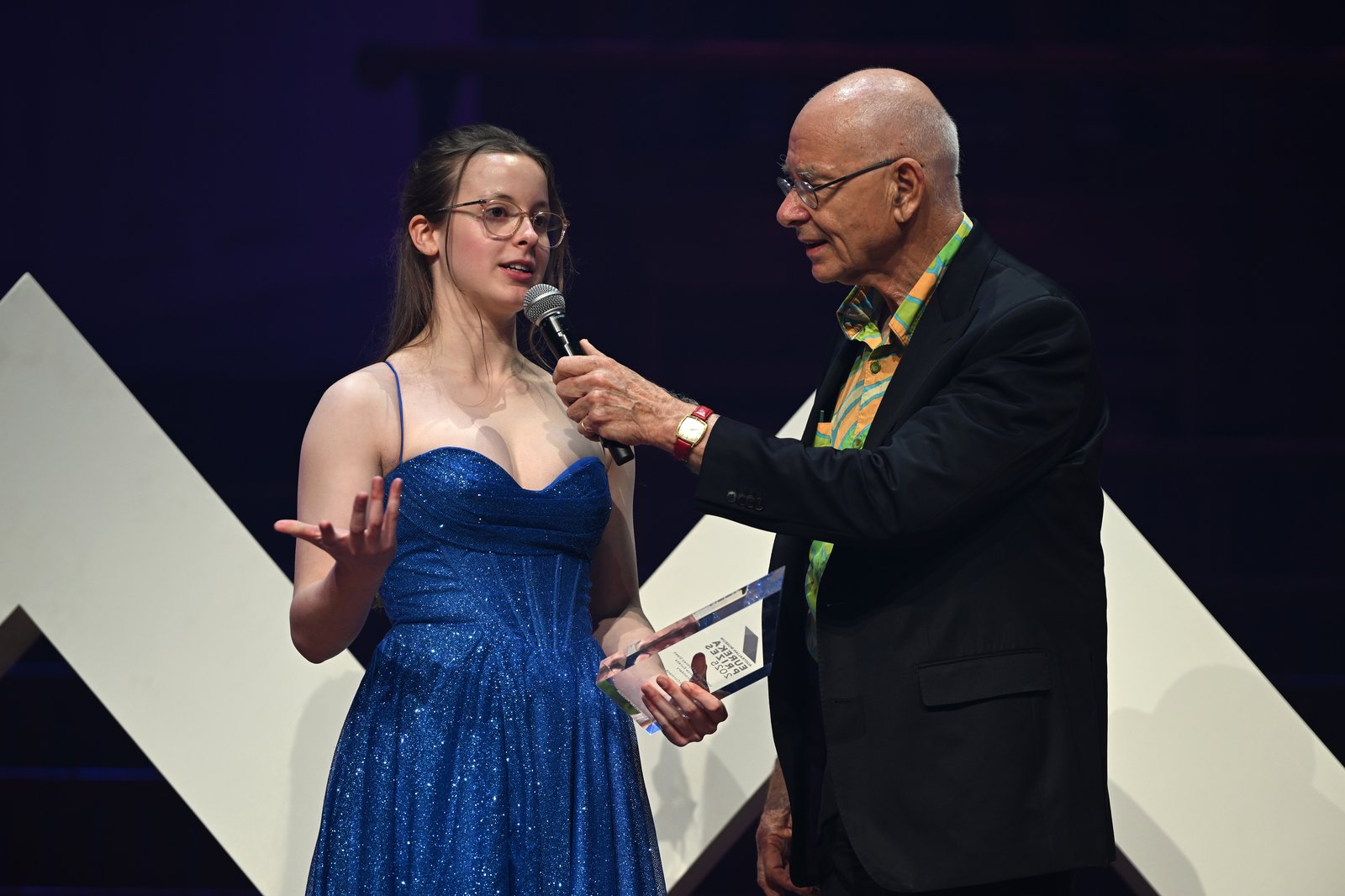
Sophie M accepting the 2025 University of Sydney Sleek Geeks Science Eureka Prize – Secondary with Dr Karl Kruszelnicki. Photo by Getty
Image: Wendell Teodoro/Getty Images for Australian Museum© 2025 Getty Images
Congratulations on being awarded a Eureka Prize! What were you thinking as you made your way to the stage?
Honestly, I was in shock! I did not expect it at all. It felt surreal – and a little bit intimidating – walking up those stairs and onto the stage. I was comforted seeing Dr Karl and Professor Dinger were up there too; it made the moment feel more exciting than scary.
Your short film explains how a giant pendulum helps stabilise a skyscraper during earthquakes and typhoons. What was the most interesting thing you learned throughout this process?
Did you know that Taipei 101 was designed to withstand winds up to 216 km/h and earthquakes up to magnitude 9? It can reduce approximately 40% of the tower’s movement! The actual limit of the skyscraper is unknown, but it has already withstood a 7.4 magnitude earthquake and winds from Typhoon Soudelor. Not only does the tuned mass damper stabilise the building, but it’s also visible to the public as a tourist attraction – complete with its own mascot, the “Damper Baby”.
Overall, the most interesting thing that I learned is that the damper has only ever moved 1 metre (during Typhoon Soudelor). It’s crazy how this mechanism can move so little yet counteract the motion of an entire skyscraper!
From watching your film, it seemed like you enjoyed researching this topic and going down a rabbit hole to learn as much as you could. Is this a regular occurrence for you? If so, what topics are you interested in exploring next?
Oh, absolutely! I love going down research rabbit holes. I’ll start looking doing classwork and somehow end up three hours later watching documentaries about neutron stars or exploring completely unrelated science topics. The concepts that just one teaspoon of neutron star matter would weigh as much as Mount Everest, or that strange matter might exist inside the core, is mind blowing.
I love how the internet lets you explore anywhere your curiosity takes you. My next project for elective science looks at how scientists use teeth and bones to infer the climate and environment of early humans – and I’m very excited for it!
“It taught me that explaining science can be just as creative as technical.”
What did you enjoy most about making your film?
Creating the animation and the diagrams! I’m quite an arty person, so choosing colours and designing the visuals that helped to simplify the concept was really fun (and surprisingly relaxing). It taught me that explaining science can be just as creative as technical.
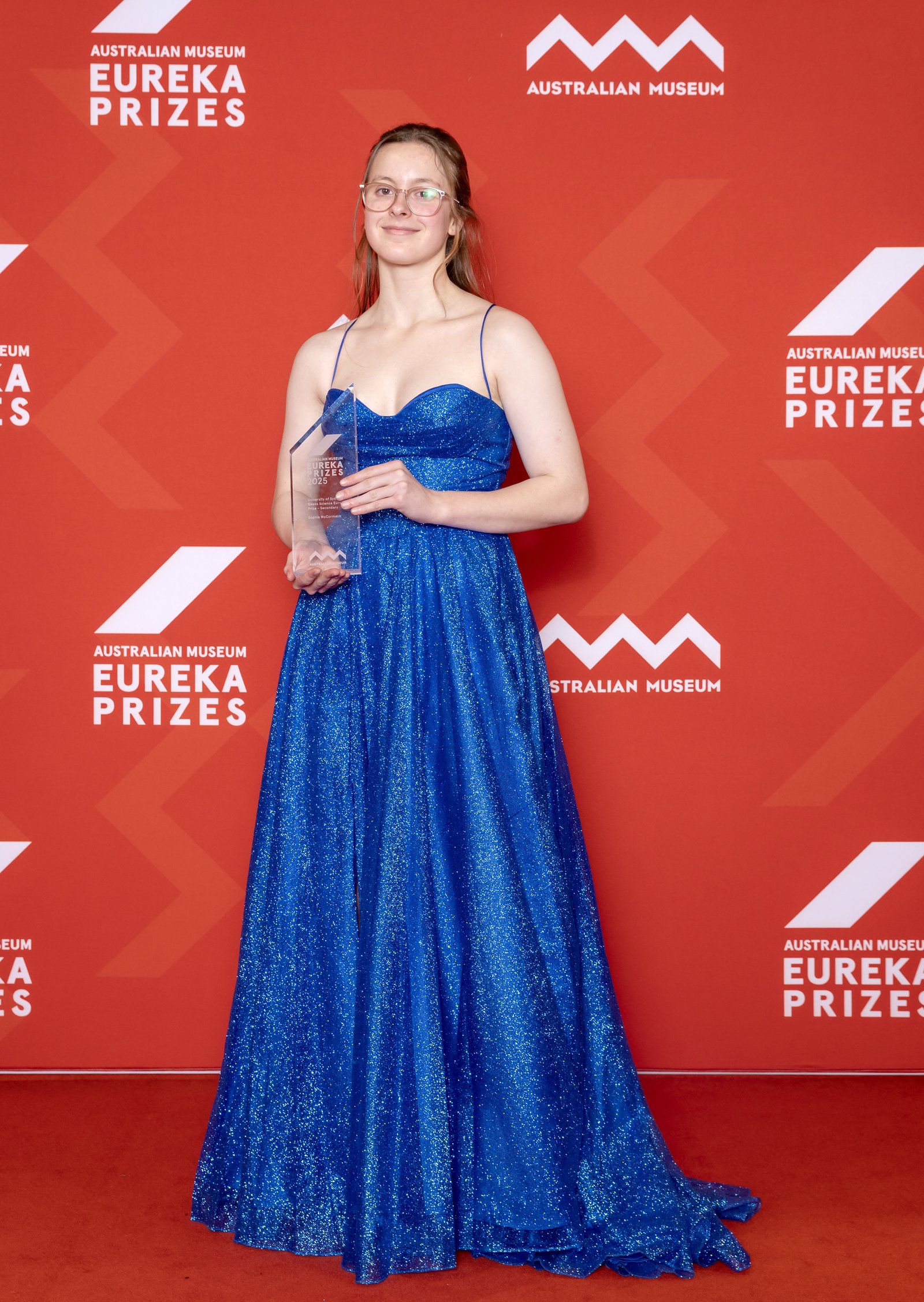
Sophie M. at the 2025 Australian Museum Eureka Prizes Award Ceremony. Photo by Mel Koutchavlis
Image: Mel Koutchavlis© Mel Koutchavlis
What did you find most challenging?
There was a lot of information out there about the TMD and one of the elements I found most challenging was synthesising and understanding the information. The engineering reports that I investigated were very complicated and went deeply into maths I have only seen on the internet. It was challenging, but very fascinating.
The Australian Museum Eureka Prizes are the country’s most comprehensive national science awards, honouring excellence across the areas of research & innovation, leadership, science engagement, and school science.
