
Ornithology
Ornithology is the branch of zoology devoted to studying birds. Around 11,000 species of bird inhabit the world, ranging from tiny hummingbirds to huge ostriches.


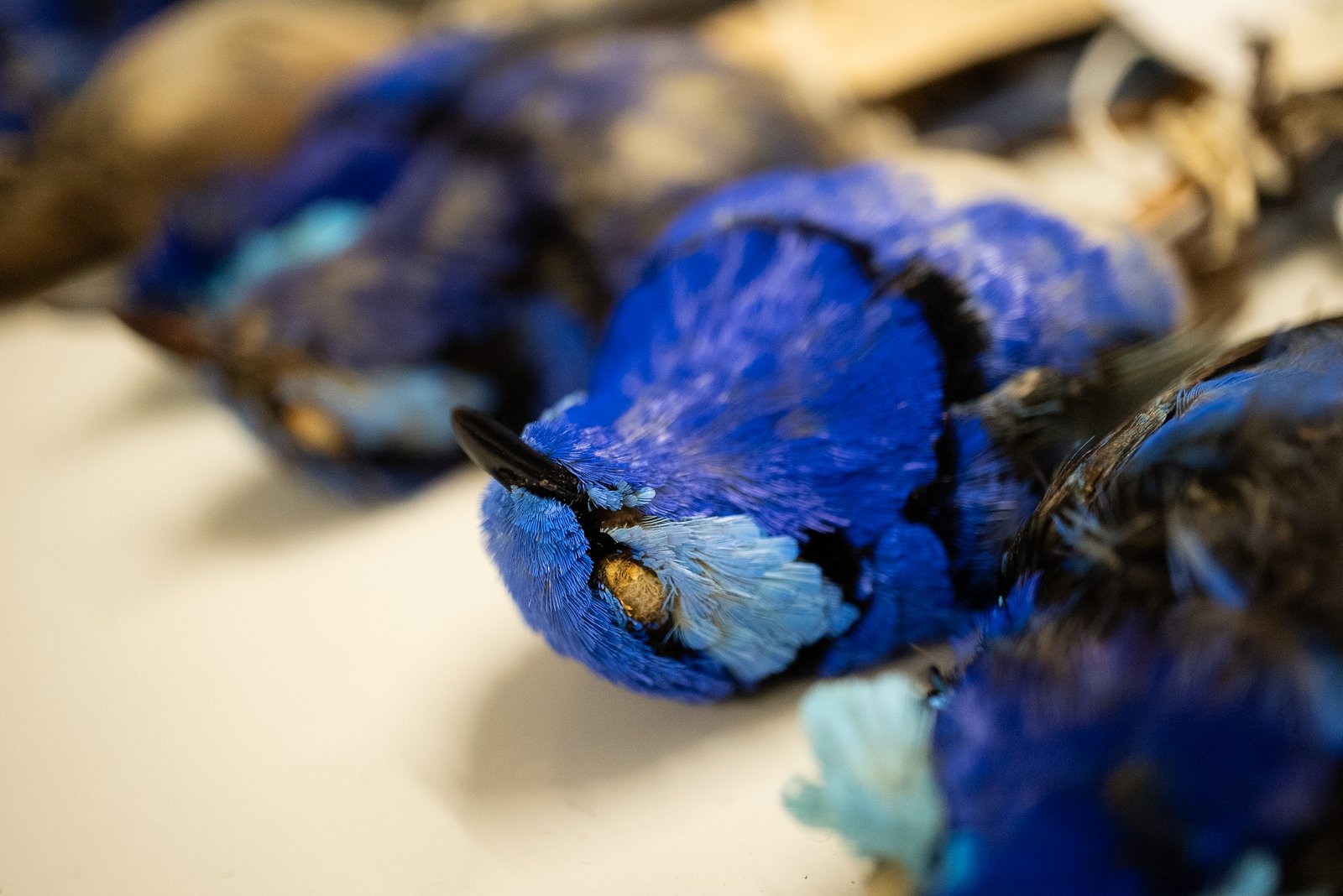
The Australian Museum holds one of the largest ornithological collections in the Southern Hemisphere. Rare, endangered and extinct species share the shelves with many type specimens, primarily from Australia and the Pacific. Many specimens date from the 1860s or earlier so the collection provides an insight into avian biology, anatomy and geographical distributions over time. There are also skeletons, eggs, nests, wet specimens and tissue samples. It comprises of over 100,000 registered specimens.
What is Ornithology?
Ornithology is the branch of zoology devoted to studying birds. Around 11,000 species of bird inhabit the world, ranging from tiny hummingbirds to huge ostriches.
Living birds are warm-blooded vertebrate animals that have:
- feathers
- forelimbs modified as wings
- scales on their legs and feet
- a bill without teeth
- lay hard-shelled eggs.
Discover the collection rooms in Ornithology at the Australian Museum with Dr Jacqueline Nguyen, Scientific Officer Ornithology, and Emily Cave as they answer "What is Ornithology?".
Dr Jacqueline Nguyen: Museum collections are a place of biological discovery. They record what, when, where, and how a bird species has lived. Museum collections provide the fundamental information about bird species' names, classifications, and how different species are related to each other. But they also allow us to ask all sorts of questions about the biology of birds, and every specimen in our collection tells its own story.
We're here in one of the collection rooms in Ornithology at the Australian Museum. My name is Dr Jacqueline Nguyen. I'm a Scientific Officer in Ornithology at the Australian Museum.
Birds are one of the largest groups of vertebrates, so animals with backbones. There are over 10,000 species of living birds today. The most important specimens in the bird collection are type specimens. Type specimens are the official name bearers and physical definitions of a species. They are a permanent representative of a species that scientists will use to clarify the identity of an unknown or potentially new species, or to better understand species definitions.
One of the ways in which the Australian Museum bird collection is used is for scientific research. For example, I use the bird collection to understand how bird diversity has changed over time and across Australia. I use a combination of fossils, anatomy, and DNA to understand how birds have evolved, how fossil and modern birds are related to each other, to better understand the bird tree of life and the timing of the evolution of birds, as well as to identify new species of fossil birds, and more broadly, to understand how birds and their environments have changed over time.
Birds come in a wide range of sizes, shapes, and colours, but they all have the same basic body plan. A beak with no teeth, a long neck, two wings, two strong legs, a short tail, and feathers. Because of all these features, we know a bird when we see one today.
Birds have evolved their form to adapt to a wide range of habitats and diets. For example, birds have a diversity of beak shapes and sizes to suit different types of food. Some birds, like penguins, have adapted their wings into flippers so they can swim underwater. Other birds, like emus and cassowaries, have become flightless, so their wings are very reduced relative to their body size. Birds are found on every continent, including Antarctica, in almost every habitat on land, as well as in the sky and in water. Because birds are so excellent at adapting, they've become one of the most successful animals on Earth today.
Birds have been around for a very, very long time, going as far back as about 150 million years ago, which is the age of one of the oldest birds, Archaeopteryx. Archaeopteryx appears in the fossil record nearly 70 million years before Tyrannosaurus rex and Triceratops.
Emily Cave: My name's Emily Cave, and I've been working here at the Australian Museum in Ornithology since 2020. The Ornithology collection here at the Australian Museum, we have over 100,000 registered specimens. We've got a variety of different types of specimens. So we have mounts, we've got about 50,000 study skins, and that's easier to store them that way, and they're most commonly used for research. About 3,500 skeletons, nests, a massive egg collection of about 20,000 or so eggs. We also keep wet specimens in jars, and we also have feet and wing specimens. We also have a large tissue collection. So we've got about 17,000 or so tissue samples, which are kept in special freezers.
Dr Jacqueline Nguyen: Some of the unusual specimens we have in the bird collection include bird nests built in unusual places; for example, we have a Grey Shrike-thrush nest built in an old boot, a bird nest that was built in part of a horse bridle, and even magpie nests made out of wires.
Specimens of some species have feathers that fluoresce or glow under UV light. When we shine a UV light on it, we can see what birds see and see that their feathers are even more spectacular.
Emily Cave: The Australian Museum collection's really important for conservation because our bird collection is a big library. We need to understand the different species before we can conserve anything. Habitat loss is one of the biggest threats to birds, and a really big example is the Regent Honeyeater, which is now critically endangered because 90% of its habitat has been lost because of clearing of land by humans. And this species used to occur throughout all of Eastern Australia in flocks of hundreds of birds, but sadly now there's just so few remaining that you're lucky to see them. And the museum's got quite a collection of Regent Honeyeaters, and it's a really important example of historical distributions and the impact that humans can have on habitat clearing and loss of species diversity. So a lot of our specimens in the museum are quite old, from late 1800s to early 1900s, and so sometimes if people are studying genetics and you don't have fresh material like frozen tissue or blood samples, you can take genetic material from the historical specimens.
Dr Jacqueline Nguyen: With new techniques like CT scanning and DNA analysis, specimens that have been collected decades ago can still provide new information that is scientifically important, and this is one of the many reasons why our museum collections are really important.
One of the purposes of our collection is for exhibitions, and we've also got another reason to make mounts for education to be used in school programs. One of the more unexpected uses of our collection is artists will come in, so photographers, painters, sculptors, and even animation studios wanting to look at specimens for reference material.
Even though birds are found everywhere, we see them every day, we feel like we know a lot about birds, there's still a lot to learn about them. And the bird collection is an important resource for expanding our knowledge about all different aspects of birds.
The Australian Museum Ornithology Collection
The Australian Museum's Ornithology Collection contains a wide cross-section of these fascinating animals. Specimens include a large variety of bird skins, mounts, skeletons, eggs, nests, spirit specimens and tissue samples.
- Comprises: 75 percent of all living bird species and 95 percent of the world's bird families
- Specimens: 100,000, including 360 Type specimens across 180 taxa
- Location: onsite at the museum in the Sydney CBD and at Castle Hill Discovery Centre.
Types are original specimens on which the first description of a particular species or subspecies is based.
Collection strengths
The collection contains many rare, endangered and extinct species plus a significant number of Type specimens, primarily from Australia and the Pacific Islands. As many specimens date from the mid-1860s, some even earlier, the collection affords us an insight into avian biology, morphology, anatomy and geographical distributions over time.
Our egg collection is very large, rivalling other large collections like that of the American Museum of Natural History.
Distribution
The collection focus is species from New South Wales, but almost all bird species that breed in Australia are well represented. It also contains 3,500 non-Australian species, many from New Guinea, New Zealand, the south-west Pacific.
Collectors and contributors
Important collectors or figures associated with the collection include G Krefft, AJ North, G Masters, EP Ramsay (Dobroyde Collection), E Troughton and FG Waterhouse.
Notable scientific officers and collection staff include T Iredale, JA Keast, KA Hindwood, J Disney and WE Boles.
Collection highlights
Some of the most important specimens in our collection are the types. Types are original specimens on which the first description of a particular species or subspecies is based. We hold about 360 type specimens of birds across around 180 taxa. Most of them are Australian species; for example, the skin of a Princess Parrot (Polytelis alexandrae) that John Gould used when originally describing this species. Other types are species that were collected in the Pacific Islands, such as the holotype of the New Britain Kingfisher (Todiramphus albonotatus).

The Princess of Wales Parrakeet (Polytelis Alexandrae), as depicted in The Birds of Australia 1840 to 1848.
Image: Leone Lemmer© Research Library
Many specimens have a special place in history, such as more than 700 Antarctic birds and eggs collected by Douglas Mawson and his team on their historic Antarctic expedition (1911-14). These range from large King Penguins (Aptenodytes patagonicus) to dainty Wilson's Storm-petrels (Oceanites oceanicus).

This King Penguin was collected by Sir Douglas Mawson, as part of his Australasian Antarctic Expedition of 1911–14. The penguin was found on Macquarie Island, a subantarctic island located between Australia and Antarctica, and is one of more than 700 specimens of birds and eggs that Mawson and his team collected during their research trip. The King Penguin is the second-largest of all penguin species, standing at 70–100 centimetres tall, and weighing up to 16 kilograms. It has an unusually long breeding cycle and lays one egg each year, which is incubated by both parents in shifts that last for several days.
Collected on the Australasian Antarctic Expedition 1911–14. Registered 1914
AM ornithology Collection.
Penguin dimensions: 96cm long x 25cm wide.
Image: Stuart Humphreys© Australian Museum

The King Penguin has an unusually long breeding cycle and lays one egg each year, which is incubated by both parents in shifts that last for several days.
Macquarie Island
Collected on the Australasian Antarctic Expedition 1911–14. Registered 1914
AM Ornithology Collection
Egg dimensions: 9.3cm (high) x 7cm (diameter).
Image: Stuart Humphreys© Australian Museum

© Australian Museum
Among the extinct species is the beautiful Paradise Parrot (Psephotus pulcherrimus), which holds the dubious distinction of being the only Australian mainland bird to have become extinct since the arrival of Europeans. Of the 12 Paradise Parrot specimens in the collection, one of the most beautiful is a mounted specimen in a glass dome, presented to the Museum by the estate of Sir Edward Hallstrom.

The Paradise Parrot holds the dubious distinction of being the only Australian mainland bird to have become extinct since the arrival of Europeans in Australia. There are very few specimens of Paradise Parrots in museums around the world.
Dimensions: 44cm (high) x 35cm (wide) x 17cm (deep). Donated by the estate of Sir Edward Hallstrom, 1970. AM Ornithology Collection
Image: Stuart Humphreys© Australian Museum
Other species, such as the Night Parrot (Pezoporus occidentalis), represented in the collection by five specimens, have not yet slipped into extinction but remain very rare and endangered.

© Australian Museum
Some birds are known only from a single representative. Captain Blood's Bird of Paradise (Paradisaea bloodi) is the only known specimen of a hybrid between Raggiana's Bird of Paradise (Paradisaea raggiana) and the Blue Bird of Paradise (P. rudolphi). It is named after the collector, Captain Neptune B. Blood, who collected the specimen from Mount Hagen area in Papua New Guinea in 1944. As well as being the only known specimen in existance, it is also the type of Paradisaea bloodi.

© ©Australian Museum
Another example is the Upland Sandpiper (Bartramia longicauda). While widespread in the New World, this is the only record for Australia. The bird was collected at the Randwick Swamps in 1848. It was sent on loan by the Museum to John Gould, in order that he could illustrate it for his book series, 'The Birds of Australia'.

© Australian Museum
Some specimens offer a fascinating insight into the lives of birds. In 1903, a specimen of the very uncommon Grey Falcon (Falco hypoleucos) was donated to the Museum. This specimen is of particular interest as it still has the head of its last meal, a Mallee Ringneck Parrot (Barnardius zonarius barnardi), clamped firmly to its leg by the beak. The Falcon had been shot by a farmer in Condobolin, who was no doubt surprised to see that the parrot had not given in without a fight.

Grey Falcon (Falco hypoleucos) with skull of Mallee Ringneck (Barnardius zonarius barnardi) clamped onto its leg.
Image: Jaynia Sladek© Australian Museum
Other peculiar specimens include some of the nests held in the collection. They are arresting due to the manner in which they are built, or else because of the unusual locations in which the bird has constructed the nest. For example, the collection contains a number of magpie nests constructed of wire, a Willie Wagtail's nest built on an old horse bit and a swallow's nest built on the skull of a dead eagle. And this Grey Shrikethrush nest in a boot!

Grey Shrikethrush nest built in a leather boot. April 2017
Image: vanessa pitt© Australian Museum


How the Collection is used
Scientists use the collection to understand how bird diversity has changed over time and across Australia. They use fossils, DNA and anatomy to understand how they have evolved and to better understand how they are related to each other.
Specimens from the collection are displayed in exhibitions, and school programs. And artists, photographers, painters, sculptors, and even animation studios visit to look at specimens for reference material.
Australian Museum avian palaeontologist Dr. Jacqueline Nguyen helped lead the largest and most complete study of bird evolution. The research combined genomic data from over 360 bird species with fossil records to precisely map the family tree of modern birds.
Search Australian Museum Collection records on the Atlas of Living Australia (ALA) or visit Online Zoological Collections of Australian Museums (OZCAM).
Specimens on display at the AM
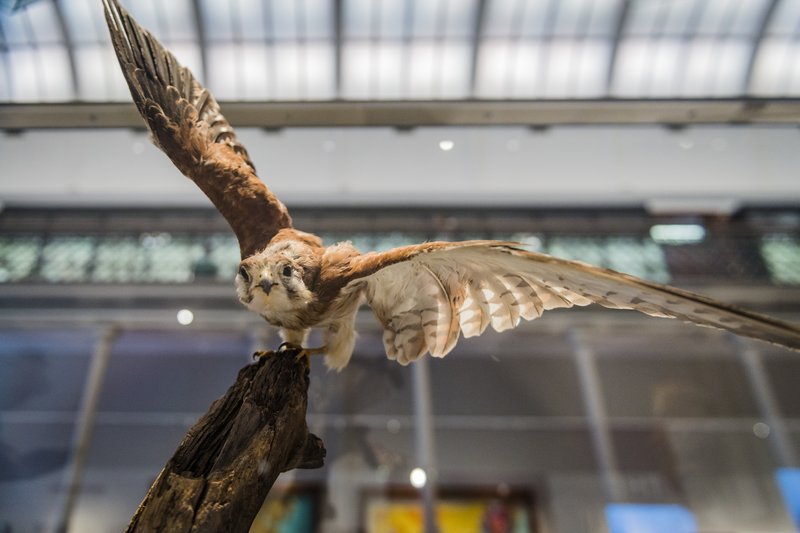
There is a large and comprehensive display of Australian Museum Ornithological Collection specimens in our Birds of Australia exhibition. Birds of prey specimens including a Wedge-tailed Eagle and Black-shouldered Kite are also on display in the Westpac Long Gallery 200 Treasures of the Australian Museum exhibition. The display showcases adaptations for hunting such as talons and hooked beaks. Bird specimens are also presented in our Wild Planet exhibition illustrating biodiversity of animal species.


