
Legendary Australian science changemaker honoured with Lifetime Achievement Award by Australian Museum
Former AM Director, renowned marine biologist Dr Des Griffin awarded 2025 AMRI Lifetime Achievement Award.
Sydney, 25 November 2025: Dr Desmond (Des) Griffin AM, who served as Director of the Australian Museum (AM) for a record 22 years, has been awarded the Australian Museum Research Institute (AMRI) Lifetime Achievement Award, in recognition of his contributions to the AM through science research and education and First Nations cultural consultation and repatriation.
During his tenure as Director from 1976 – 1998, Dr Des Griffin’s work shaped and developed the Australian Museum into an internationally significant institution, particularly through his work as Curator and Senior Research Scientist in Crustacea, and most recently as Gerard Krefft Memorial Fellow. He was also instrumental in developing the national ‘Previous Possessions, New Obligations’ policy that led the way for First Nations peoples to repatriate cultural items and to consult on collections and knowledge holding.
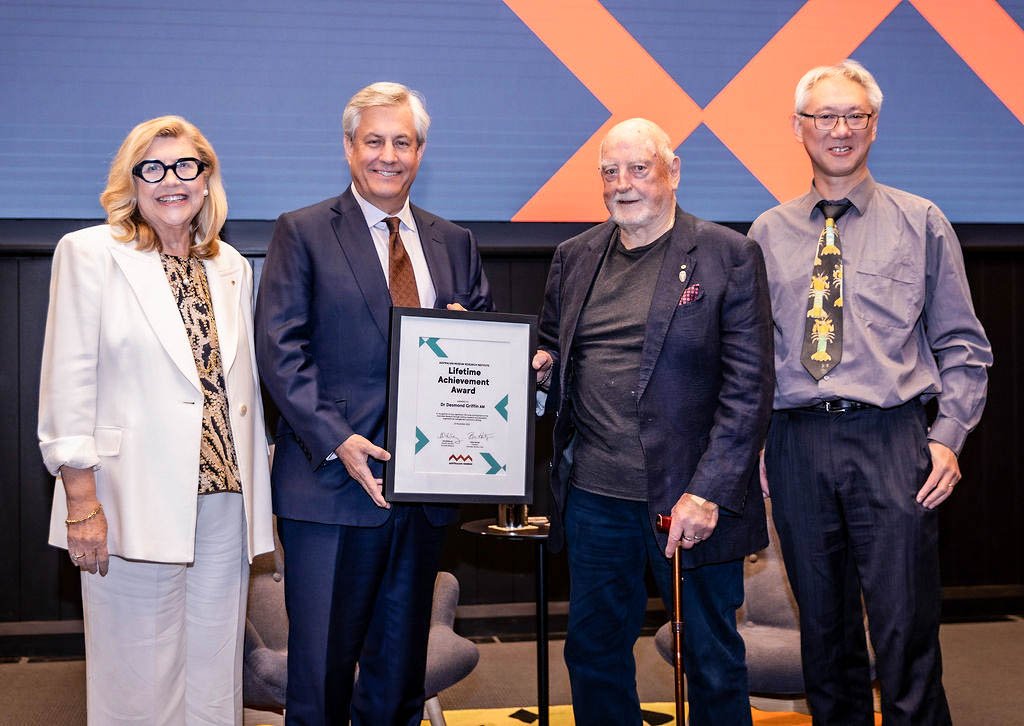
© Australian Museum
Director and CEO of the Australian Museum, Kim McKay AO, said Dr Des Griffin transformed how Australians experienced natural science, turning museums from places of observation into spaces of connection and discovery.
"Dr Des Griffin's legacy at the Australian Museum spans generations. He understood that museums must be places of understanding, dialogue and access for all Australians. From introducing impactful public education programs to taking the AM collections to regional communities, he championed the idea that museums belong to everyone. His passion for marine science was matched only by his commitment to making the AM a truly public institution," Ms McKay said.
Professor Shane Ahyong, Acting Chief Scientist Australian Museum Research Institute and himself an expert in crustaceans, said Dr Griffin’s contributions to science were particularly evident in marine biology.
“Dr Griffin's influence on science and marine biology research has been profound and enduring. His work has inspired generations of scientists, including myself, and his vision for collaborative, accessible, international science together with societal impact continues to guide our work at AMRI today,” Professor Shane Ahyong said.
Julie Ellmers, Acting Director AMRI said that much of the success that AMRI enjoys today was established by Dr Griffin during his tenure.
"Dr Griffin demonstrated that world-class research and public engagement aren't competing priorities, they're inseparable. That principle continues to guide everything we do at AMRI today," Julie Ellmers said.
Accepting the Award, Dr Griffin said working alongside his peers at the Australian Museum was an honour and a privilege.
"I've been fortunate to work alongside brilliant scientists, dedicated curators, and inspired educators who share a commitment to making science accessible and meaningful. This award recognises the collaborative efforts we all make to connect visitors to the natural world, to history and to truth telling," Dr Griffin said.
Dr Griffin was appointed a Member of the Order of Australia (AM) in 1990 in recognition of his services to museums and was elected a Fellow of the Royal Society of NSW in 2014. He is the Gerard Krefft Memorial Fellow, an honorary position commemorating one of the earliest curators and directors of the AM, Gerard Krefft (1861-1874) – a renowned natural scientist, museum pioneer and Australia's first zoologist.
Established in 2014, previous recipients of the AMRI Lifetime Achievement Award include Prof Tim Flannery, Robyn Williams AM, Prof Frank Talbot AM, the 1971 Lord Howe Island Environmental Survey Group, Catherine Livingstone AO, Prof Lesley Hughes, and Brian Sherman AM.
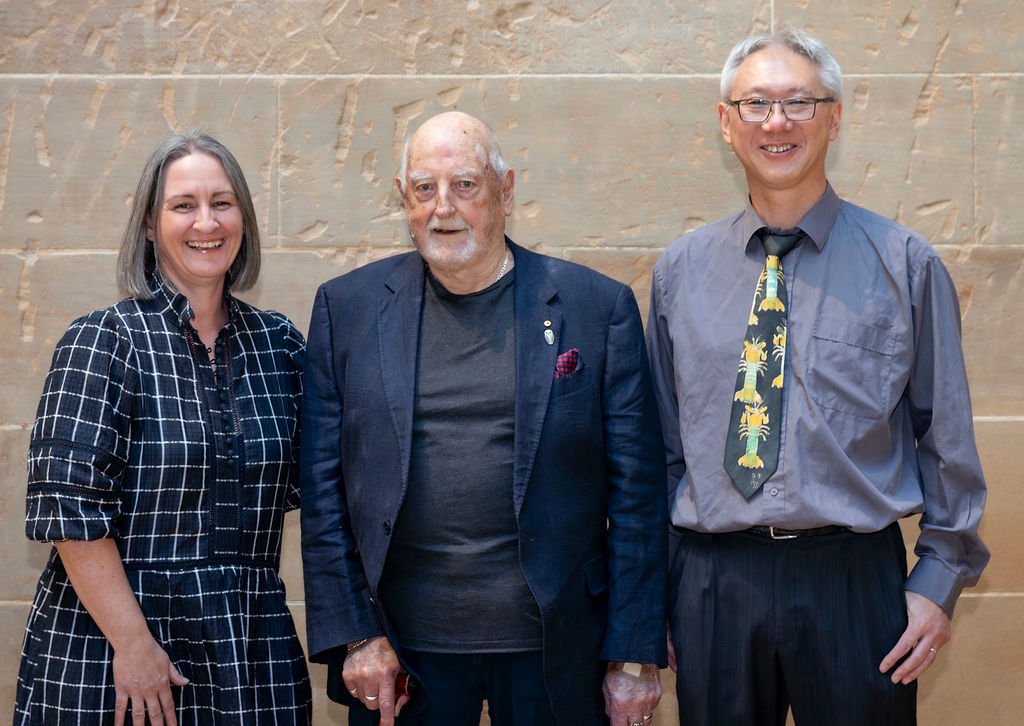
© Australian Museum
Download the media release
For interviews and media inquiries, email media@australian.museum
About Dr Desmond Griffin AM
Dr Desmond John Gerald Griffin AM is a marine biologist with a particular interest in crustacea. He was appointed assistant curator of marine invertebrates in 1966, and curator in 1969. In 1970 he spent nine months at the Smithsonian Institution, Washington D.C. as a visiting postdoctoral research associate, and subsequently visited museums in Europe, Israel, India and Singapore. Des Griffin was made Deputy Director of the Australian Museum in 1975, and Director in 1976.
The relationship between museums and First Nations peoples is of particular concern to Dr Griffin. In 1993 he was instrumental in developing a national policy on this issue, Previous Possessions, New Obligations. A key event in his directorship was the return of precious cultural objects to representatives from the Solomons, Vanuatu and Papua New Guinea at the opening of the Pieces of Paradise exhibition (1988). Objects from the Cape Mudge (Native American) collection were also returned on request. The Indigenous Australians gallery (1997) broke new ground in the inclusion of contemporary stories and the close involvement of First Nations communities in its development.
The 1990s saw the expansion of many non-science areas of the museum, including community relations, education, exhibitions and materials conservation. Several new public programs were aimed at reaching and attracting new audiences. The theatre unit, Search and Discover, Kids’ Island, and the Community Access Program (CAPS) were all introduced. Other programs took museum exhibits away from the AM and to rural and regional areas.
The author of numerous papers on marine biology, as well as museum management and policy, Dr Griffin was chairman of the Council of Australian Museum Associations (CAMA) 1988-1993 and the first president of Museums Australia. He retired in September 1998, after 32 years at the Australian Museum (22 years as Director), and was appointed a Member of the Order of Australia (AM) in 1990 in recognition of his services to museums. Dr Griffin was also elected a Fellow of the Royal Society of NSW in June 2014, the same year that his book titled, Education Reform: the Unwinding of Intelligence and Creativity was published, which addresses the future of education reform in Australia.
Dr Des Griffin is the Gerard Krefft Memorial Fellow, an honorary position commemorating one of the earliest curators of the AM, Gerard Krefft (1861-1874)– a renowned natural scientist, museum pioneer and Australia’s first zoologist. Dr Griffin continues to write on current affairs, including environmental affairs, climate change, economics and museums.
About the Australian Museum
The Australian Museum (AM) was founded in 1827 and is the nation’s first museum. It is internationally recognised as a natural science and culture institution focused on Australia and the Pacific. The AM’s mission is to ignite wonder, inspire debate and drive change. The AM’s vision is to be a leading voice for the richness of life, the Earth and culture in Australia and the Pacific. The AM commits to transforming the conversation around climate change, the environment and wildlife conservation; to being a strong advocate for First Nations cultures; and to continuing to develop world-leading science, collections, exhibitions and education programs. With 22 million objects and specimens and the Australian Museum Research Institute (AMRI), the AM is not only a dynamic source of reliable scientific information on some of the most pressing environmental and social challenges facing our region, but also an important site of cultural exchange and learning.
