
Fission Chips Team: Turning an accident into a breakthrough
Who Associate Professor Noushin Nasiri from the Fission Chips Team
What In a paradigm shift for nanosensor production, Associate Professor Noushin Nasiri and her Fission Chips Team developed a cheaper, more efficient sensor using non-toxic vinegar in a special low-temperature joining technique. The sensors have a myriad of applications in smart, wearable systems, such as monitoring skin cancer risk or pregnancies in cattle.
Winner of the 2025 ANSTO Eureka Prize for Innovative Use of Technology
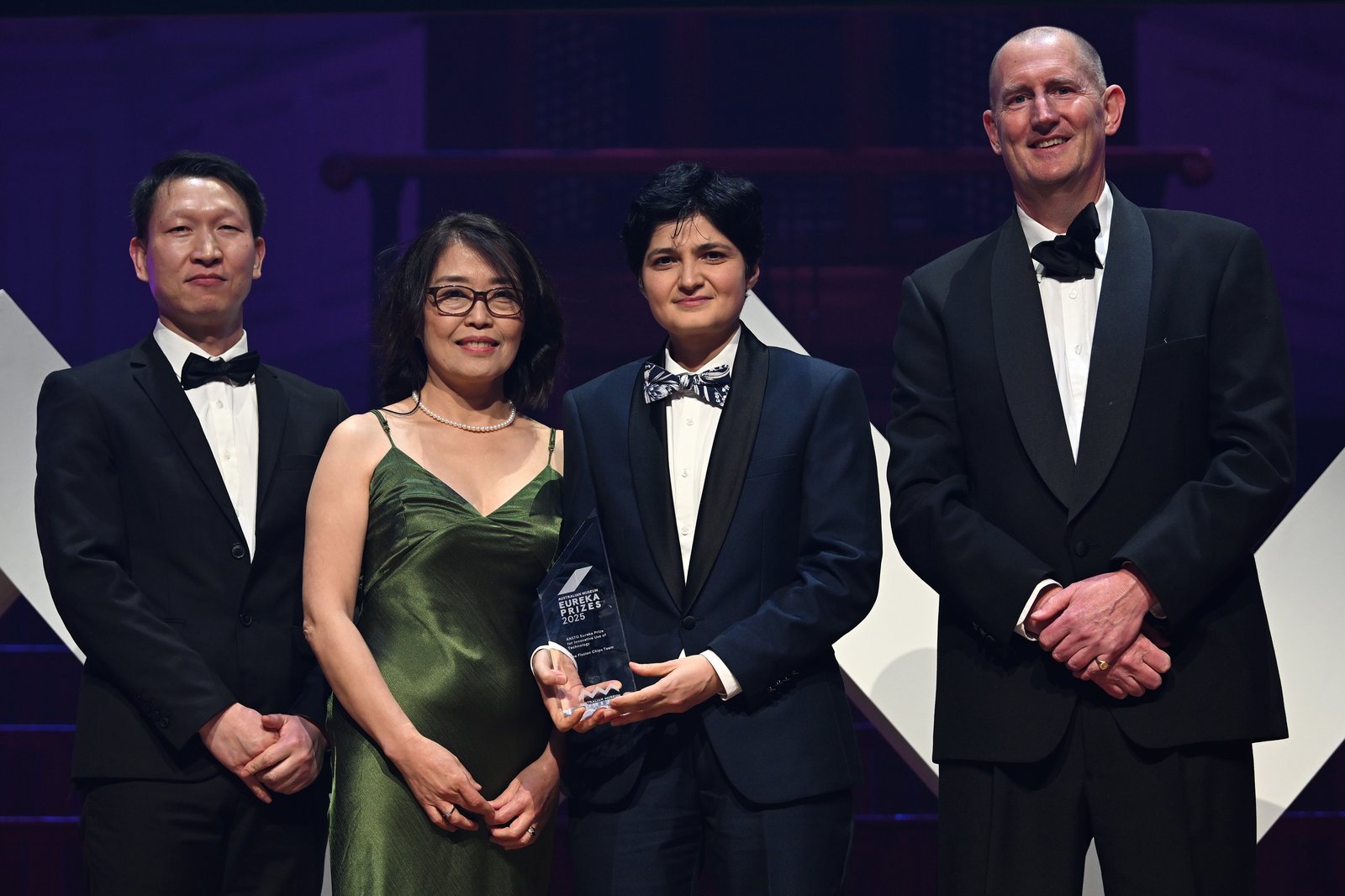
The Fission Chips Team accepting the 2025 ANSTO Eureka Prize for Innovative Use of Technology, with presenter Dr Andrew Peele. Photo by Getty
Image: Wendell Teodoro/Getty Images for Australian Museum© 2025 Getty Images
Congratulations on winning the ANSTO Eureka Prize for Innovative Use of Technology! Your discovery was a real life ‘Eureka’ moment. Can you explain what happened?
Thank you! It truly was a “Eureka” moment, and it started completely by accident. One afternoon in the lab, while cleaning equipment, we accidentally spilled a tiny droplet of ethanol onto a zinc oxide nanosensor. Instead of destroying it, as we expected, the sensor’s performance skyrocketed. That single droplet triggered an enormous enhancement, something we’d never seen before.
From that serendipitous event, we began a deep scientific investigation to understand why. After months of experiments, we discovered a new, room-temperature process that transforms the way nanoparticles connect to one another. By simply exposing our nanosensors to vinegar vapour, we could create strong, conductive bridges between nanoparticles, achieving the same effect as heating them to 500°C, but without the energy cost, time, or damage to the material. That’s how Fission Chips was born.
When something like this happens in the lab unexpectedly, how do you transform that into a real-world solution?
Turning an accident into a breakthrough takes persistence and collaboration. Once we realised what was happening, my team and I designed a series of controlled studies to map out every variable, the nature of the liquid, the amount of vapour, exposure time, and the nanosensor’s structure.
Once we confirmed the science, we moved quickly to protect and translate it. We filed a patent through Macquarie University (PCT/AU2024/050143) to secure the intellectual property, and soon after, began conversations with industry. The technology immediately captured interest for its simplicity and scalability. Seeing an accidental lab discovery evolve into a patented, commercialised technology that’s now being developed for real-world use has been one of the most rewarding parts of this journey.
These sensors have a myriad of applications in smart, wearable systems, such as monitoring skin cancer risk or pregnancies in cattle. What kind of solutions are your nanosensors able to achieve, and what solutions are they already achieving?
Our nanosensors are designed to act as intelligent bridges between biology and technology. They can detect incredibly small traces of photons, chemicals or biomarkers, things like UV exposure, stress hormones, methane emissions, or disease indicators.
They’re already making an impact. For example, our SunWatch wearable sensor helps users monitor their UV exposure in real time to reduce skin cancer risk. The same sensing platform is being adapted for agriculture, to detect early-stage pregnancy in cows and monitor methane emissions.
What makes this platform powerful is its versatility: one fundamental technology that can potentially be tailored to protect human health, animal welfare, and the environment — all in real time.
Seeing an accidental lab discovery evolve into a patented, commercialised technology that’s now being developed for real-world use has been one of the most rewarding parts of this journey.
What are some of the larger impacts you hope to see from your work in the future?
I want to see a future where health and sustainability are monitored seamlessly and ethically, using technologies that are as intelligent as they are energy efficient. Imagine farmers being able to monitor animal wellbeing without stress or people receiving early warnings about environmental or health risks through wearable sensors.
Beyond the direct applications, I hope our Fission Chips approach will redefine how nanosensors are made, replacing energy-intensive manufacturing with clean, chemical-driven processes. It’s about changing not only what we sense, but how we build the technologies that sense it.
What have been the biggest challenges you’ve faced throughout this research?
The science itself was challenging. We had to completely rethink how nanoparticles interact and then translate that understanding into a reliable, scalable technology through patience, creativity, and rigorous testing.
Beyond the lab, securing sustained funding and building a talented, multidisciplinary team across nanotechnology, chemistry, and engineering were equally demanding.
Aligning diverse expertise and goals took persistence, but overcoming these hurdles made the achievement even more rewarding, especially now that the technology is making a tangible impact beyond the lab.
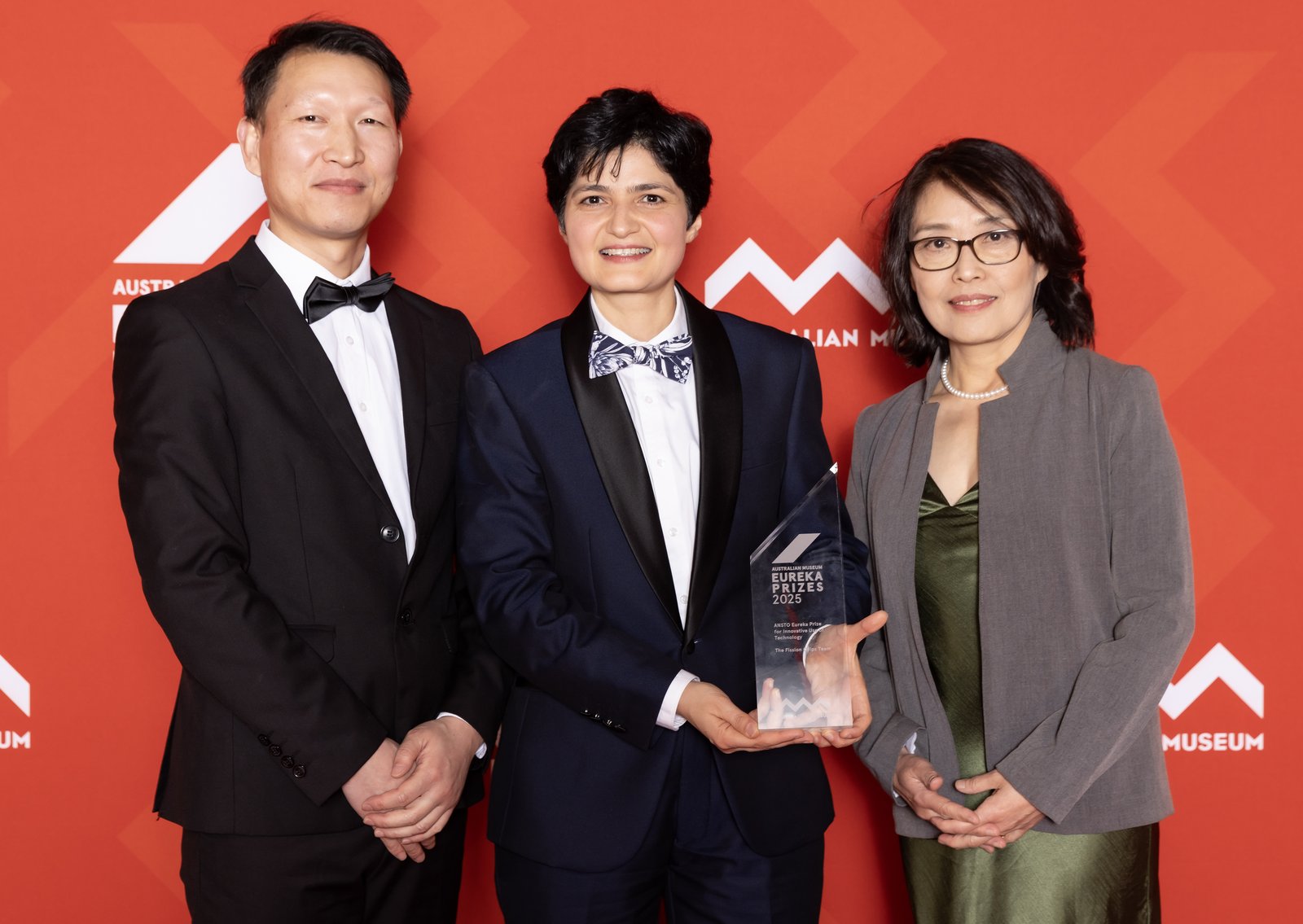
The Fission Chips Team at the 2025 Australian Museum Eureka Prizes Award Ceremony. Photo by Mel Koutchavlis
Image: Mel Koutchavlis© Mel Koutchavlis
What does winning a Eureka Prize mean to you?
It’s an incredible honour and deeply humbling. The Eureka Prizes represent the pinnacle of Australian science, celebrating discoveries that truly change lives. For me, this award recognises not just the technology, but the teamwork, curiosity, and resilience that made it possible.
It’s also a reminder of the power of accidents in science, that sometimes the most transformative discoveries happen when you least expect them.
And for me personally, it feels like a long-time dream coming true. It inspires me to keep pushing boundaries and to show young scientists, especially young women, that innovation can start anywhere, even with a drop of vinegar.
The Australian Museum Eureka Prizes are the country’s most comprehensive national science awards, honouring excellence across the areas of research & innovation, leadership, science engagement, and school science.
