
Green solutions for regenerative farming
On this page...
It is no easy task to provide food for over 8 billion people; as a result, many farming techniques have become unsustainable and have detrimental impacts on our natural environment. Caring for Country is key. Country sustains us as long as we sustain Country. Below, hear from changemakers across NSW who are incorporating First Nations’ practices into their farming, and creating healthy, productive, and thriving food systems.
There is a magic that happens when you start to work with nature. Martin Royds, regenerative farmer
© Australian Museum
Martin Royds
Martin Royds’ family has managed Jillamatong Farm for three generations. Since taking over management, Martin has transformed Jillamatong into a regenerative farm, profoundly benefitting the farm's ecological and economic health, as well as its productivity. Through these regenerative techniques, Jillamatong is minimizing the impacts of climate while boosting soil nutrients, reproductive potential, and profits.
You can't have healthy food without healthy soil. Martin Royds, regenerative farmer
Jillamatong is a 435 hectare property, a bit over 1,000 acres. It was originally granted to the church and then the church leased it out, and consequently it was grazed heavily and there was not much thinking of long-term survival of the property. It was, how much can the leaser take off the farm?
I've gone totally off all the chemicals, and we just focus on working with nature and trying to encourage the frogs, the birds, and everything. I suppose my goal is to have as much biodiversity in the soil, in the plants, in the enterprises on the farm.
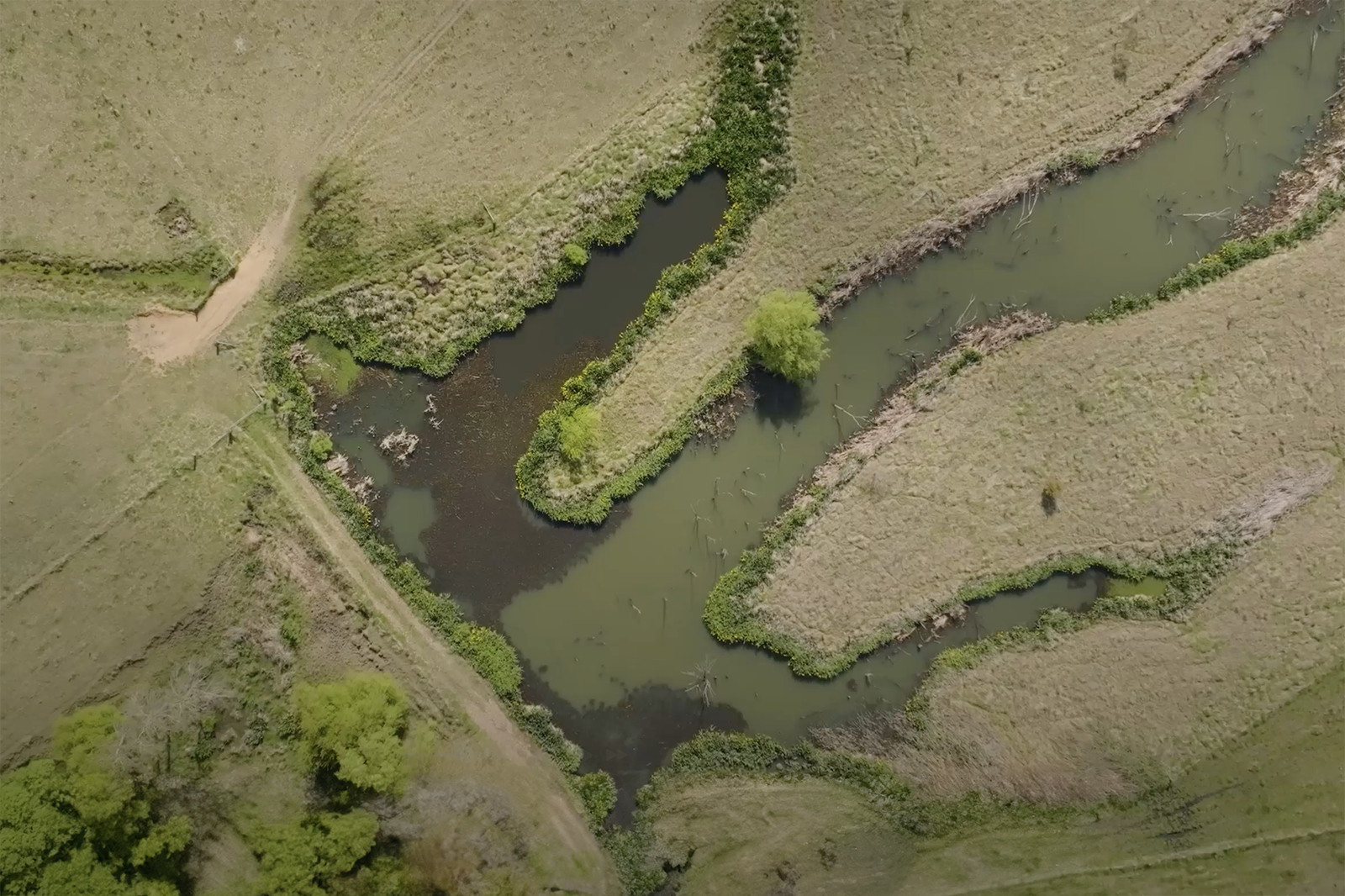
What we've done is put a suture back into the landscape that blocks up that drain, and then it keeps the salt where it should be, underneath the ground. And then you start amazing things happening. You've got a water cycle that's not draining away. You've got it recycling in situ. So we've got... The dew's formed, it evaporates back up, and so we've got a water cycle, a daily water cycle happening. We've got a mineral cycle. We've got these little insects here, the birds, the frogs, and all those are taking fertility out of the pond and they can take back up to the top of the hill.
What I've done with my animals now is we've designed all our fences that come down. I let my cows come in and eat all this, and then they go up and sit in the shade of the trees, ruminate, stand up, and defecate. So they take fertility back up. And I've now got 53 different paddocks and we've put all the cattle into generally one or two mobs. So that's the holistic management principle, and that's the big brain-changing paradigm that we've had to make. Instead of having stock in every paddock, we've now got them... Most of the farm is being rested, or as we say, recovering.
That means that two things: the grasses can grow exponentially, and it's a bit like a solar panel in the city. The more solar panels you've got, the more energy you're going to capture. We grow more grass for less cost, and consequently, my cost of production's gone down, my production's gone up, so our profit levels have gone up. I'm not spending any money on drenches, fertilizers, particularly spraying weeds or anything like that. And there's so much I've learned from indigenous thinking of how to work with nature, and just reading it.
So you can start the positive process really quickly, and then with time, it gets better and better.
My ultimate goal is that food gets sold on nutrient density rather than on cents per kilo. When a farmer gets paid cents per kilo, he's going to try and make those kilos weigh more, and the best way to increase the weight of something is with salt and water. It's not very nutritious. So most of our foods have become less and less nutritious, and consequently, we've got all these problems.
If farmers get paid for the nutrient density of the food rather than the weight of the food, then we've got an incentive to go out there and start building the fertility of the soil up, and then it all starts fixing itself. The soil doesn't blow away, it doesn't wash away, so you get rid of erosion problems. Then the insects get into balance, so you don't need to spray for them. It becomes a nice little utopia, I suppose, and that's my dream of the future.
Robert Servine & Emily Henderson
Green Connect is a social enterprise that combines sustainable food, zero waste, and employment opportunities for young people and former refugees. In these videos, Robert and Emily (the farm's managers) illustrate how sustainable food systems can not only reduce carbon pollution and grow healthy, local produce but can also provide benefits for our communities.
GreenConnect is a nonprofit social enterprise and registered charity in the Illawarra. We're what's considered a WISE social enterprise, so a work-integrated social enterprise. We do an employment pathway mainly for former refugees, Aboriginal and Torres Strait Islander people, and young people. We generally start the work experience on the farm, and then they move into some of our other business programs.
The farm is its own entity. It's 11 acres. It's Department of Education land, and we grow vegetables and sell those in veg boxes. We do about 170 veg boxes per week. So the farm is an education space and a productive farm.
We tend to work with the Karenni or the Karen community, which are stateless people from Burma, and they usually grow up in refugee camps in Thailand.
We've moved into an unsustainable place, and I think we need to look toward the past for some of the solutions. 'Cause in the past, we grew food in a way that was sustainable. We thought about how the soil would benefit from that for the future. Right now, we're destroying the soil. The modern farming techniques are absolutely destroying the planet and contributing to climate change.
I think we have a lot to learn from the Indigenous people, 'cause they worked with the land. They looked at the way nature worked, and they tried to work with it rather than against it.
Support the farmers trying to create a better future. You know, buy local veg boxes. Go out and see the farm. See how it's grown. You know? Talk to your politicians. Demand that they make change and they make access to healthy organic food more of a priority.
Support the farmers trying to create a better future...buy local veg boxes, go out and see the farm, see how it's grown. Robert Servine, Green Connect
If we don't teach children and show children an alternative to what might be presented to them as the easy option, then we are letting the planet down. Emily Henderson, Green Connect
