
Community solutions to climate change
On this page...
Climate change can often feel like too large a problem to tackle alone, creating feelings of anxiety, fear, and paralysis. Community solutions to climate change are therefore sometimes the most powerful. Whether these solutions are focused on renewable energy, wetland regeneration, or making overlooked voices heard, joining a group to fight climate change results in some amazing outcomes.
The future is made right now. We make the future between ourselves. It's really powerful to realise how much we can accomplish as a collective. Marlene Bacquiran & Eezu Tan, Climate Writers
© Australian Museum
Ed Suttle
Ed Suttle is a founding member of the Community Solar 4 Goulburn project. Set up by The Goulburn Group (TGG), Community Solar 4 Goulburn aims to help the region move towards a renewable economy based on sustainable practices and community ownership of energy production. Upon completion of the community solar farm, Community Solar 4 Goulburn is now pursuing a solar bulk buy project.
Doing nothing isn't an option, we must be more active in our determination to make a change. Ed Suttle, founding member of the Community Solar 4 Goulburn project
This group, over the past 10 years, has taken the concept of a community-owned solar farm from literally concept through to the stage where, and you can see behind me, there's a levelled site ready for the installation of about 4,000 solar panels, inverters, transformers, and battery. As an ex-industrial site, it's inappropriate for any kind of residential use, and so what we're doing is turning a piece of toxic, degraded land into a really useful piece of development within the community, creating clean energy.
One of the first things we needed to do when we had the concept was to ensure that all neighbours were going to be onside with having a solar farm within the view of their home or their business. So, we went to every single house and business which could see this site, spoke to them personally, face-to-face, and we didn't get a single objection. We then began to build knowledge within the community of what we intended to do, and over a two, three, four-year period, through numerous articles and letters in the local press, through radio interviews, through holding one or two more fairly sizeable public meetings, we got to the stage where now, we have a database of over 1,500 people who are supporters of the project. And when it came to it, in 2020, when we needed to raise the $2.1 million from the local community, we achieved that sum within three months of starting. One of the rules is that a percentage of profits every year will be donated to a community fund, which will assist those who find paying their electricity bills on a monthly basis. We will help those people.
The challenges have been huge, partly because we are almost the first community group in the country to do what we're doing. One of the wonderful things we have done as part of the entire project is to prepare and be able to present a template of how for others to do this. So, any community in Australia, anywhere, who is contemplating a community-owned renewable project from scratch, we can hand them a document basically saying, "This is how you do it."
From the outside, Goulburn, like many other country cities and towns, probably looks like a rather conservative, "We don't care much about what's going on, just leave us to ourselves" type town. Well, I think what the support the community has given to this community-owned project demonstrate that that is an inaccurate view of Goulburn, and if enough people in enough cities and towns, let's just stick to Australia for now, get behind and demand that at, particularly at federal level, that there is a consistent strategy to act extremely urgently on climate change, then maybe there is still some chance.
Mhairi Fraser
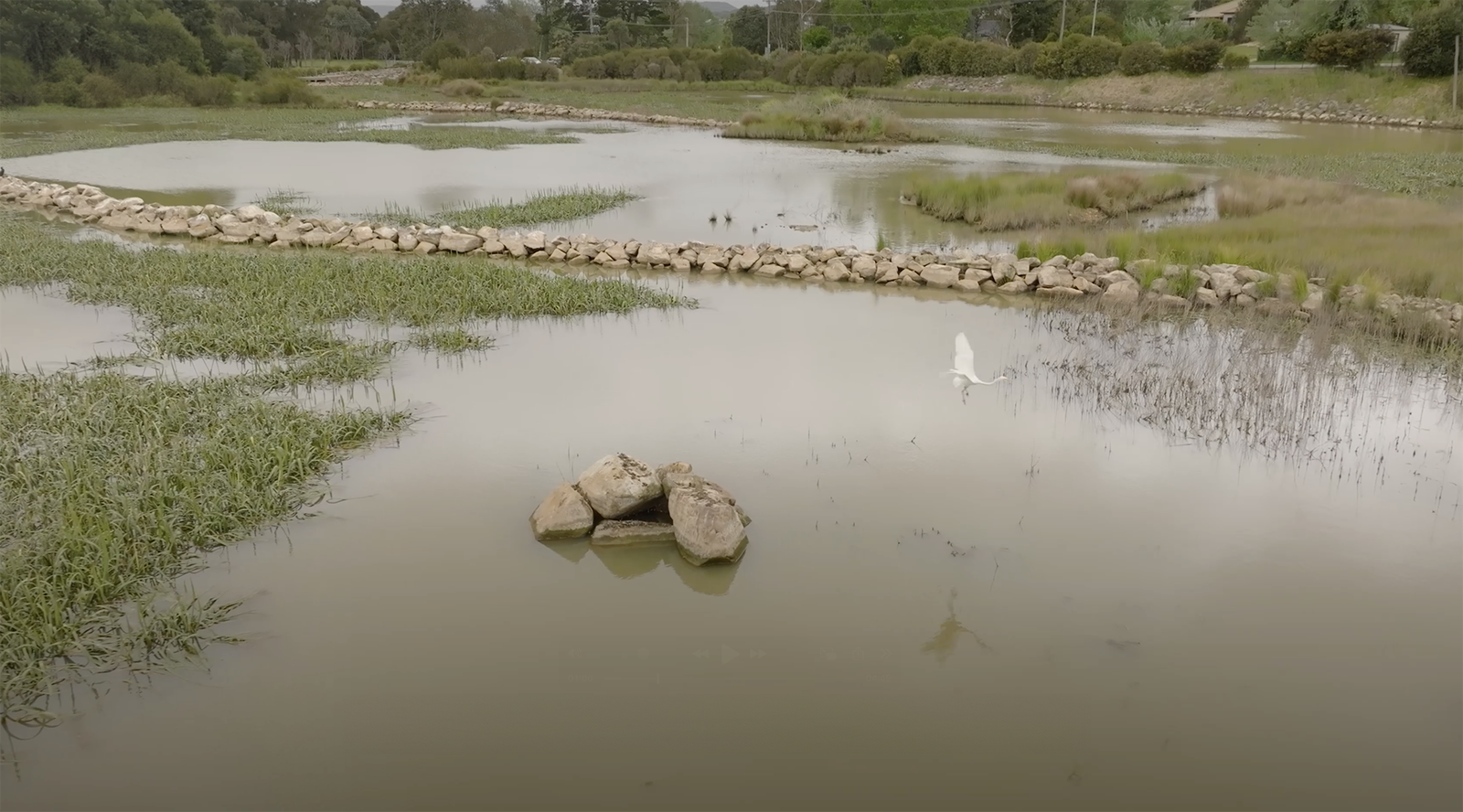
Mhairi Fraser is a proud member of The Goulburn Group (TGG), a grassroots community action group and think tank, founded in 2007. Their restoration of the Goulburn Wetlands, a 13.5 hectare council-owned site on the Mulwaree floodplain, transformed a disused industrial and dumping site into a place teeming with diversity of bird and plant life. In 2021, Council unanimously adopted the plan to revitalise the wetlands and "create an attractive, safe, and accessible community focal point promoting environmental awareness."
I think throughout history, people have had their moments. Our moment is the ecological crisis. Mhairi Fraser, member of The Goulburn Group (TGG)
Goulburn, like many areas of western New South Wales, was in severe drought for a long time. It was a dust bowl. And the Goulburn Group were looking for ways to begin sustainability work, and it seemed to us that there was an opportunity here to look at the role of water in regenerating nature and the human spirit. And council owned this area, it was on the banks of the Mulwaree River, but it had become a weed-infested rubbish tip. So, six people began the work of designing and lobbying for a wetlands restoration project in this place. We were fortunate enough to have a scientist in the group, a biologist in the group, an engineer in the group, as well as people who had a long history of working in community development and community engagement. And I guess that was part of my role, was to start to engage people to become excited about this project.
When a local business offered to start the construction work and gave a huge amount of voluntary time, and materials, such as huge big sandstone boulders to build the berms, we started to see a transformation. And people would come down onsite and start clearing out rubbish. But when the actual structures got put in place, and the water started to flow, and the planting started to be put in, it became really exciting. So this is a much-loved place in Goulburn now. It's a passive recreation site for humans. This is a place for wildlife. It is a place for nature.
It was trust that was built. We didn't talk endlessly about politics, we actually talked about achieving things, and what could we do together that would make something happen. And my experience of Goulburn is that people actually want things to happen. They're sick of the talk. They wanna see something new and different.
It is our moment. And I think throughout history people have had their moments, and our moment is the ecological crisis. We can either turn away from that and say, "She'll be right. Someone will fix it," or we can get involved. Getting involved is not always a happy place to be, because getting involved means you become face-to-face with the facts, that we're using resources of two and a half planets. That our atmosphere is changing and causing massive destruction through extreme weather. That wildlife is shrinking to the margins.
I have experienced, and continue to experience, periods of ecological grief where I wonder how long nature can hang on, and I wonder about how human society can continue.
I want to be with people who see that there's a task to be done, and to play my part, because it's going to take generations of good people to do good things before there's gonna be a big shift. I have grandchildren, and children, but I think the view has to be beyond them. We have to start thinking about generations a thousand years from now, and we need to see the birds and the lizards and the snakes and the spiders as kin.
Eezu & Marlene
Eezu Tan and Marlene Bacquiran are the founders of Climate Writers, a workshop that teaches participants how to write to elected officials about the climate and biodiversity crisis. Now expanding into Melbourne and beyond, the Climate Writers represent a powerful voice on youth activism and politics.
We want to see a future where young people's input into politics is taken seriously, and that their future is being taken into account. Eezu Tan and Marlene Bacquiran, founders of Climate Writers
My name's Eezu, and this is Marlene, and together we run a climate action community called Climate Writers. So, this started two and a half years ago when we were having a conversation about how frustrated we were with the bushfires and the floods happening, and we wanted to do something about it. And so, we decided to bring together a handful of friends in Marlene's share house in inner west Sydney to write letters to MPs.
And so since then, we've had over 400 emails sent, a community of, like, over 200 people, and have had dozens of meetings with MPs across Sydney as well.
We've learnt a lot along the way actually, because neither of us were policy or government experts, or really involved in any strong political way at the beginning. And over time, as we get these responses from MPs, we learn a little bit more about what different people respond to and how to engage.
Something that has been really helpful is making sure that people incorporate their personalized stories in those letters, instead of coming across as a copy-paste website template.
Oh yeah, you can say that one. Join the community. Join our community. Climate Writers, woo. Yeah.
Yeah. It's so helpful to do it with other people, and you get so many other benefits from that, which is like, the casual education you get from conversations you have with other people there, and, you know, just the fun of meeting other people with shared values and interests, and also other people working on cool solutions.
