
Introduced snails and slugs in Australia
On this page...
There are almost 2000 species of snails and slugs in Australia. However, most of the snails and slugs we find in our gardens are not natives.
Introduced snails and slug species arrived accidently in Australia on potted plants, or stuck to packing cases, pallets and shipping containers. A few species seem to have been deliberately smuggled in to be bred and eaten as delicacies. Unlike other exotic species, there is no evidence to suggest that these 'immigrant' snails have affected the survival of Australia's native snail fauna. In fact, most of these introduced snails invade places only after humans have destroyed the habitat of native snails.
Over 65 land and freshwater snails and slugs have been introduced to Australia from overseas. But only a few of these have become pests.
The common garden snail, Cornu aspersum, has been known to occur in Australia for well over 120 years. Today, it is by far the most widespread of all our introduced species, existing in all states and territories. These snails live in non-tropical areas and avoid desert country. In Europe, predators such as thrushes and blackbirds keep garden snail populations in check and cold winters limit their breeding to warmer months of the year. In Australia, warm winters allow garden snails to breed for most of the year, and the lack of predators have led to it becoming a major pest. The Mediterranean Green Snail, Cantareus apertus, another widespread introduced snail, is often mistaken with the garden snail.
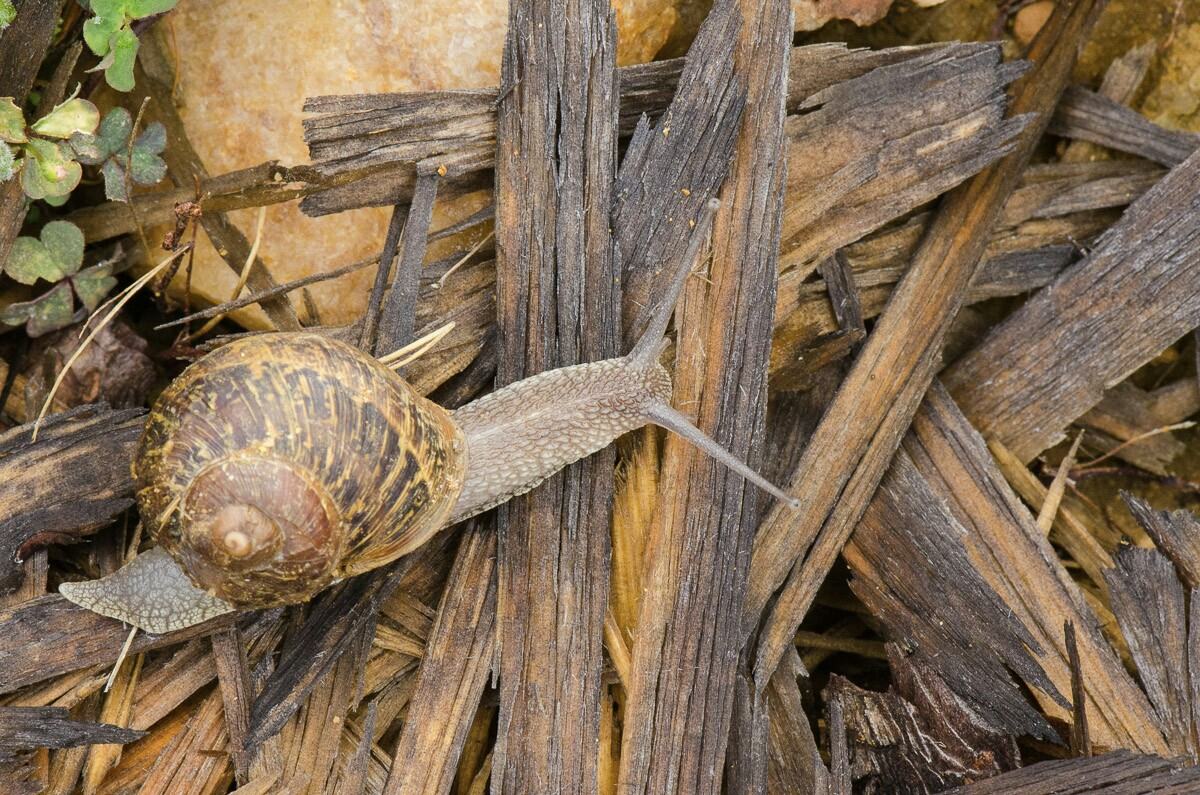
CC-BY-NC 4.0 (Int)
The white Italian snail, Theba pisana, is probably the best-known pest of Australian agricultural crops. Native to the Mediterranean, it was first found in Western Australia early this century and is now very common throughout southern Australia. It climbs the stems of cereal crops in late spring and summer and seals itself to the stems during dry spells. It is then harvested with the crop, clogging machinery and contaminating the grain. Theba can also destroy crops of dried fruit, lucerne, clover, peas, beans and oil seed. This species is confined to the southern parts of Australia.
The oriental snail, Bradybaena similaris, is native to China, but is now found all over the world in tropical and subtropical climates. It is found along the east coast of Australia, from Brisbane to Bega, and is slowly moving further south. Bradybaena is a pest of hanging fruit, such as citrus.
