
Dr Vanessa Pirotta: inspiring ocean action through science, media, and education
Who Dr Vanessa Pirotta
What From Play School to politics, Dr Vanessa Pirotta champions ocean conservation through clear, accessible science communication. A wildlife scientist specialising in whale research, she is a trusted media voice, an author and the founder of citizen science programs, helping Australians of all ages make informed decisions about the future of our marine ecosystems.
Winner of the 2025 Celestino Eureka Prize for Promoting Understanding of Science.
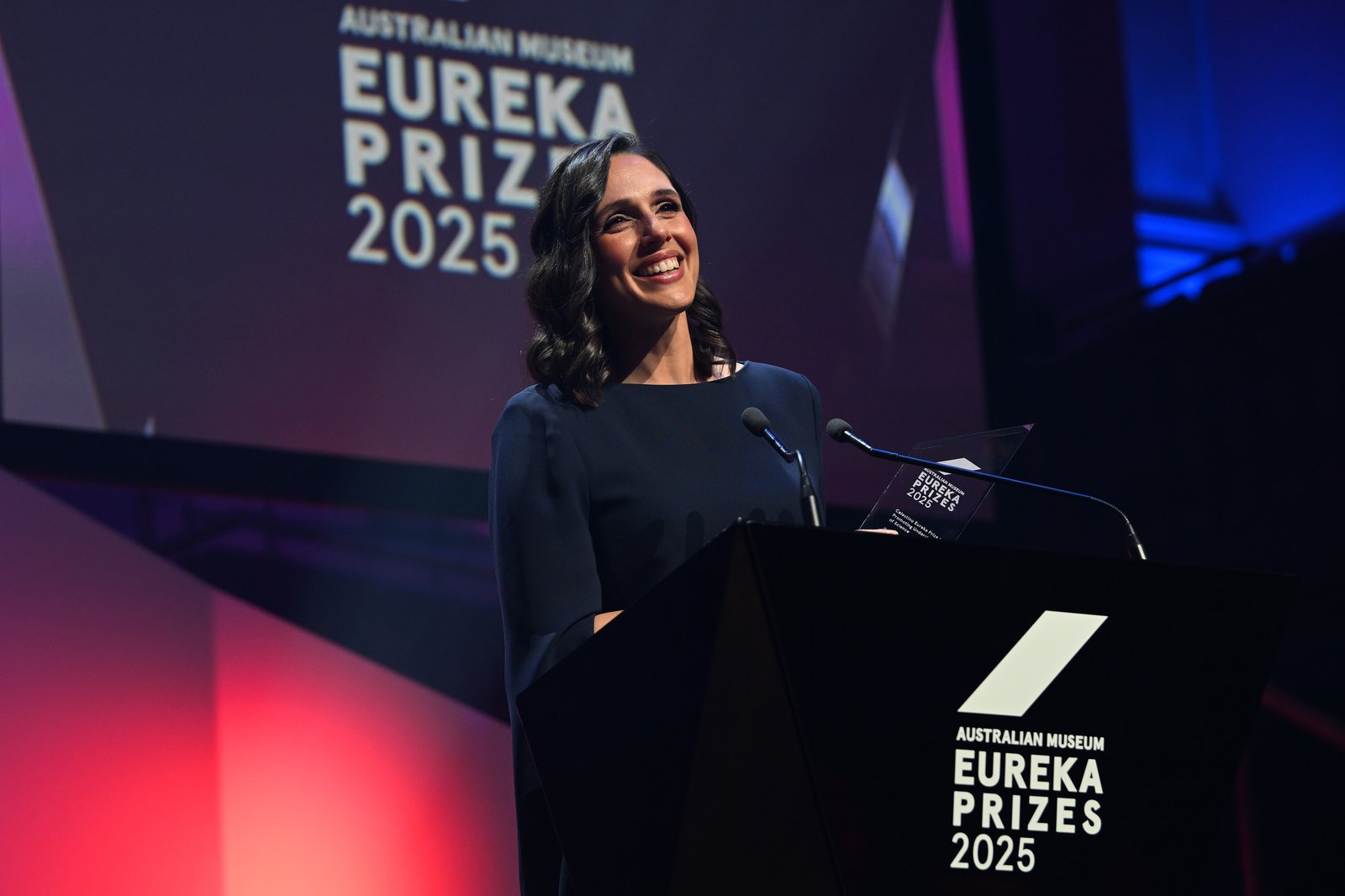
Dr Vanessa Pirotta accepting the 2025 Celestino Eureka Prize for Promoting Understanding of Science. Photo by Getty.
Image: Wendell Teodoro/Getty Images for Australian Museum© 2025 Getty Images
As a sought-after expert voice around Australia, you wear many hats. How do you strike the right balance between your teaching and research, and the work of communicating more broadly with the Australian public?
This is a great question because as I’ve gone along in my career, that is the very key to growth - balance. Making sure you have the science and the credible backing so that when you speak to the general public you are able to draw upon that expertise. I’ve also learnt teaching looks different. It might be to a class full of students, a one-on-one mentoring session to being on Play School. Teaching and being accessible to the general public is something I’m trying to encourage within science so that we have many representatives from different fields, which shows young minds that you can be what you see.
When you started your career as a wildlife scientist, did you expect that you would end up spending so much time promoting the understanding of science, or did this come about more organically?
No! Talking about what I love started at the National Zoo and Aquarium in Canberra and then progressed to marine mammals as a dolphin and sealion trainer. I then went onto doing my whale research and people wanted to learn more, so naturally I started speaking about it. I also learnt that it would become one of my most powerful methods of sharing science and this is a wonderful thing to do for society. People are curious and we as scientists should take the chance when asked to share knowledge, acting in service to others.
What are some of the larger impacts you hope to see from your work in the future?
Beyond science, I hope to use my expertise across various disciplines in fascinating and powerful collaborations. When we work with others, we learn and grow. I would like to use my expertise to help Australia be on the international stage when it comes to wildlife conservation. Innovation and science is also a field I wish to help grow here in Australia, connecting people with each other to make amazing things happen for STEAM (science, technology, engineering, art and math). I’m a big believer in the arts and so much of what I enjoy as a scientist is visual. The merging of science and art can lead to some amazing designs from nature into the everyday, planes are a great example of this.
“There is power in being a scientist and mother, the strength and persistence needed to do both propels me forward in a way that makes me future driven to do more”
In your acceptance speech, you spoke about the importance of visibility as both a woman in science, and a mother in science. That was really powerful. Can you share why it’s so important to highlight this journey?
I used to hide being a mother in science. I felt children were not only was a setback for your career but also made you less attractive to future employers. I was wrong. Having children has helped shape the kind of scientist I have become; it has made me ask better research questions for tomorrow, and years beyond. The way my calves see the world inspires me to be creative and to rethink how we present and share science across generations. There is power in being a scientist and mother, the strength and persistence needed to do both propels me forward in a way that makes me future driven to do more. It has also shaped the way I see my study species, whales. I view mothers with their calves on a much deeper level with an even greater appreciation for what they need to do to produce the next generation.
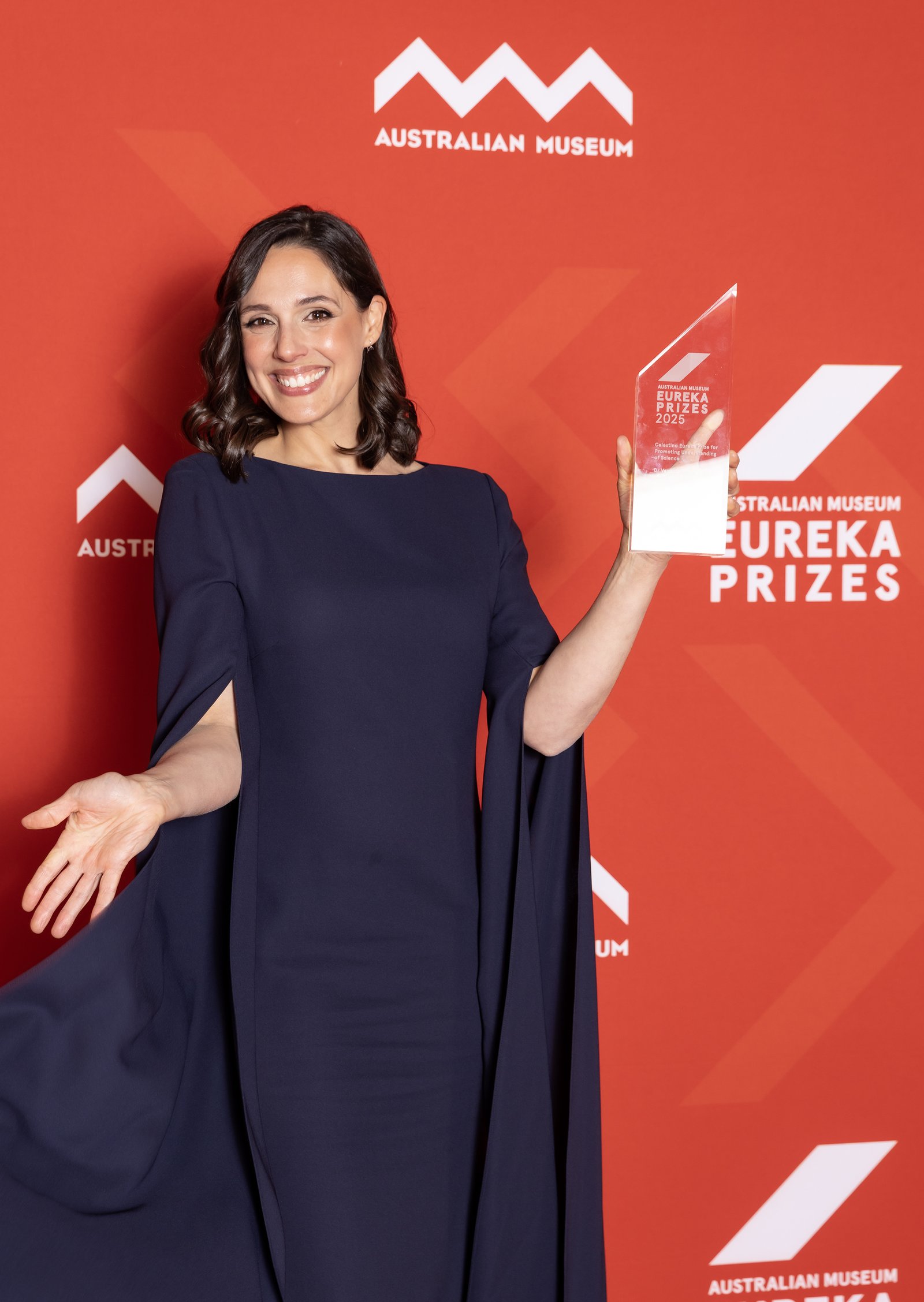
Dr Vanessa Pirotta at the 2025 Australian Museum Eureka Prizes Award Ceremony. Photo by Mel Koutchavlis
Image: Mel Koutchavlis© Mel Koutchavlis
What does winning a Eureka Prize mean to you?
I’m honoured to have been acknowledged in this way because it represents an acknowledgement at the highest level here in Australia for what I do as a scientist. This is particularly powerful as there have been times where I had doubt in myself when doing this. It reinforces just how important it is to be present and to share good science as a real-life scientist. This comes at a time where people digest information across various platforms. It is a real honour and a prestigious recognition of what I love doing - research and sharing science.
The Australian Museum Eureka Prizes are the country’s most comprehensive national science awards, honouring excellence across the areas of research & innovation, leadership, science engagement, and school science.
