
Crayfish
Australia has a large and unique crayfish fauna including the largest and smallest species in the world.

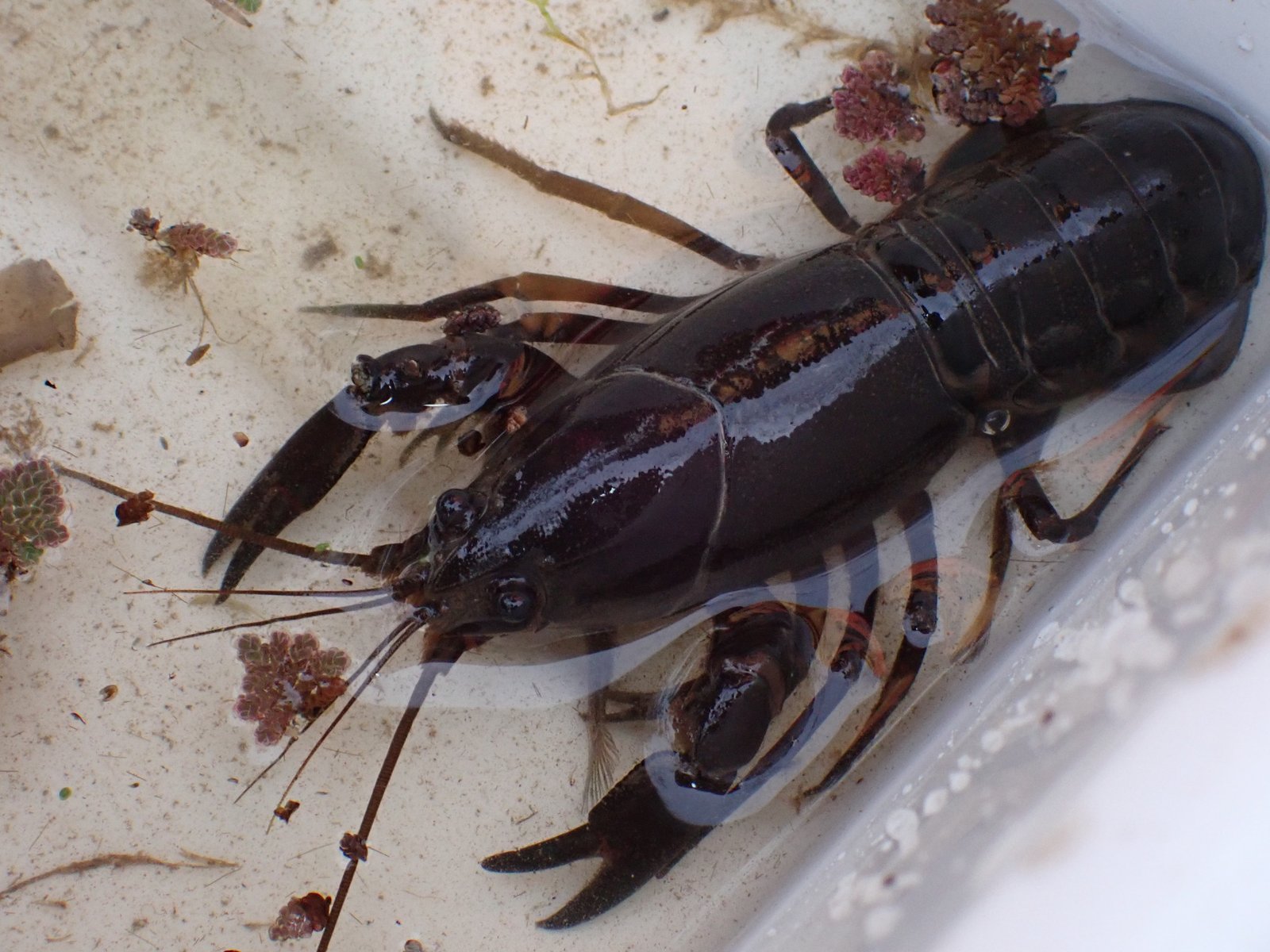
Crayfish are heavy bodied crustaceans with an enlarged, pincer-like first pair of legs.
They are known by many common names:
- 'yabby' in New South Wales and Victoria
- 'Koonac', 'Gilgie' and 'the Marron' in Western Australia
- 'Redclaw' in Queensland.

© Australian Museum
All freshwater crayfish in Australia belong to the Family Parastacidae. Australia's crayfish fauna are divided into nine genera (or groups of species), which include over 100 species.
Crayfish belong to a group of animals called Crustaceans and are part of the phylum Arthropoda. All Arthropods have a hardened outer shell, called cuticle (made from calcium carbonate) that acts as a skeleton.
Identification
Unlike other Arthropods, Crayfish have two pair of antennae - an outer pair called antennae, and an inner pair called antennules.
Crayfish bodies are divided into three parts:
- head
- thorax (with legs)
- abdomen (or tail).
The tail is edible in large crustaceans such as crayfish, prawns and lobsters.
Crayfish have a carapace or shield that projects backwards from the head and covers the thorax. It protects feather-like gills that branch off from the base of the legs. It also provides a water channel through which oxygenated water passes over the gills, enabling the crayfish to breathe.
Cherax species are the hardiest, and distinguishable by their smooth bodies and claws.
Crayfish are various colours:
- Yabbies - brown, green to pale blue with mottled claws
- Queensland Red Claw bright red patch on the outside of the large claw
- The Marron - dark brown, black or bright blue
Genus Euastacus
Commonly referred to as freshwater lobsters, spiny lobsters or spiny crayfish because their bodies are covered in large spines, particularly on the tail and the claws.
The Euastacus species come in an array of colours:
- Murray River Crayfish (Euastacus armatus) - green to green-brown body and large white spines on the tail and white claws.
- Lamington Plateau Crayfish (Euastacus sulcatus) - blue and white
- Euastacus suttoni - dark red, green or black body and red or orange claws to
- Large Sydney Crayfish (Euastacus spinifer) - dark green body, red tipped spines on the abdomen and blue tinged claws.
Size and diversity
The Giant Tasmanian Crayfish (Astacopsis gouldi) is not only the largest crayfish in the world but is also believed to be the largest freshwater crustacean. Although large animals are now rare, specimens have been recorded to weigh in excess of 6 kg, and measuring over 400 mm in length with claws longer than 150 mm.
An interesting genus found only in Queensland is Tenuibranchiurus. This genus includes the world's smallest crayfish, Tenuibranchiurus glypticus, which does not exceed 30 mm in length.
Habitat
Crayfish can be found in freshwater habitats such as rivers, streams, dams, lakes and swamps.
Cherax species are the best known crayfish and occur over the widest range, from northern, eastern and south-western Australia
Distribution
The yabby (Cherax destructor) has the largest range, occurring across most of Victoria, western New South Wales, south-western Queensland and eastern South Australia.
The second most widely distributed genus is Euastacus. It occurs from north Queensland throughout eastern and southern New South Wales, most of Victoria and southern South Australia. IEuastacus species generally prefer well oxygenated water and are often found in cooler, faster flowing mountain streams and rivers.
The third genus Astacopsis is found only in Tasmania and includes the Giant Tasmanian Crayfish (Astacopsis gouldi).
CC-BY-NC 4.0
Feeding and diet
They are mostly vegetarian and most active at night (nocturnal). They forage on the stream bed, eating water weeds and the decaying roots and leaves. Crayfish are opportunistic omnivores, which means they can eat almost anything including meat.
Behaviours and adaptations
Moulting to grow
Crayfish shed or moult their outer skin as they grow. Small crayfish moult every three to four weeks. As the animal ages, the length of time between each moult increases. Full grown animals will moult once a year. Most Cherax species are 15 to 20 cm long when they reach maturity.
When moulting, the crayfish stops eating and reduces activity. To moult their shell (ecdysis) crayfish split their tail along the back and flick off the old shell The head and claws are removed last. With the shell gone, crayfish are very soft and will hide until they have expanded into a new hardened shell.
Burrowing
All crayfish can burrow. Cherax destructor got its name because of the damage its causes burrowing in dam walls and levee banks. They tolerate poor water conditions and long periods of drought by burrowing to stay moist.
The genus Engaeus or Land Crayfish spend their whole life cycle in a burrow and have adapted their bodies to live in an enclosed space. They have a reduced tail, eyes and antenna, with a body size under 45 mm in length.
Burrows can be up to 10 metres long to reach the water table. At the entrance is a mud chimney that can range from a few centimetres to 40 cm in height.
Interactions with humans
Cherax are also the main species used in the rapidly growing aquaculture industry. They have a relatively rapid rate of growth and greater tolerances of larger temperature ranges and water conditions than many other crayfish.
The three main species used in yabby farming and found in pet shops in Australia are the Dam Yabby (Cherax destructor), the Marron Cherax tenuimanus from Western Australia, and the Queensland Red Claw (Cherax quadricarinatus).
Keeping crayfish as pets
Crayfish can be purchased from most pet shops. The only species sold as pets are the Dam Yabby, the Marron, and the Red Claw. These are hardy species that require little maintenance and will live from two to five years.
To set up an aquarium for crayfish you need a good aeration system, 3-5 cm of sand, some small pebbles and some large hollow or cavernous rocks which the crayfish can hide in during the day, and plenty of long water weeds.
Change the water every two to three months and add conditioners each time the water is changed. Do not leave uneaten food in the aquarium - in a couple of hours it will make the water bad. If your pet crayfish moults, leave the old shell in the tank so the crayfish can eat it as a source of calcium. Adding a small amount of calcium carbonate to the water will help strengthen the shell.
Do not over-stock your tank. Crayfish are very territorial and will kill or damage each other if placed in too small a tank. Each animal requires about 30 to 40 cm area with places to hide from the other crayfish.
References
- Carrol, P. N. (ed). 1980. A yabbie pot pourri. Hawkesbury Agricultural College, Richmond.
- Jones, D. & Morgan, G. 1994. A field guide to Crustaceans of Australian Waters, Reed (William Heinemann Australia), Sydney.
- Merrick, R. 1993. Freshwater Crayfishes of New South Wales. Linnean Society of New South Wales, Sydney.
- Williams, W.D. 1980. Australian Freshwater Life. The Invertebrates of Australian Inland Waters. Macmillan Company of Australia, Melbourne.
