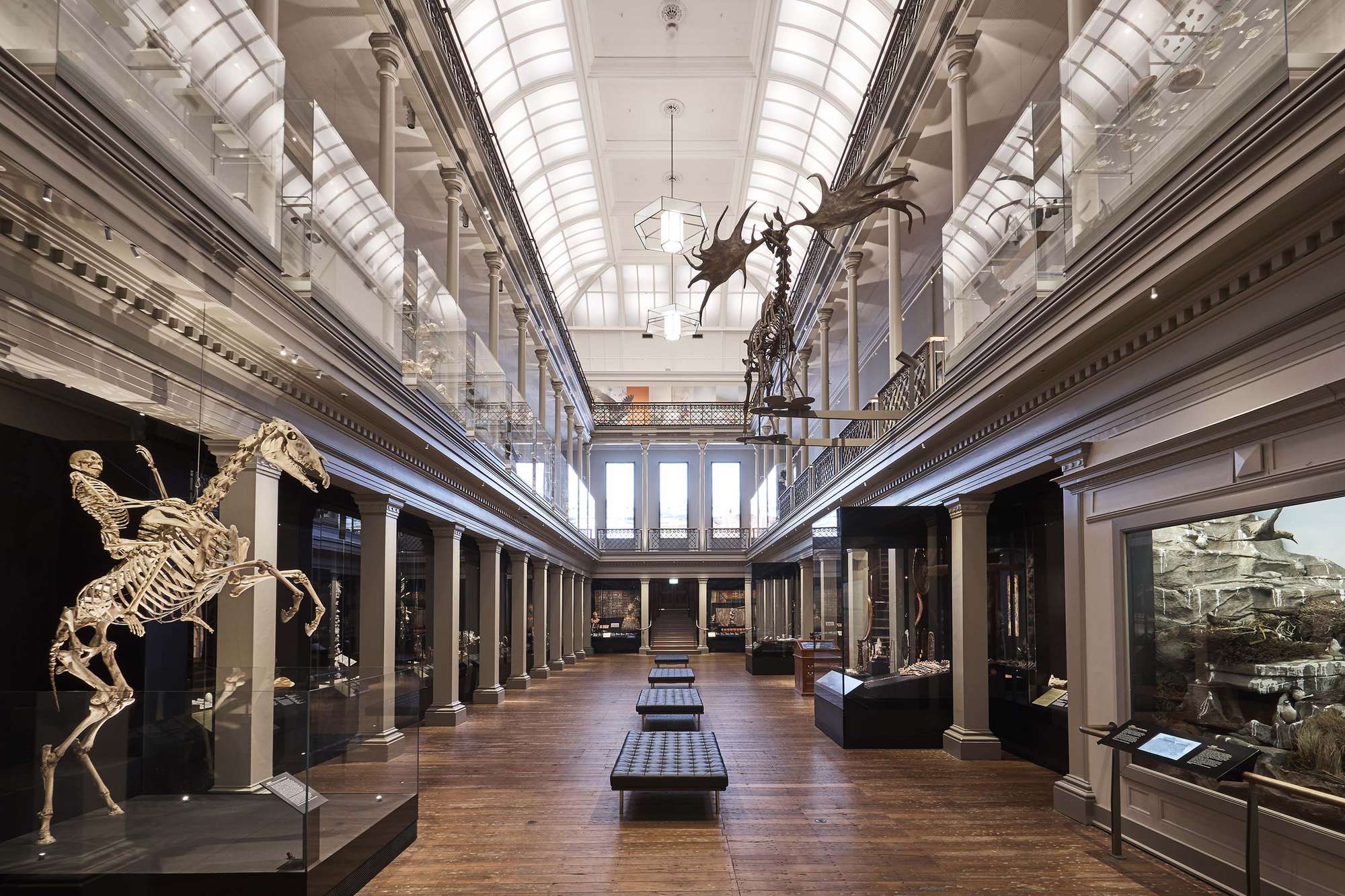
Raven Head Mask case
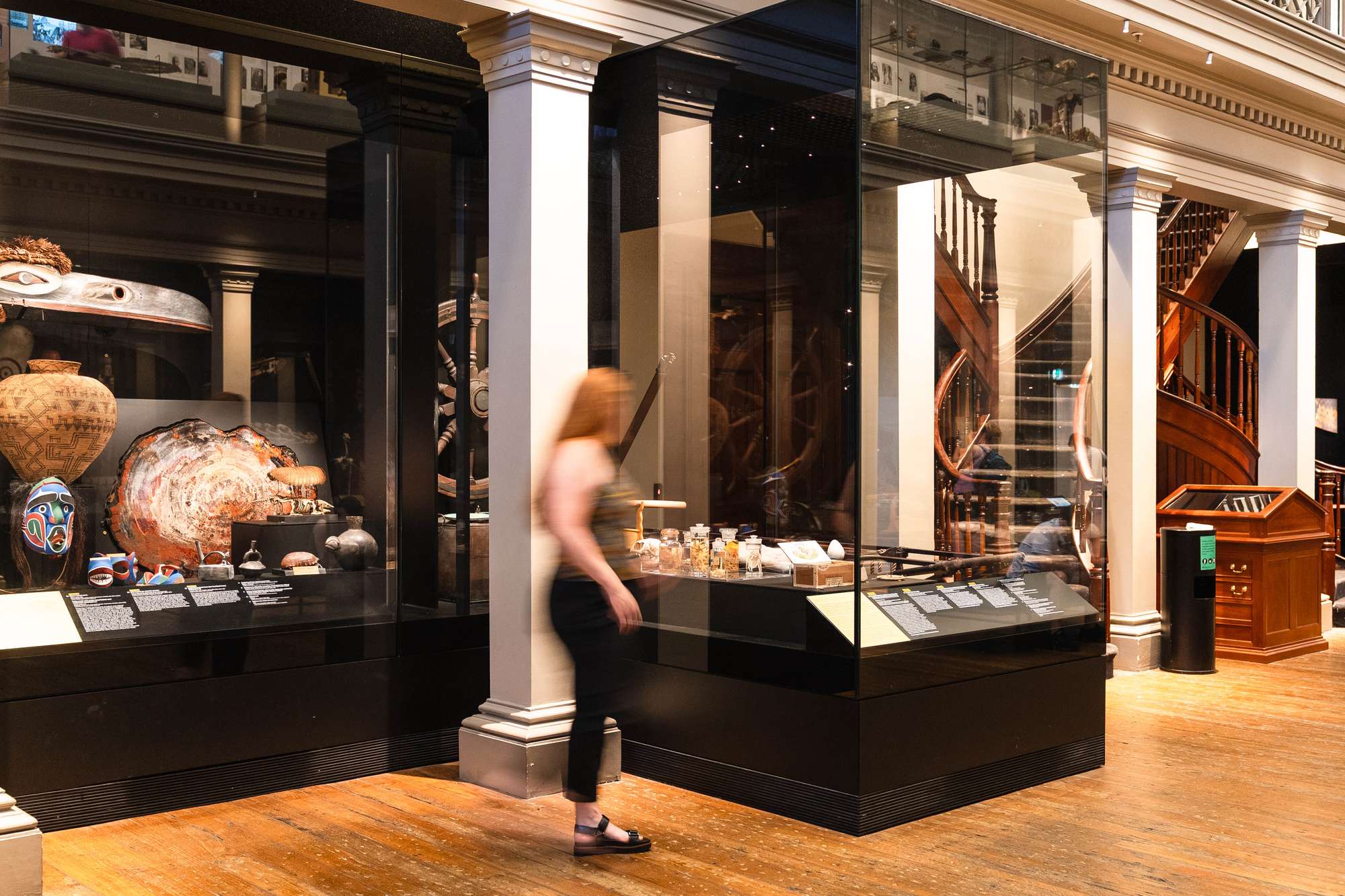
From a ceremonial Kwa-guilth mask to a coiled Apache basket and a 225-million-year-old slice of petrified forest, this case brings together remarkable objects from across the Americas, each with an extraordinary story to tell.
Story of the case
Listen to the audio guide of the Raven Head Mask case.
Audio Transcript
The Museum’s connections with the Americas are long-standing, and have produced many weird and wonderful stories as well as treasures of cultural and natural history.
In 1910, a group of Indigenous Canadian performers was brought to Australia for a Wild West-style show. When the venture failed, their costumes and artefacts were sold to help fund their return to Canada. A dealer sold this collection to the Museum in 1912, including the large raven head mask hanging in this showcase.
Along with the other items in the collection, this mask was made for traditional ceremonial use at a time when the Canadian government was trying to stamp out indigenous practices.
More recently, the mask’s sad story of cultural dispossession received a more hopeful chapter. In 1987, the Museum began working with the Canadian Museum of History and the Kwa-guilth people of Canada’s west coast to repatriate some of these rare artefacts. In return, the Museum received several new objects commissioned from contemporary Kwa-guilth artists Calvin and Richard Hunt. These included the colourful mask on the bottom left, known as an echo mask. Echo masks have interchangeable mouthpieces to allow the wearer to transform into different creatures during a ceremonial dance.
At the rear of the showcase, a polished slice of jasperised wood is a North American treasure of a different sort. Created by a process of natural transformation, it comes from the Petrified Forest National Park in northeast Arizona. Now semi-arid and almost treeless, about 225 million years ago the area was covered in a forest of tall conifers. Periodically, fallen trees were buried in volcanic ash, protecting the wood from the air. Groundwater dissolved silica from the ash and carried it into the wood, where it formed crystals that replaced the cellulose cell by cell. Traces of iron oxide and other minerals combined with the silica to create the wood’s varied colours.
Olla basket made by Apache people
This sturdy, coiled basket was made by the Western Apache people in about 1900. Baskets like this, called olla – a word meaning ‘pot’ and adopted from Spanish – were used to store food and other dry goods. They are woven from the fibres of the willow tree and the strong, thorned wood of a plant known as devil’s claw, both of which are native to Central Arizona. The basket is remarkable for both its quality and size – it is estimated that it would have taken up to a year to complete. Its' intricate design includes motifs of animals, probably coyotes or wolves, and crisscrossing triangular and cruciform shapes, with strong vertical lines that contrast with the horizontal weave of the basket itself. Basket-making among the Western Apache at that time was marked by changes in coiling technique and overall high quality. Their production ended in the early twentieth century.
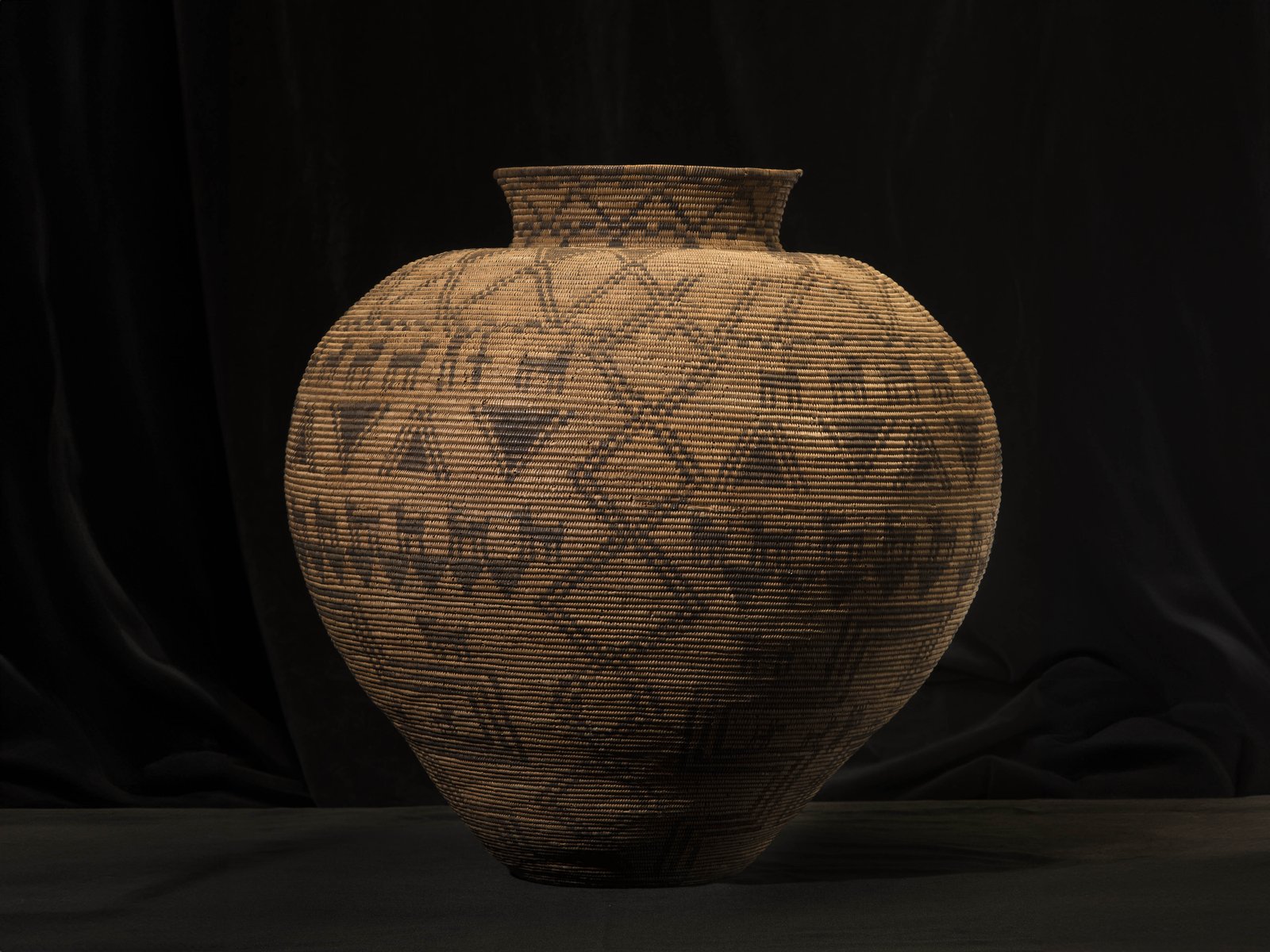
Olla basket. Made by Apache people. Coiled willow fibre, devil’s claw plant, yucca root dye. 55 (high) x 51 (wide) cm. Central Arizona, USA c1900. Donated by Mrs A.B. Golby, 1950. AM American Collection. E053632.
Image: Stuart Humphreys © Australian MuseumAM Treasure Circle
Interested in supporting this treasure? Contact the Australian Museum Foundation to discover how.
Jasperised wood from the Petrified Forest National Park, Arizona
This polished, richly hued slice of jasperised wood is from the Petrified Forest National Park, which covers parts of Navajo and Apache Counties in north-eastern Arizona. In particular, it is from the Chinle Formation, which is tinted by iron oxides. The tree from which it came, Araucarioxylon arizonicum, grew in the Late Triassic, about 225 million years ago. It was turned to stone after the forest became buried under ash deposited over wide areas by volcanic eruptions common at that time. The settled ash sealed the wood, protecting it from oxidisation and, in turn, decomposition. Silica leached from the sediments, infiltrated the wood and transformed it cell by cell from cellulose to silica in a process known as permineralisation.
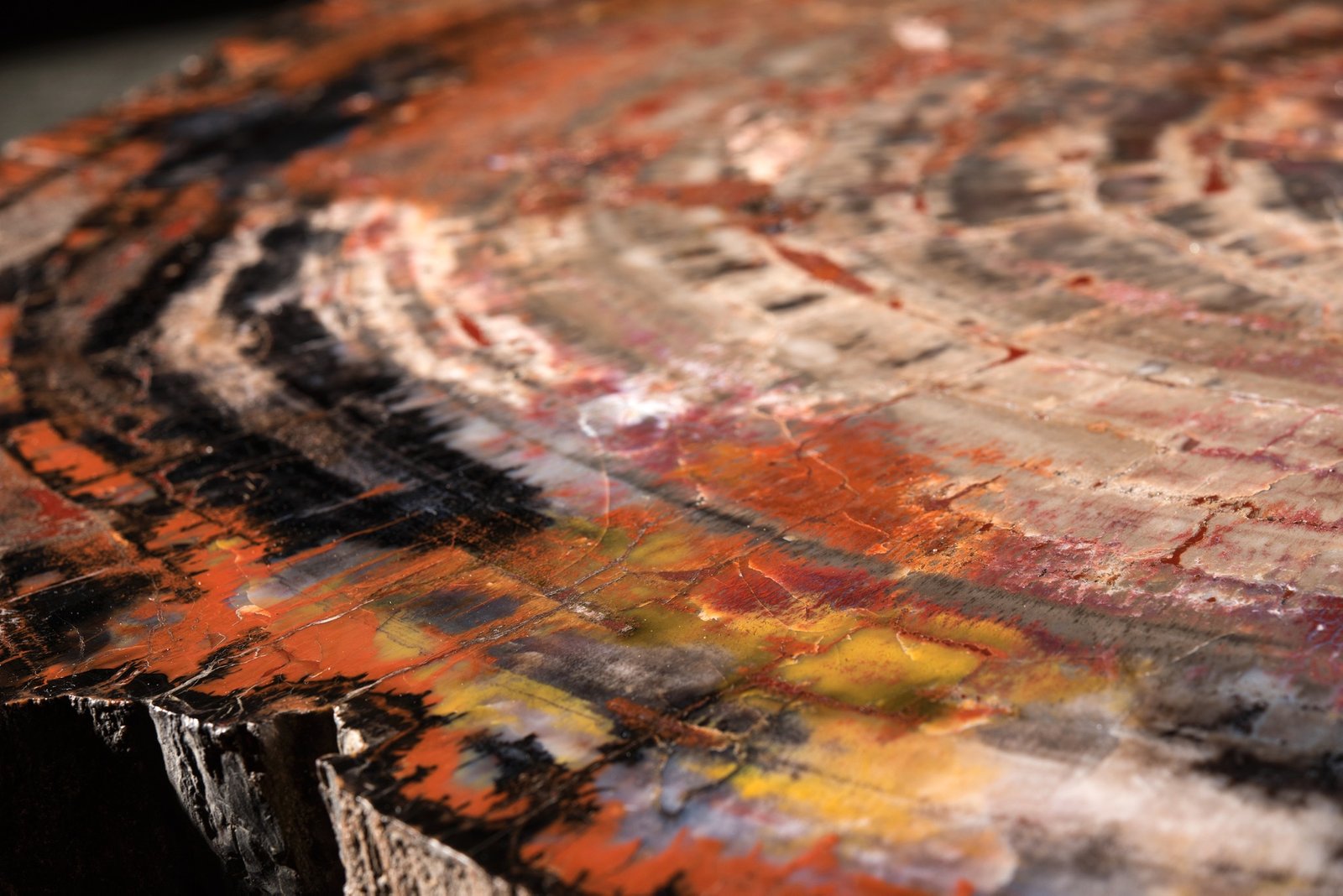
Jasperised wood from the Petrified Forest National Park, Arizona. 3.5 (high) x 111 (wide) x 84 (deep) cm. Petrified Forest National Park, Arizona, USA. Late Triassic (c225 million years ago). Purchased 1984. AM Mineralogy Collection. D.47884
Image: Stuart Humphreys © Australian MuseumAM Treasure Circle
Interested in supporting this treasure? Contact the Australian Museum Foundation to discover how.