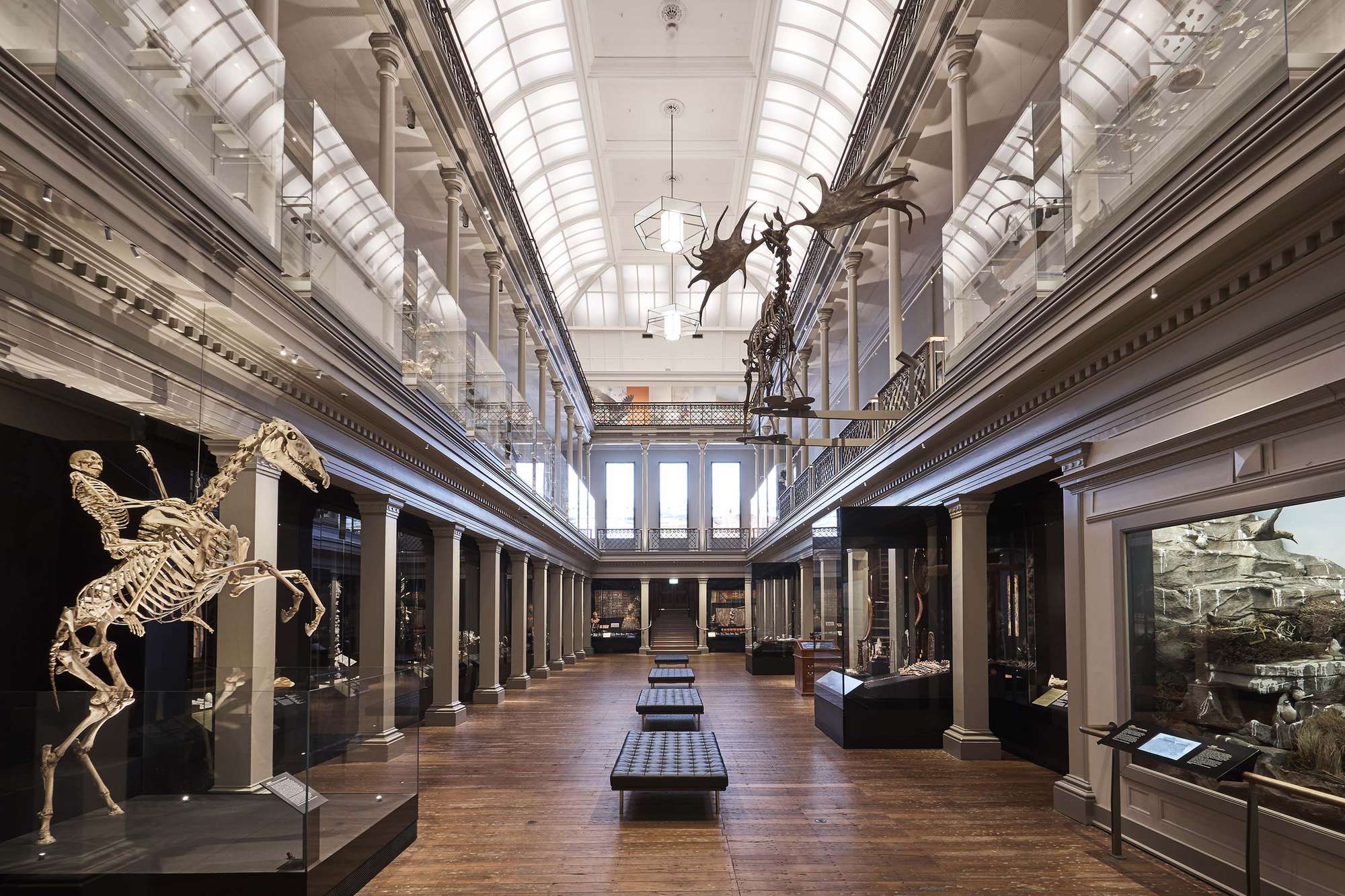
Rainforest Shields case
Beautiful rainforest shields made by the Koko-Yellani people of Cape York sit alongside remarkable iridescent Morpho butterflies, larval reef fish and the only Australian mainland bird to become extinct since European arrival.
Story of the case
Listen to the audio guide of the Rainforest Shields case.
Audio Transcript
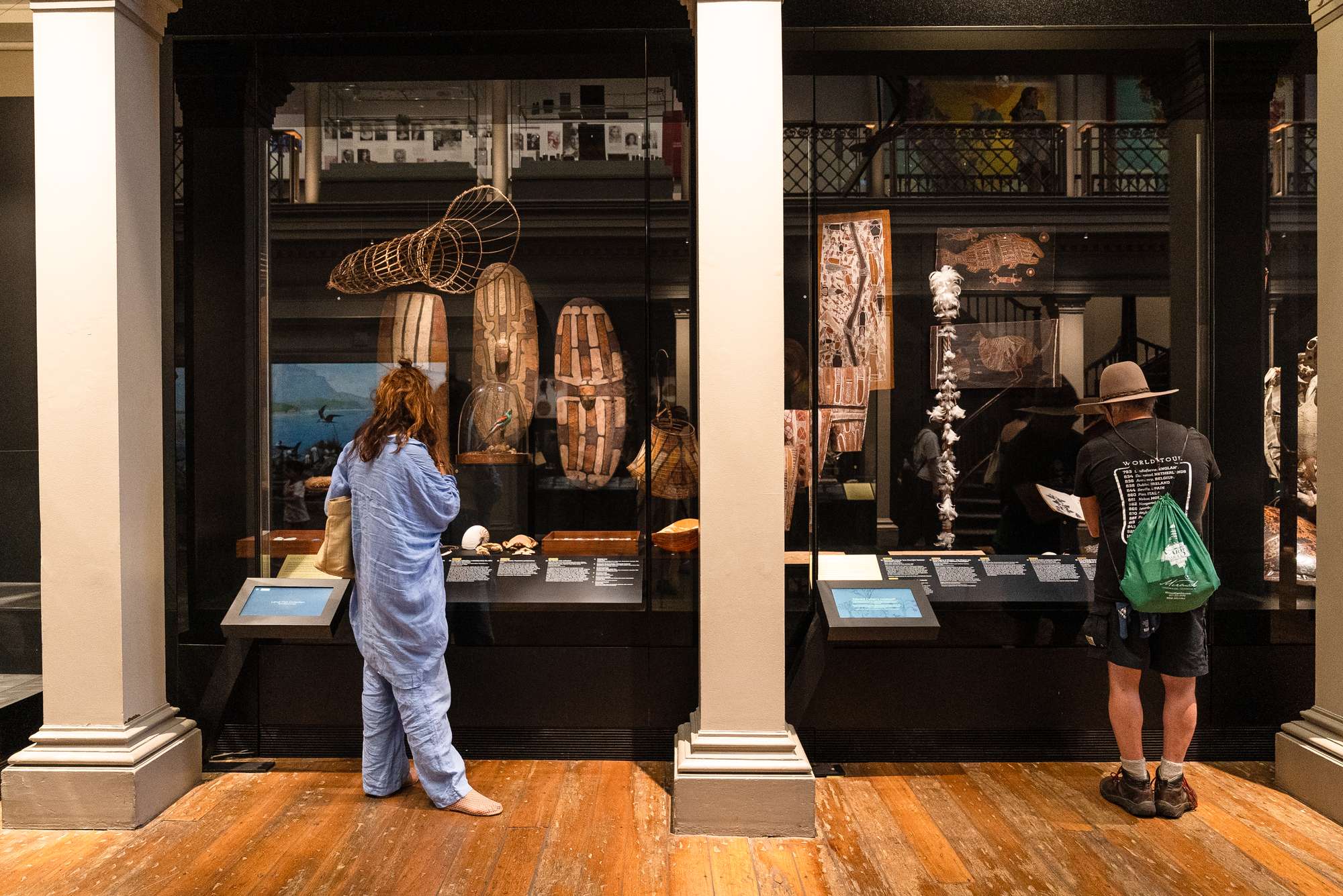
The objects in this showcase all come from tropical North Queensland, one of the world’s most biodiverse regions.
Aboriginal people lived within this extraordinary environment for thousands of years. They had extensive knowledge about local plants and animals – the foods and medicines they provided, and the tools into which they could be turned. These three shields were made by the Koko-Yellani people of Cape York, who cut them from the wood of rainforest fig trees and painted them with natural pigments taken from the environment around them. Above the shields is a wallaby trap woven from lawyer cane, a vine endemic to North Queensland’s rainforests.
Like the Koko-Yellani, we are all dependent on the environment for our most basic needs, such as food, water and shelter. Yet only now are we coming to understand the significance of our biodiversity and the need to protect it from adverse human impact.
Standing resplendent under the glass dome in the centre is a taxidermied specimen of the Paradise Parrot. It is likely to be the only example of this species you will ever see: the Paradise Parrot is the only mainland bird to have become extinct since the arrival of Europeans in Australia. Last seen alive in 1927, the bird’s demise is thought to have been caused by habitat loss, the introduction of cats and dogs, and hunting by bird collectors.
At the front of the showcase, small jars hold fish larvae collected along Australia’s east coast. These are just a few of the more than one million larval fish in the Museum’s collection. Today, scientists at the Museum’s Lizard Island research station are investigating the habits of larval fish. This will help us understand how Australia’s fish populations are naturally maintained, and to protect habitat around important fish nurseries.
Lamond collection drawer
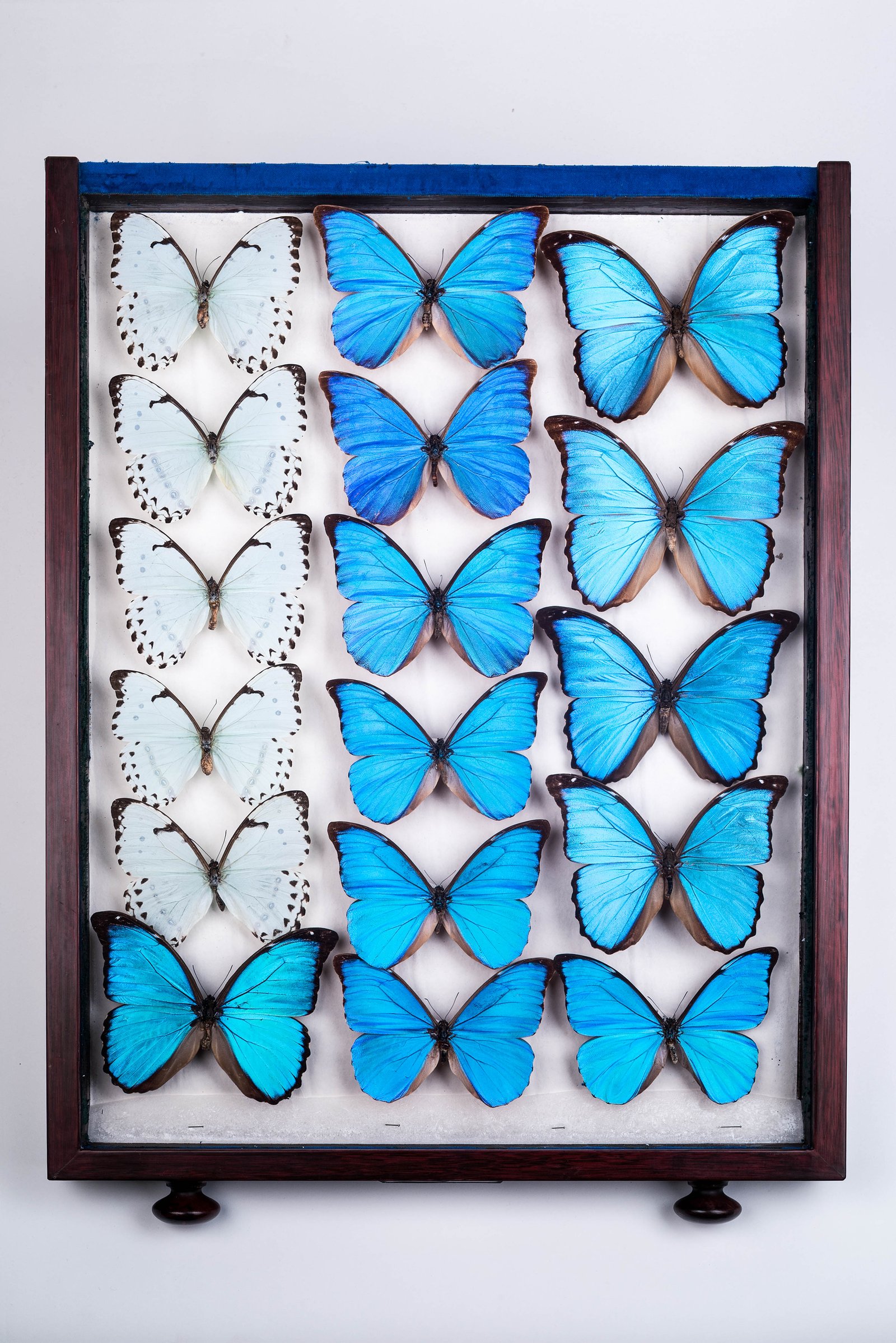
Lamond collection drawer, Morpho spp. (Nymphalidae). 61 (long) x 45.5 (wide) x 5.5 (deep) cm. Brazil. Various dates. Donated 1994. AM Entomology Collection. K.446318 – Drawer 7 (of 24).
Image: Stuart Humphreys © Australian MuseumMorpho spp. (Nymphalidae)
The drawer shown is a collection of Morpho butterflies from Brazil. The iridescent colour of the blue Morpho is due to the fine structure of the wing scales. They are part of a collection of almost 7000 butterfly and beetle specimens donated by Stephen Lamond to the Australian Museum in 1994. He presented the specimens – collected from all over the world – in a 24-drawer cabinet he himself constructed. Stephen is an amateur collector based in northern Queensland, and assembled the collection over 20 years through personal collection and exchange. Stephen donated this collection under the Cultural Gifts Program. Some of the specimens in this collection are extremely rare and, because of their quality and size, are considered very valuable on the open market.
AM Treasure Circle
Treasure supported by Memocorp Australia Pty Ltd.
Larval fish collection
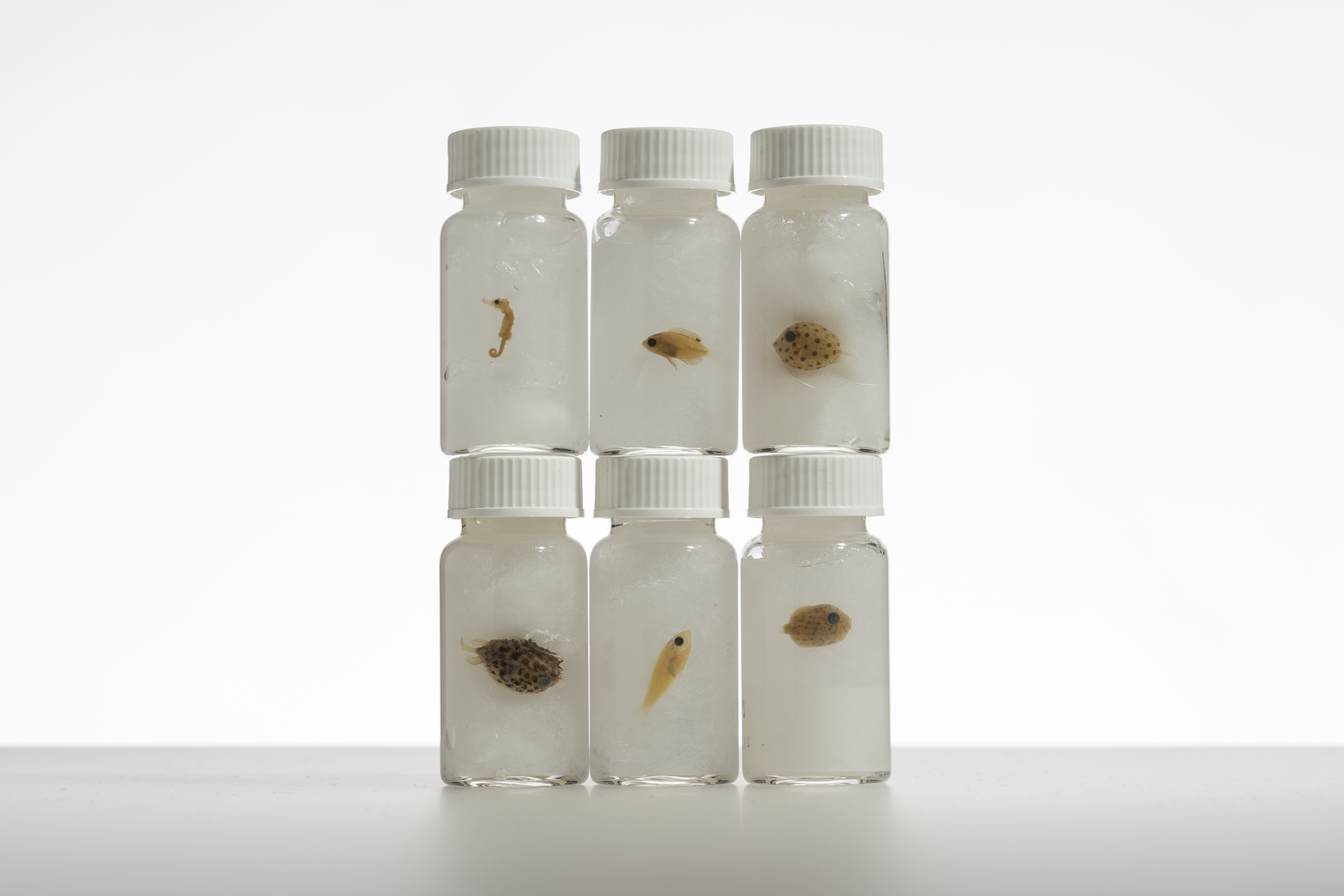
Larval fish collection. Size of specimens 7–15 mm (standard length). Various locations, ranging from Lizard Island, QLD, to Ulladulla, NSW. 1979–97. Combination of donated and collected by Australian Museum scientists. AM Ichthyology Collection. I39203-009, I22633-021, I24427-001, I28622-029, I41397-055, I41397-056.
Image: Stuart Humphreys © Australian MuseumWhen the larvae of reef fish hatch from eggs – usually in open water, far from the reefs in which they will live as adults – they are only a few millimetres long. They are also very different in appearance and behaviour from their fully grown counterparts, making it difficult for scientists to match them to their adult species. Despite their miniscule size, a 1-cm-long fish larva can swim more than one kilometre per hour, or 28 body lengths per second, and can use sound to navigate and odour to find a specific habitat to settle in. Research into the habits of these baby fish, by scientists based at the Australian Museum’s Lizard Island Research Station, helps determine how fisheries and marine parks are designed and operated, to ensure the future vitality of reef fish populations. There are more than a million Larval fish in the Australian Museum’s collection.
AM Treasure Circle
Interested in supporting this Treasure? Contact the Australian Museum Foundation to discover how.
Paradise Parrot
Psephotellus pulcherrimus
The Paradise Parrot holds the dubious distinction of being the only Australian mainland bird to have become extinct since the arrival of Europeans in Australia. The last sighting of the bird was in 1927, in southern Queensland. Extensive searches in the years since have proved fruitless. Paradise Parrots were known for their extraordinarily beautiful plumage, a mixture of turquoise, scarlet, black and brown, and their unusually long tail. They spent most of their time at or near ground level, making their nests in hollowed-out termite mounds and living in small family groups. It is speculated that overgrazing, land-clearing, the introduction of cats and dogs and hunting by bird collectors led to the species’ demise. There are very few specimens of Paradise Parrots in museums around the world.

Paradise Parrot (Psephotellus pulcherrimus). 44 (high) x 35 (wide) x 17 (deep) cm. Donated by the estate of Sir Edward Hallstrom, 1970. AM Ornithology Collection. O43861.
Image: Stuart Humphreys © Australian MuseumAM Treasure Circle
Treasure supported by The Carrawa Foundation.
Mel Ward’s crab collection
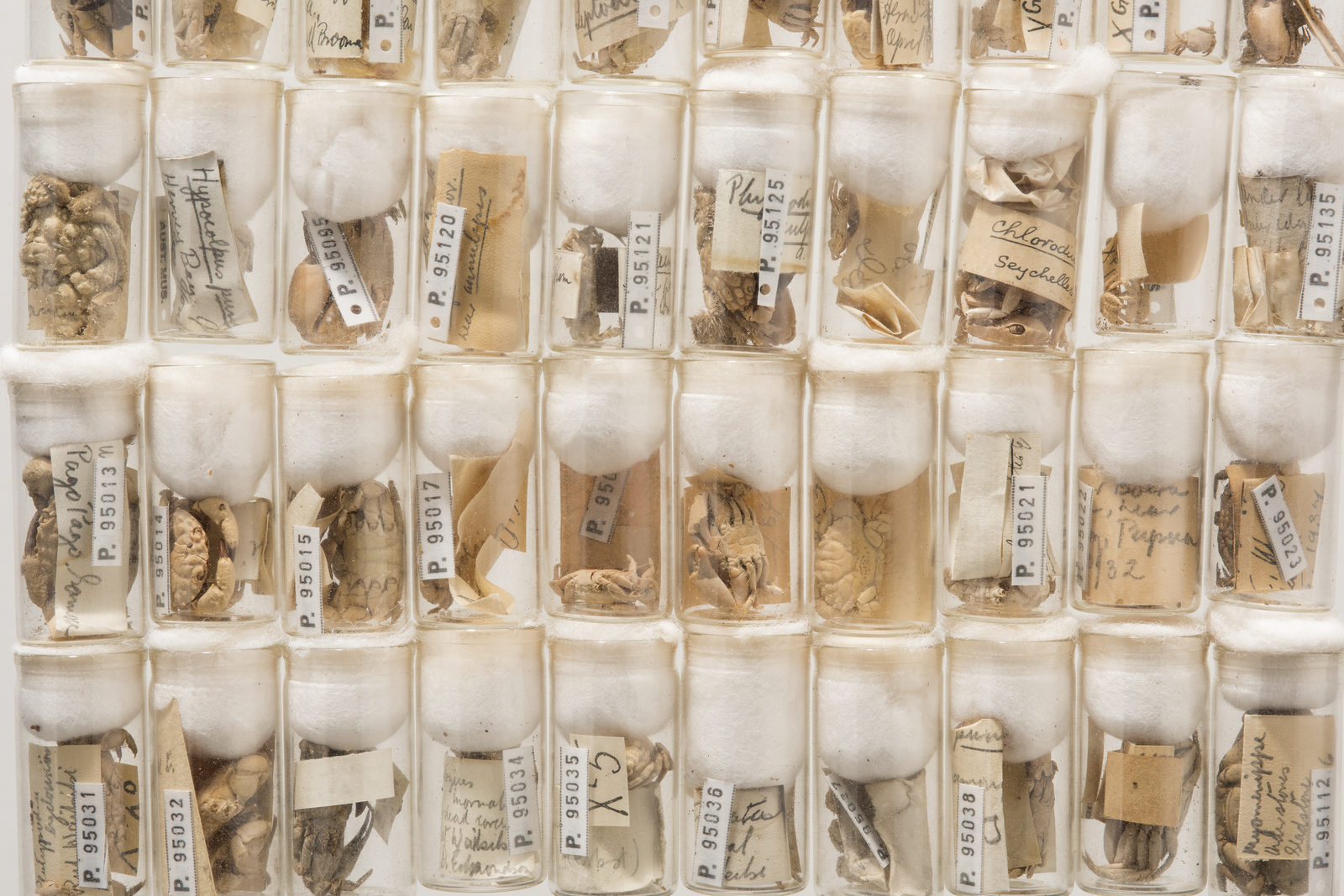
Mel Ward’s crab collection. Box of tubes of various small species. Single tubes: large 7.6 (high) x 2.5 (wide) cm; medium 5 (high) x 2.5 (wide) cm; small 4.5 (high) x 1.5 (wide) cm. Worldwide Collected by Charles Melbourne Ward, 1926–66. Donated 1970. Registered 2003–16. AM Marine Invertebrates Collection.
Image: Stuart Humphreys © Australian MuseumCharles Melbourne (Mel) Ward was a polymath who started his career captivating audiences as an acrobatic dancer and comedian on the stage. Since boyhood, the talented thespian was also fascinated by crabs. After discovering a new species on a Queensland beach – subsequently named after him by the American Museum of Natural History – he left the stage and in 1929 became an honorary zoologist at the Australian Museum. After his death in 1966, his substantial collection of around 25,000 crabs was bequeathed to the Museum. Recently, the Museum’s Digital Volunteer program catalogued a large portion of the collection online, making Ward’s important contribution accessible to audiences around the world.
AM Treasure Circle
Interested in supporting this Treasure? Contact the Australian Museum Foundation to discover how.