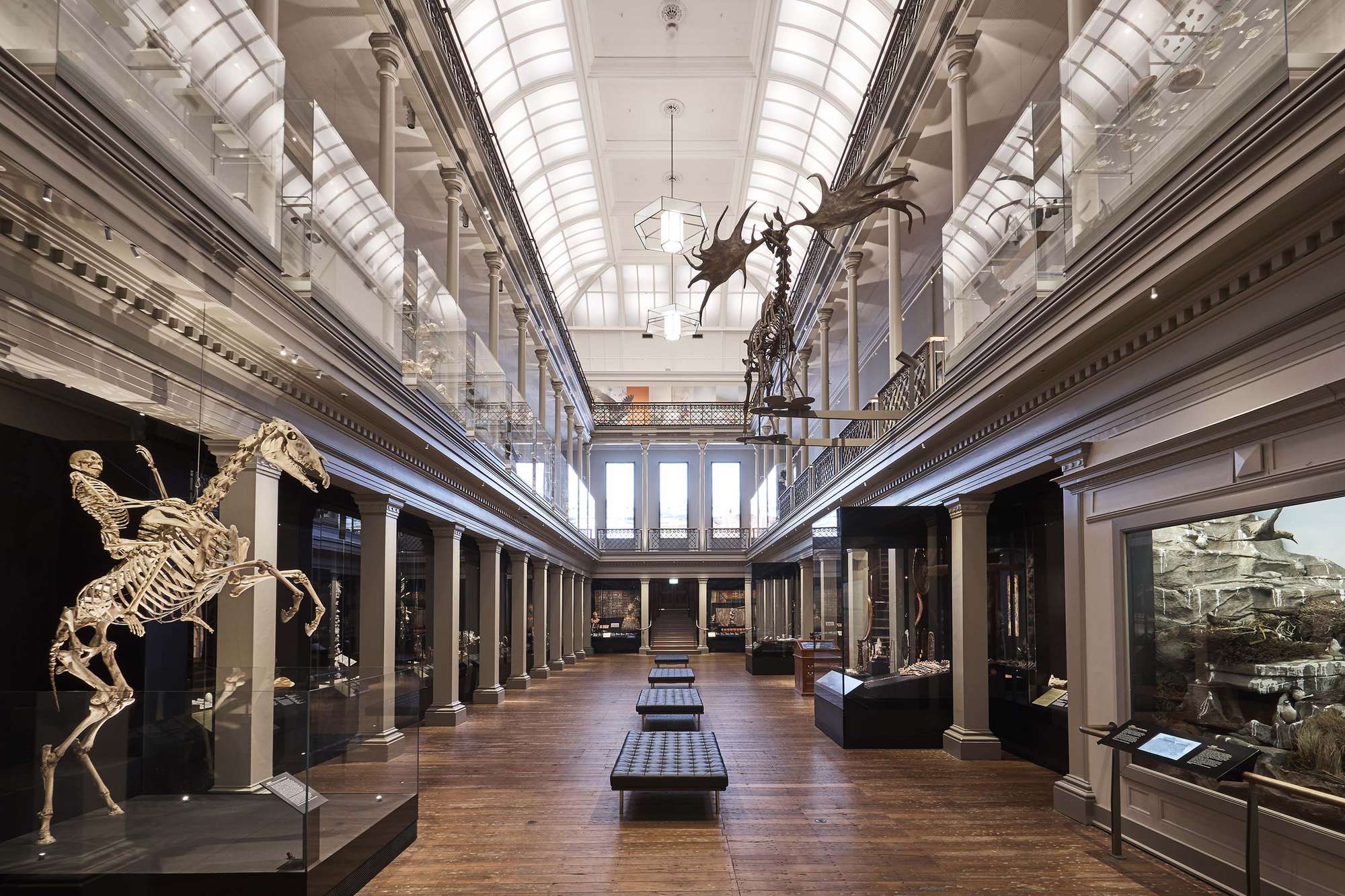
Krefft's Chair case
When curator Gerard Krefft was dismissed in 1874, he barricaded himself inside the Museum and had to be physically carried out - reportedly still seated in this chair. Discover the objects that defined a pivotal era in Australian natural history.
Story of the case
Listen to the audio guide of the Krefft's Chair case.
Audio Transcript
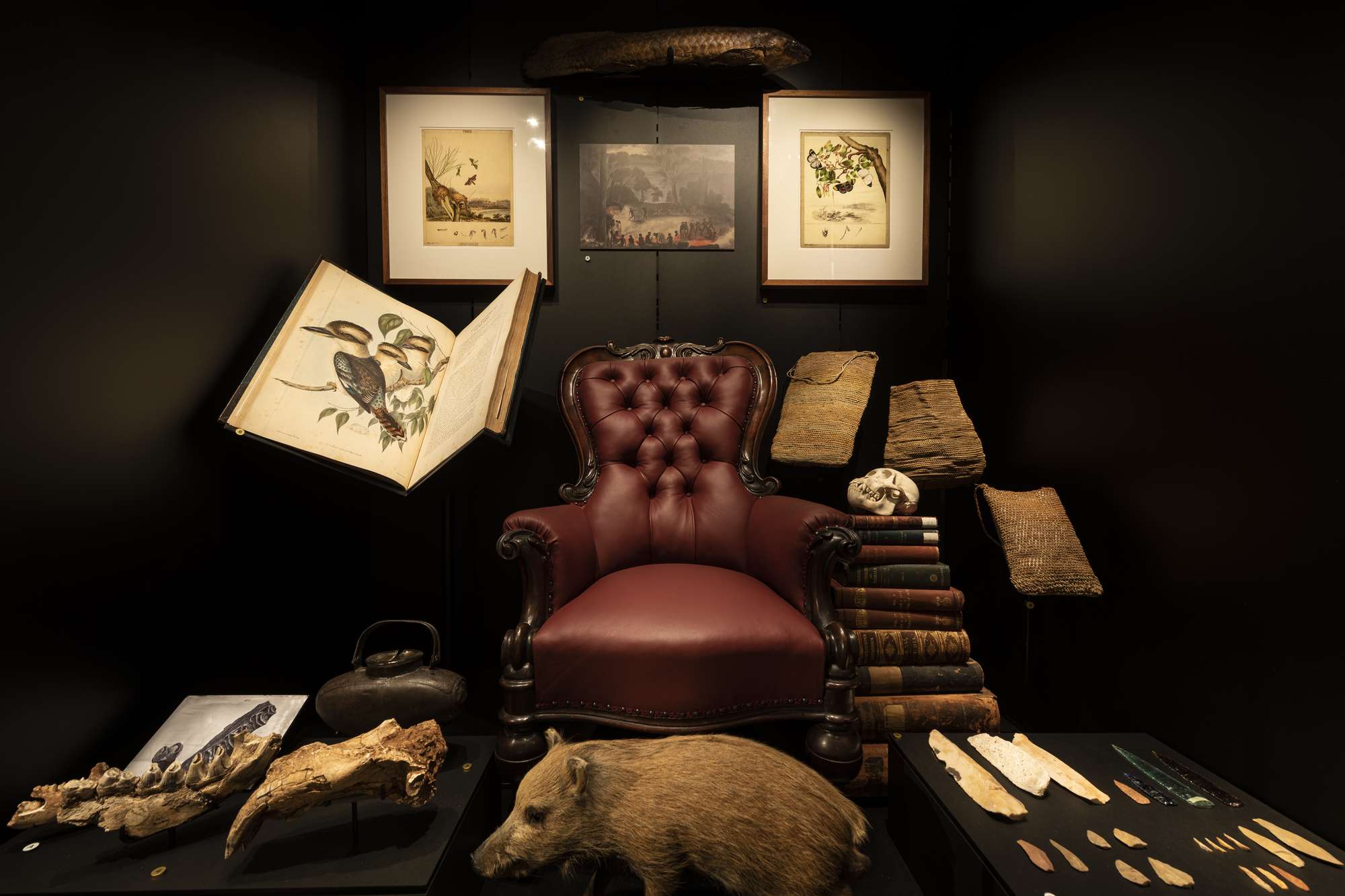
A single wooden chair from a small museum in a far-off colony may seem an unlikely object to tell a story of global scientific upheaval. It belonged to Gerard Krefft, curator of the Museum from 1864 to 1874 and a central figure in Australian science in the 19th century.
Krefft was a renowned zoologist, a prolific specimen collector, and an accomplished scientific illustrator. But his support for Darwin’s theory of evolution saw him come into conflict with many of the Museum’s trustees and he was dismissed in 1874. Refusing to leave, he barricaded himself in his living quarters in the Museum. Edward Smith-Hall, a trustee, hired two prize fighters to carry him out, still seated in this chair.
Australia’s unique wildlife and geology had become a focus of growing scientific interest since its colonisation by the British. To the left of the chair is a small bottle used by Joseph Banks and Daniel Solander to collect some of the first wildlife specimens to be sent from Australia to England. It is one of the few surviving relics from Captain Cook’s first voyage to Australia on the Endeavour in 1770.
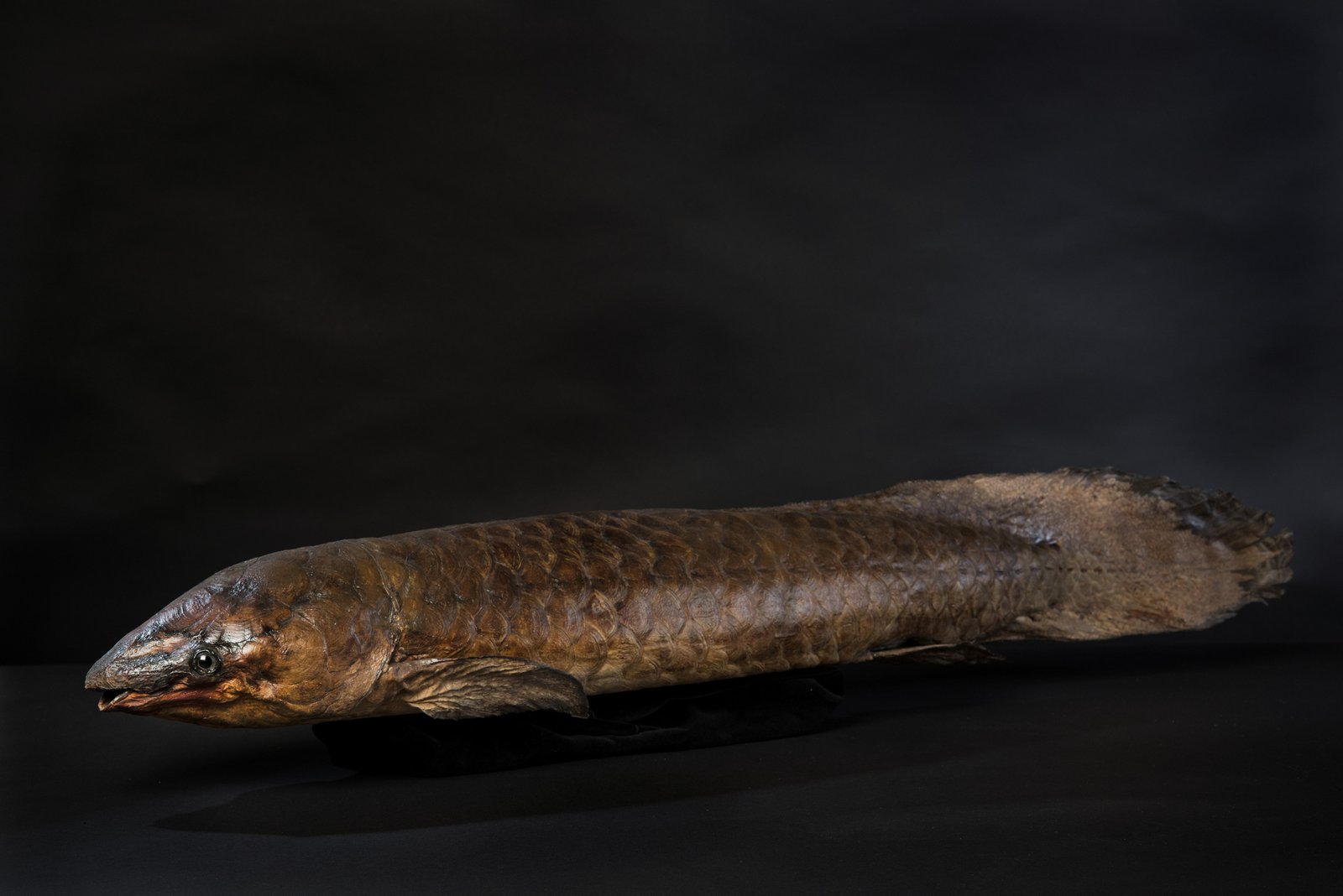
Above the chair is an Australian Lungfish, first identified as a separate species in 1870 by Gerard Krefft. The Australian Lungfish has a single lung which enables it to breathe air when its river habitat becomes stagnant and restricted. Krefft suggested that the lungfish could be the missing link between fishes and amphibians.
Scientific illustration plays a fundamental role in the spread of knowledge by allowing those with no access to specimens to see a species’ distinguishing features. Above Krefft’s chair hang two illustrations produced by sisters Harriet and Helena Scott, two of 19th-century Australia’s most accomplished natural history illustrators. The paintings they made for their father’s book on Australia’s butterflies and moths secured their reputations, and soon they were producing nearly all the scientific illustrations in Sydney. At a time when education for women was limited, the sisters gained the necessary knowledge of botany and zoology from their father.
Krefft's Chair
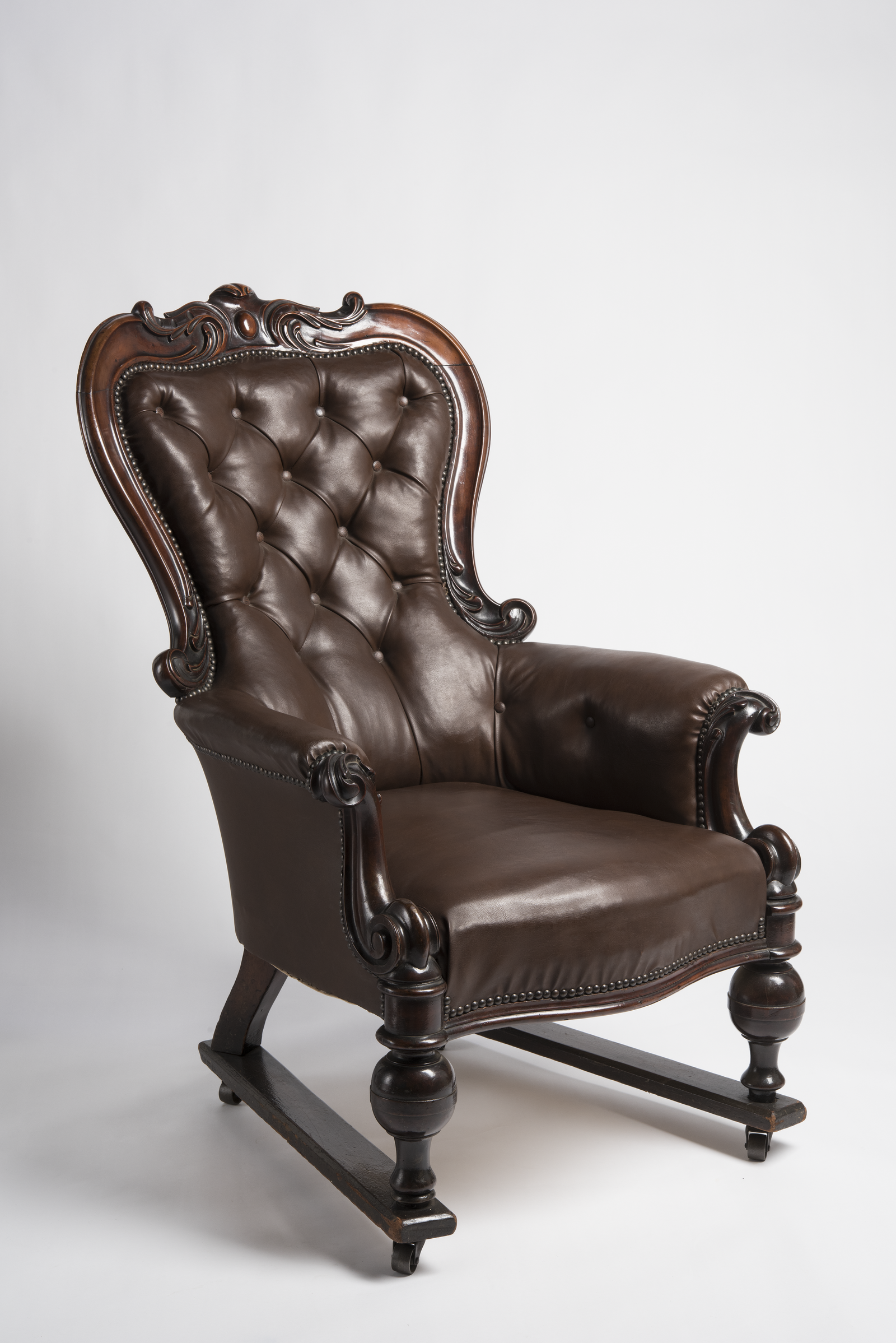
Krefft's Chair. Victorian gentleman’s armchair in Louis XIV style. Cedar, leather 110 (high) x 71 (wide, to edge of arms) x 90 (deep) cm. Sydney, NSW, 1860s. AM Archives, Rare Books and Library Collections. MA361.
Image: Stuart Humphreys © Australian MuseumJohann Ludwig Gerard Krefft was a brilliant but irascible scientist who was the Curator of the Australian Museum from 1864 until his dismissal in 1874. Originally from Germany, Krefft, a talented scientific illustrator, made significant contributions to natural science, discovering extraordinary species such as the Australian Lungfish and publishing a great number of books and papers about Australian snakes, rocks, minerals and fossils. He was also an early exponent of Darwin’s theory of evolution. Krefft’s dismissal stemmed from disputes with some of the Museum’s trustees, who disagreed with him on a number of important matters. Krefft reacted to the news of his dismissal by barricading himself inside the Museum. Edward Smith-Hall, a trustee, hired two prize-fighters to break into Krefft’s living quarters and carry him out, supposedly still seated in this chair.
AM Treasure Circle
Treasure supported by Professor Jan Scott and her friends Jack, Sissi, Coquohalla and Otis.
Upper incisors and lower jaw of Diprotodon optatum
Diprotodon optatum was the largest marsupial that ever lived. This Australian megafauna was a heavily built herbivore that resembled an enormous wombat. Nearly 3 metres long and about 2 metres high at the shoulder, it weighed 2-3 tonnes. Diprotodon was also the first fossil mammal from Australia named by the eminent English paleontologist Sir Richard Own in 1838.
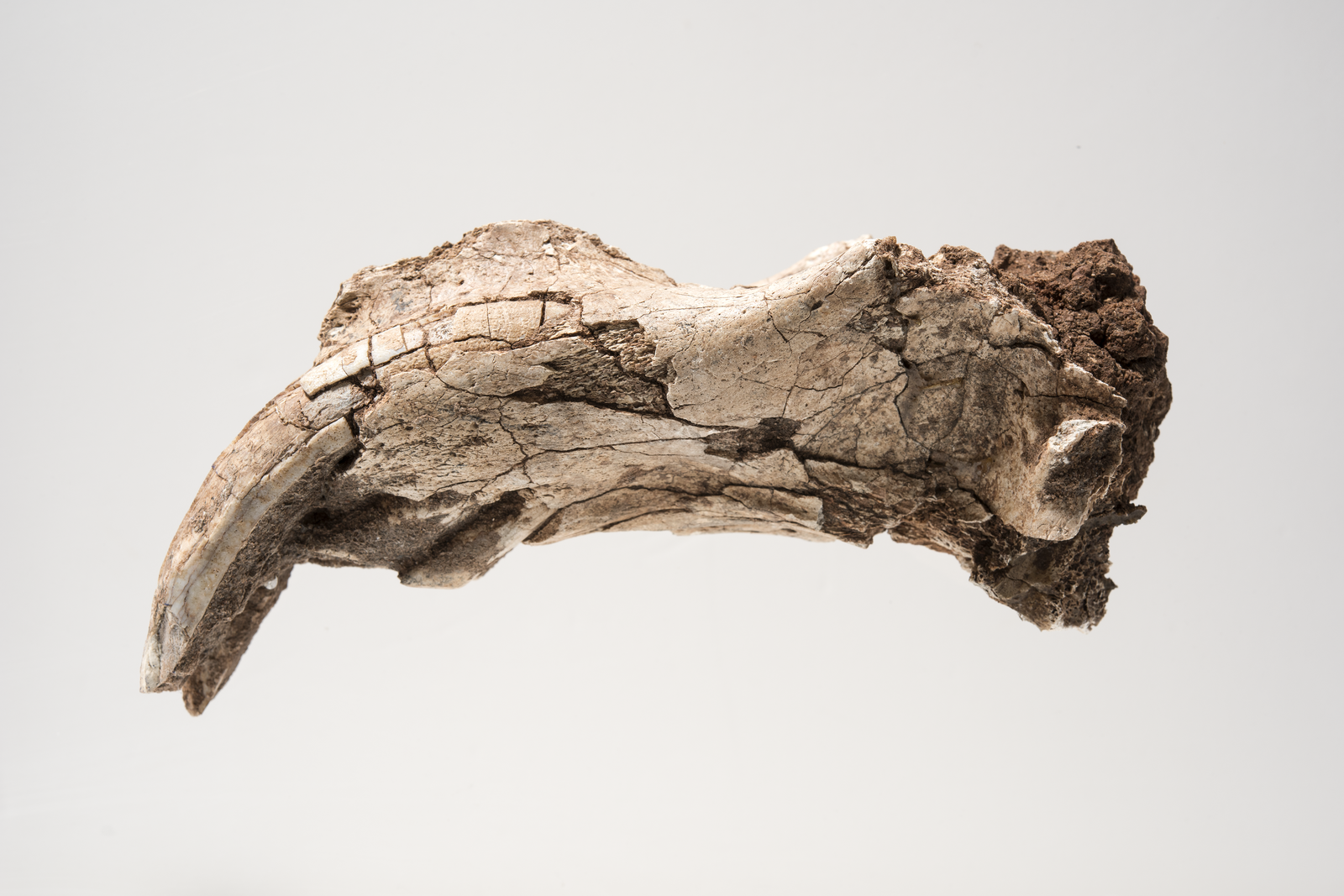
Diprotodon optatum. Upper incisors, 12 (high) x 26 (wide) x 11 (deep) cm. NSW. Collected by T. Rich, 1976. AM Palaeontology Collections. F86944.
Image: Stuart Humphreys © Australian MuseumThe name Diprotodon means ‘two front teeth’ in Greek, referring to its enlarged incisors, adapted for eating tough plant material. Fossils of this browsing giant, including complete skeletons and trackways, have been discovered at many sites throughout Australia. Diprotodon lived in open woodlands and grasslands during the Pleistocene and became extinct around 35,000 - 40,000 years ago. This creature would have co-existed with humans, but the cause of its decline and extinction are still hotly debated. The closest living relative of Diprotodon are the koalas and wombats.
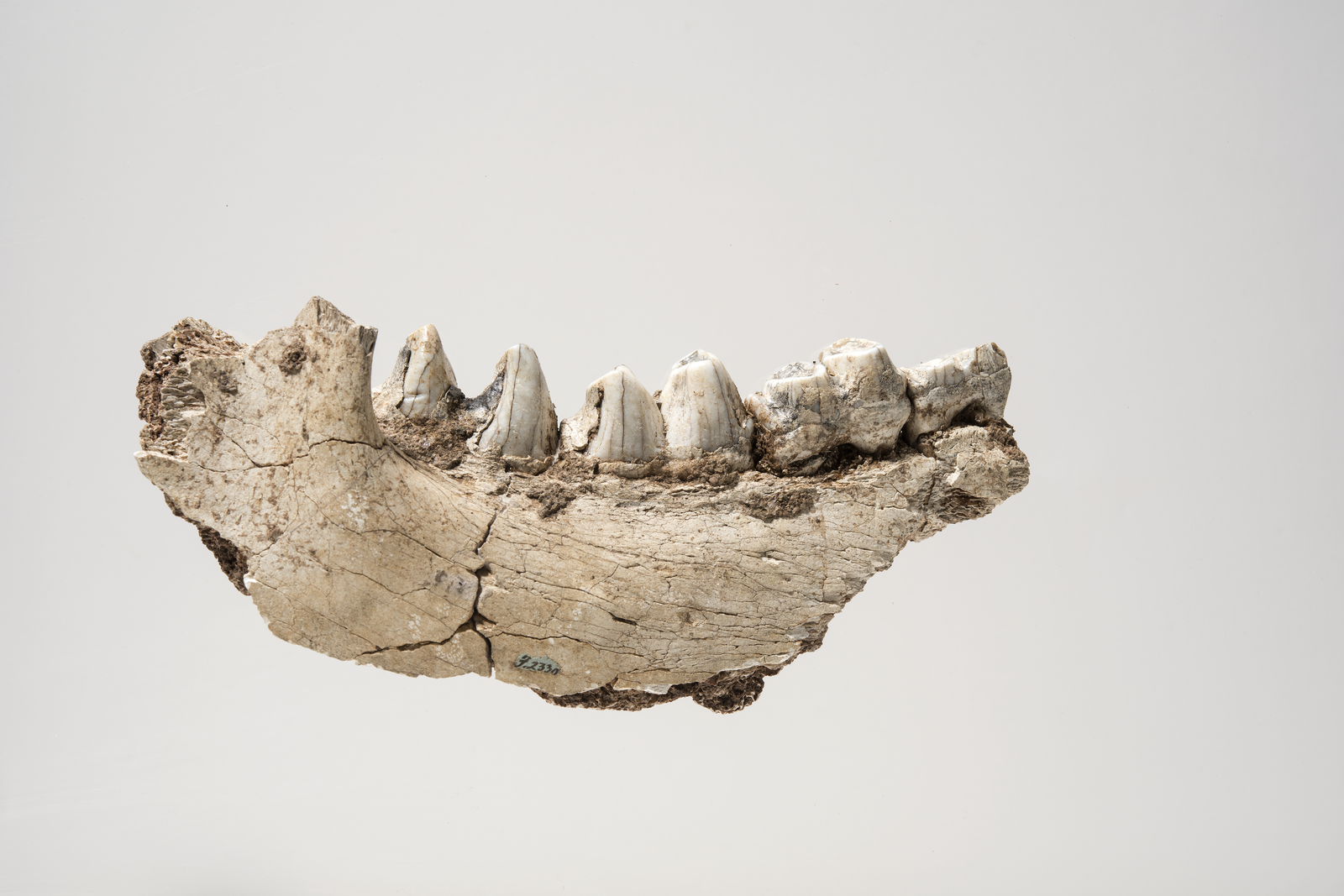
Diprotodon optatum. Lower jaw, 10 (high) x 24 (wide) x 8 (deep) cm. Weetaliba, near Coolah, NSW. Presented by J. McMaster, 1892. AM Palaeontology Collections. F2230.
Image: Stuart Humphreys © Australian MuseumAM Treasure Circle
Treasure supported by The Paradice Family Foundation.
Bottle used by Sir Joseph Banks or Daniel Solander
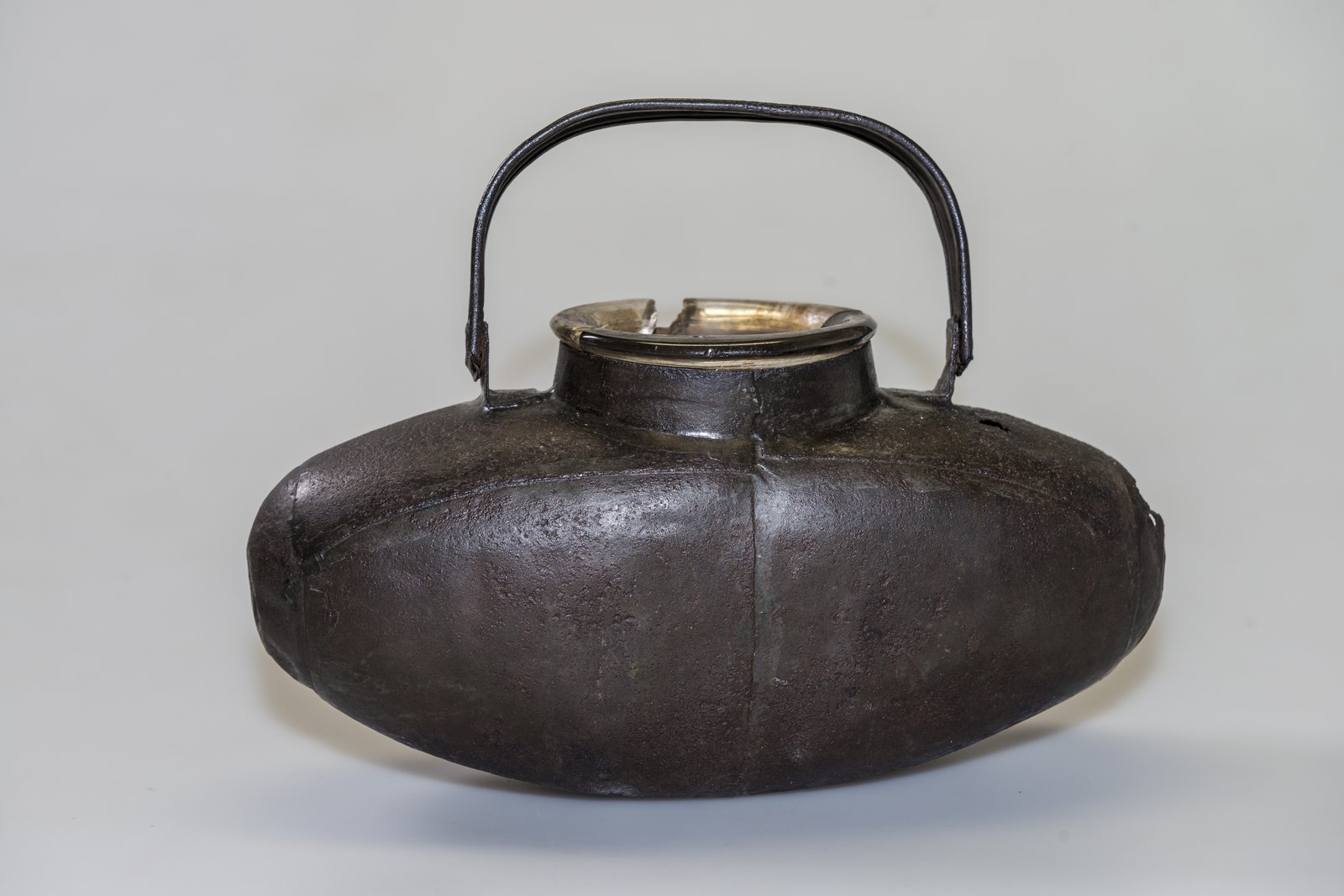
Bottle used by Sir Joseph Banks or Daniel Solander. Glass, iron. 19 (high) x 24 (wide) x 10 (deep) cm. United Kingdom Donated, 1860. AM Pacific Collection. H000495.
Image: Abram Powell © Australian MuseumThis bottle, in a protective iron case, was designed and made in England for the naturalists who accompanied Captain James Cook on his first journey around the world on the Endeavour in 1768–71. Bottles like this were used to collect biological specimens during landings at Botany Bay and other locations in 1770. The specimens were stored in water to keep them fresh for study. It is unknown if a preserving agent was used as well. This bottle is one of the very few relics of scientific and navigation equipment surviving from this epic expedition. It was presented to Dr Simon Rood Pittard, one of the members of the Royal College of Surgeons, who was appointed as a Curator of the Australian Museum in the same year. He donated the bottle to the Museum in 1860.
AM Treasure Circle
Interested in supporting this Treasure? Contact the Australian Museum Foundation to discover how.
The Birds of Australia by John Gould
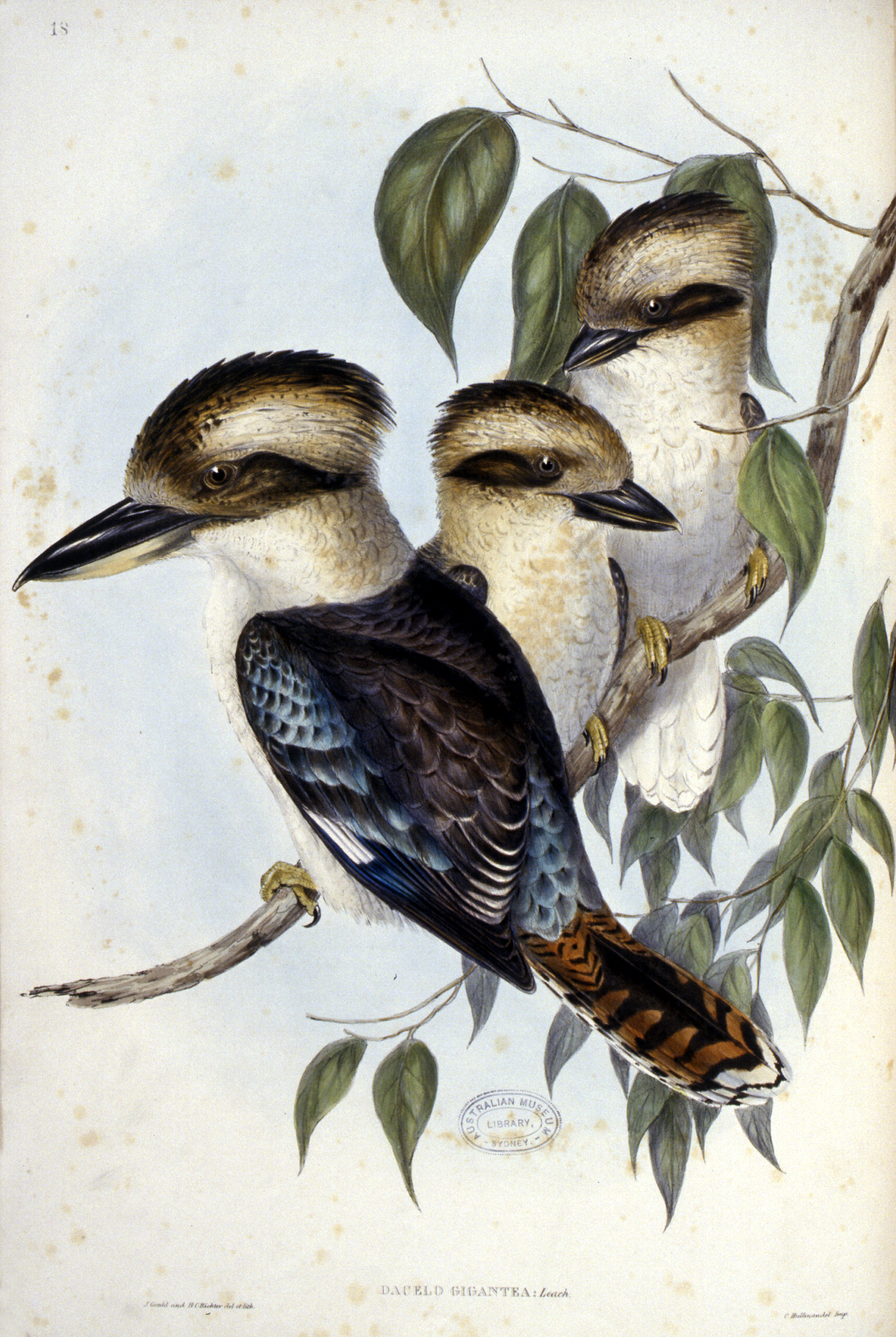
Dacelo Gigantea, Great Brown Kingfisher. John Gould. 55 (high) x 37 (wide) cm. In The Birds of Australia. John Gould and H.C. Richter. 7 volumes, 36 parts, published by the author in 1848, London. Purchased 1864. AM Archives, Rare Books and Library Collections.
Image: Leone Lemmer © Australian MuseumFor many who grew up in Australia in the twentieth century, their introduction to wildlife was through the Gould League, an organisation set up in 1909 to honour the work of John Gould (1804–1881) who was a zoologist and passionate bird collector. With his wife, Elizabeth, Gould left England in 1838 to embark on a 19-month field trip of Australia, with the aim of plugging the gap in knowledge of the country’s birds and mammals. Gould spent a number of weeks exploring the collections of the Australian Museum, familiarising himself with the native fauna, before acquiring his own specimens in the field. After his return to London, the Australian Museum and its associates sent Gould more newly discovered species – a practice that continued for the next 40 years. These specimens were quickly sketched by Gould and then finished by one of his artists under close supervision. The lavish books Gould produced and published, a full set of which is still held in the Australian Museum’s Rare Books collection, are a tangible reminder of Gould’s link to the Museum.
AM Treasure circle
Treasure supported by Francesca Packer Barham and Gretel Packer.
Butterfly and moth painting by Harriet and Helena Scott
The collection of 100 beautifully detailed scientific paintings of Australian butterflies and moths, from which these two examples by Helena Scott come, was created over a 20-year period by sisters Harriet and Helena Scott at their home on Ash Island, in the Hunter River near Newcastle, NSW. The two women collected and described butterfly and moth specimens, then captured them in vibrant and delicate paintings remarkable for both their technical detail and artistry. Each painting illustrates the complete life cycle of the butterfly or moth, including details of its habitat, the foliage it feeds on, environmental context and historic setting. Some were included in their father A.W. Scott’s expensive and painstakingly produced book Australian Lepidoptera and Their Transformations, one of the first books to illustrate and document Australian butterflies and moths. Harriet and Helena were elected honorary members of the Entomological Society of NSW in 1868 – a rare honour for women at the time.
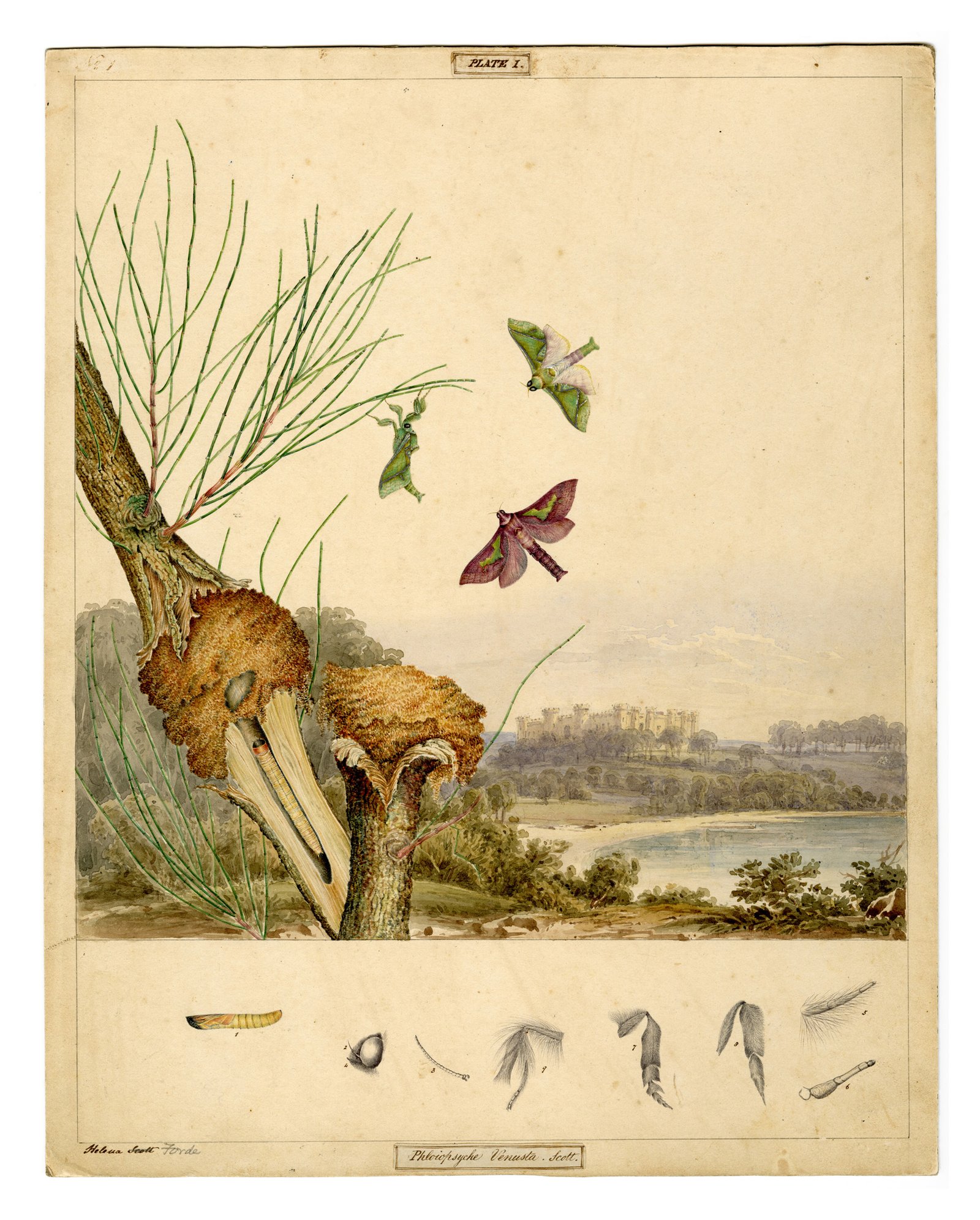
Phloiopsyche Venusta Scott. Harriet and Helena Scott. Butterfly and moth painting. Current scientific name: Splendid Swift Moth (Aenetus lewinii). 62 (high) x 54 (wide) cm.
Image: Stuart Humphreys © Australian MuseumAM Treasure circle
Treasure supported by Diccon and Elizabeth Loxton.
Dilly bags made by Bundjalung women
These dilly bags, traditionally woven by Bundjalung women for carrying food and other items, were collected by Mary Bundock in the late 19th century. These bags, designed to be worn around the neck, were crafted from vines and dried grasses, and occasionally lined with animal fur to prevent small items from falling through. Mary Bundock's collection, which included baskets and bags, was shown at the Sydney International Exhibition in 1879.
AM Treasure circle
Interested in supporting this Treasure? Contact the Australian Museum Foundation to discover how.
Australian Lungfish
Neoceratodus forsteri
Lungfish are named for their ability to breathe air by coming to the surface when water is stagnant or the quality is low. The Australian Lungfish is unique in having only a single lung – all other species have a pair. Lungfish can grow to 1.5 metres in length and 40 kilograms in weight. Well known by locals, it was Australian Museum Curator Gerard Krefft who noticed that the fish’s strange internal organs were similar to European fossilised fish. He suggested the Lungfish could be the ‘missing link’ between fishes and amphibians, whereupon this ‘living fossil’ entered into the evolutionary debates of the day. Krefft famously announced his discovery in the newspaper rather than in a scientific publication. He named it Ceratodus forsteri in 1870 in honour of his friend William Forster, who brought the fish to his attention.
AM Treasure Circle
Interested in supporting this Treasure? Contact the Australian Museum Foundation to discover how.