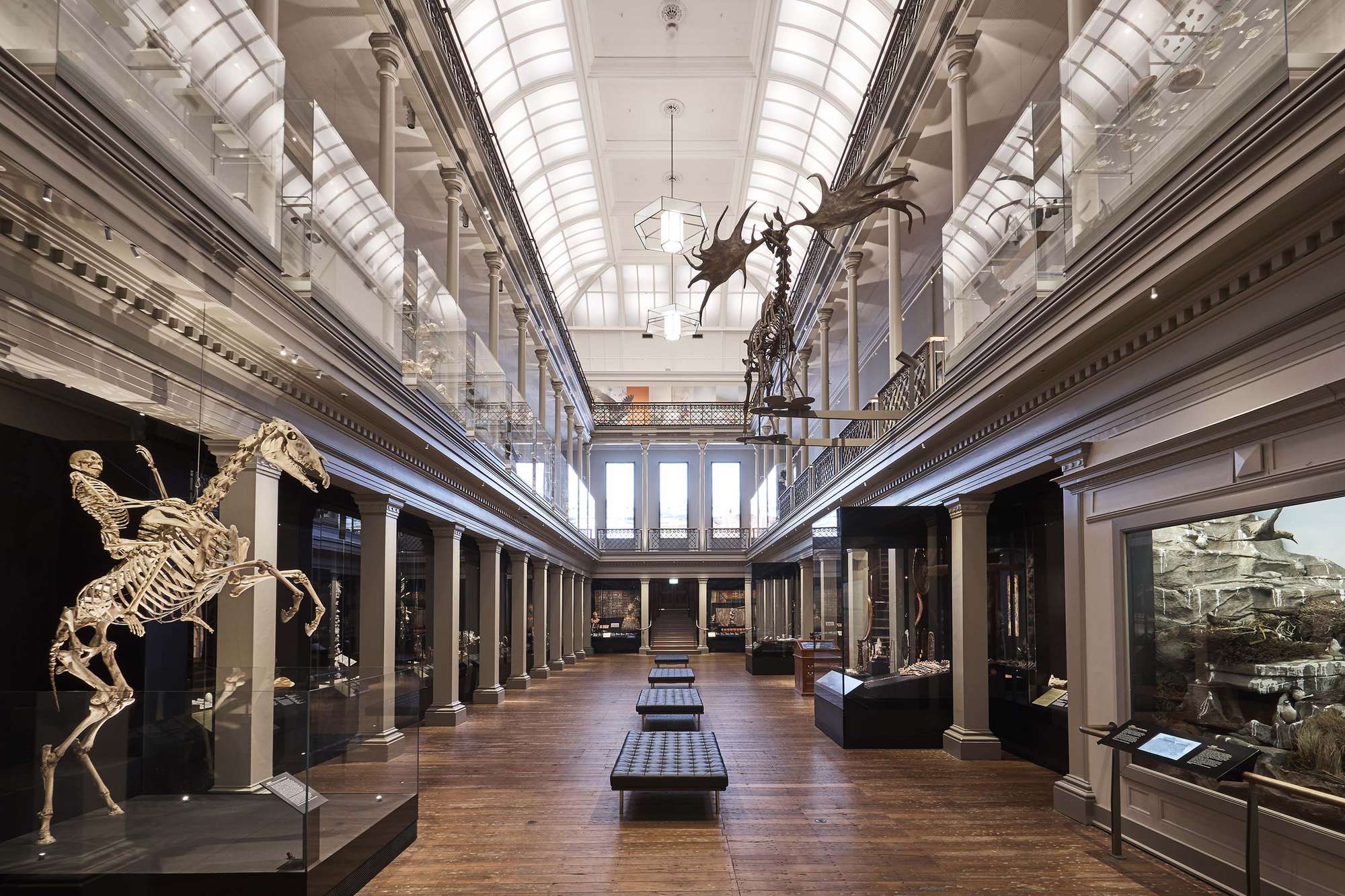
Figure of Arjuna case
Explore the rich and diverse cultures and natural worlds of Asia, from sacred Balinese deities and ancient ceremonial textiles to newly discovered rainforest frogs and a pioneering Victorian fish collection.
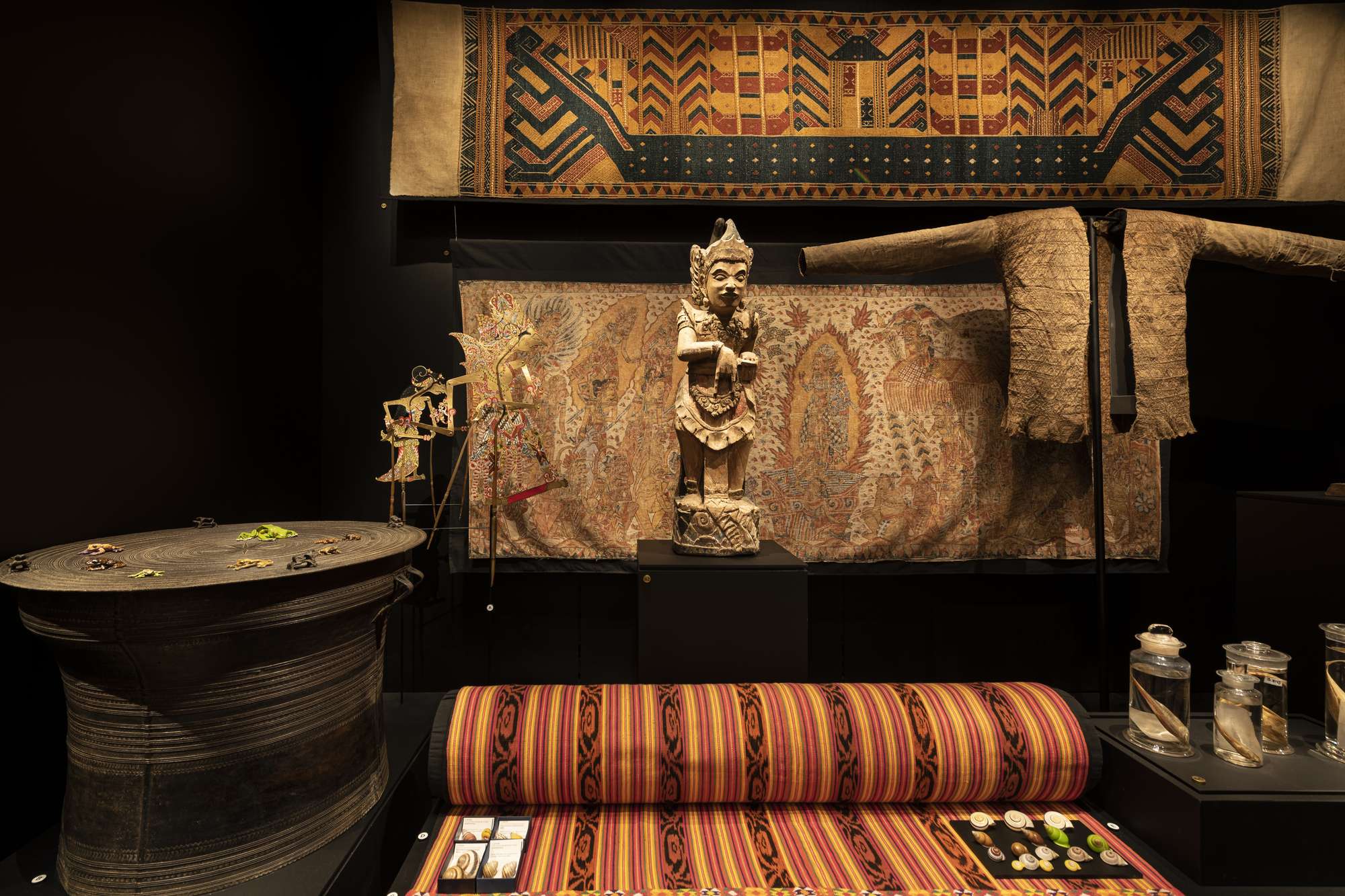
Story of the case
Listen to the audio guide of the Figure of Arjuna case.
Audio Transcript
The carved wooden figure in this showcase, purchased in Bali in the 1930s, is a representation of the Hindu god Arjuna. In the epic poem, Mahabharata, Arjuna was the son of Indra, the king of the celestials, and defended the gods against evil forces to restore the stability of the universe. Episodes from the Mahabharata are amongst the most popular subjects in traditional Balinese arts.
This figure was most likely intended as a devotional item to be placed in a temple or home. Its traditional style suggests it was made before the 1920s, when avant-garde artists such as the German Walter Spies and Dutchman Rudolf Bonnet settled in Bali. These artists were profoundly influenced by Bali’s traditional art as well as the tropical landscape. In turn, their presence led local artists to experiment with non-traditional forms. Most Balinese art is now made for the international art and tourist markets rather than ritual devotion.
The Museum continues to conduct field surveys in South East Asia. Dr Jodi Rowley and colleagues have discovered more than 20 new frog species in the Mekong since 2006, with the Museum housing most of the type specimens used to describe and name the species. Most Mekong frogs are adapted to very specific environments, many of which are threatened by deforestation. Frogs also figure prominently in the cultures of the Mekong. Under the frog specimens on the left is a Dong Song bronze frog drum from Laos. Frog drums were the most-prized possessions in Dong Song families and were used in ceremonies to invoke the influence of the ancestral spirits embodied in the drums.
In the glass jars at the front are several specimens from Francis Day’s collection of fishes. Day was Inspector General of Fishes in India and Burma in the 1880s and named 343 species of marine and freshwater fishes from an area that extends from Burma to. Despite his English connections, Day offered part of the collection to the Australian Museum instead of the British Museum.
Figure of Arjuna
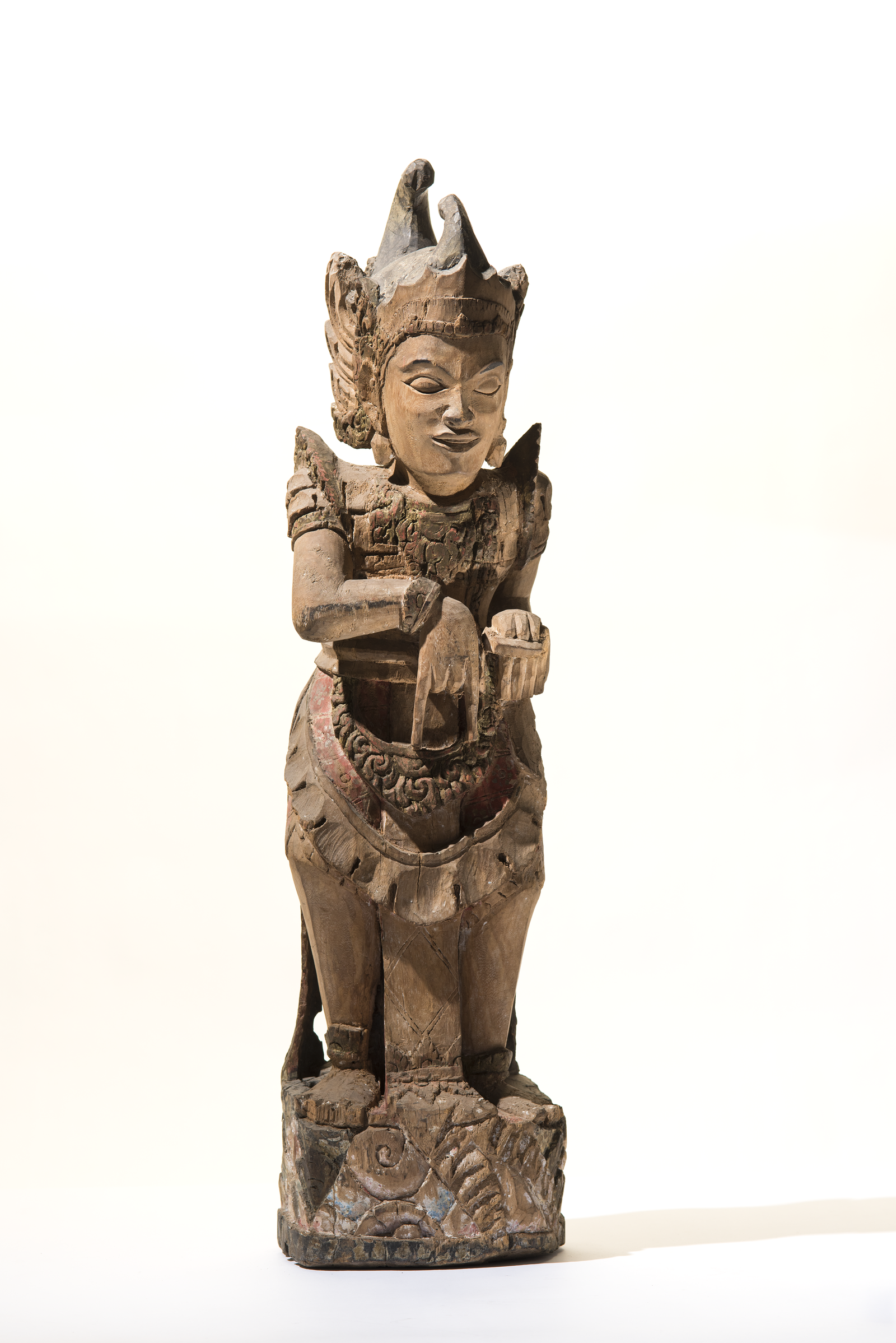
Figure of Arjuna. Wood, pigment. 77 (high) x 20 (wide) x 20 (deep) cm Bali. Late nineteenth or early twentieth century. Donated by Melbourne Ward. Acquired 1972. AM Asian Collection. E069946.
Image: Stuart Humphreys © Australian MuseumThis is a figure of Arjuna, a god and one of the central protagonists in the Hindu epic Mahabharata. It was intended to be functional rather than an art piece. Such figures would have been placed at a temple or in a home as part of ritualistic ‘decorum’ in the Javanese–Hindu tradition, most prominently preserved in Bali. Various episodes from Arjuna’s life are some of the favourite stories in shadow puppet plays, dance-theatre performances, paintings and other visual arts. Arjuna famously defended the gods against evil forces and restored the stability of the universe. This figure was made before the art market and related production became important features of Balinese culture and its economy, offering plentiful supply to private and public collections in the West. The figure was purchased in Bali in the 1930s by James Tyrell (1875–1961), a prominent Sydney bookseller, publisher and art dealer, and a significant figure in Australian literary circles.
AM Treasure Circle
Interested in supporting this treasure? Contact the Australian Museum Foundation to discover how.
Frogs of the Greater Mekong

Thorny tree frog (Gracixalus lumarius).
Image: Jodi Rowley © Australian MuseumThe Mekong River flows through six Asian countries, across an area of thick rainforests, mountains and rocky streams rich in biodiversity but difficult to explore. During scientific expeditions to the region, Australian Museum scientist Dr Jodi Rowley and her colleagues searched the rainforests by torchlight for new species of frogs. More than 20 have been discovered since 2006, with the Australian Museum housing most of the type specimens (those used to describe and name the species). Two remarkable discoveries included a huge, green flying frog, named Helen’s Flying Frog – after Dr Rowley’s mother – and Quang’s Tree Frog, a tiny, almost transparent frog splashed with vivid turquoise and yellow patterns. This frog is more easily located by its unique mating song (it resembles birdsong), which has so many variations of clicks, whistles and chirps that no-one has ever heard two identical calls. With deforestation, the future of Mekong frogs is at stake and the research resulting from these expeditions is vital to our understanding of environmental changes and the impacts on biodiversity. Frogs are superb bioindicators – they are sensitive to changes in ecosystems and so reflect the ‘health’ of a region in general. To locals, they are also a long-cherished aspect of life.
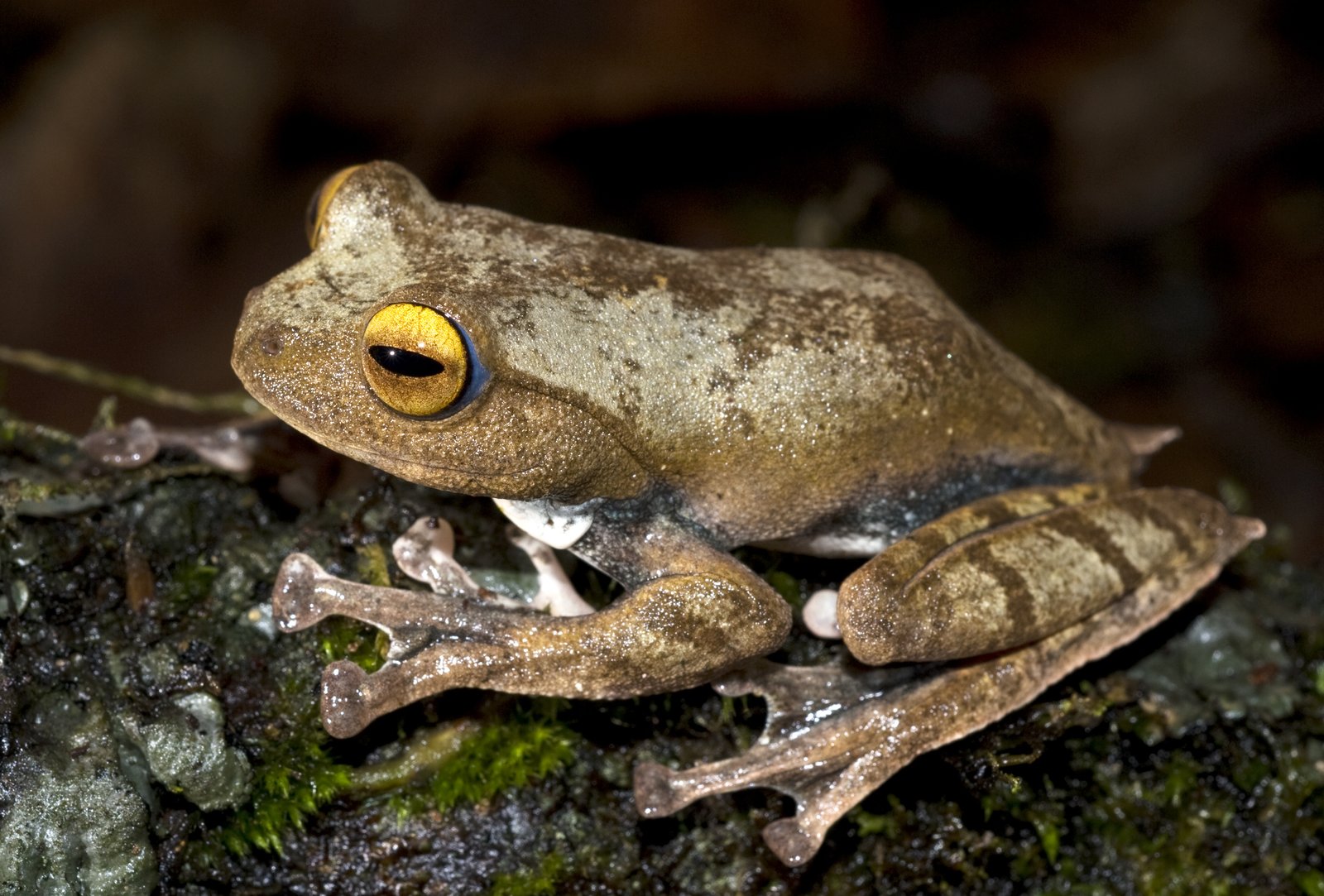
Vampire flying frog (Rhacophorus vampyrus).
Image: Jodi Rowley © Australian MuseumAM Treasure Circle
Interested in supporting this treasure? Contact the Australian Museum Foundation to discover how.
Ship cloth palepai
The palepai is a deeply spiritual and complex form of woven textile. The ‘soul’s ship’ is probably a good approximation of its significance. Palepai was the ceremonial cloth of penjimbang, local leaders who for centuries played a role in pepper production for major South-East Asian trading powers. The cloth is still used in ceremonies to mark momentous events and stages in a person’s life cycle, and the transition from one to another. It was made in areas around Semangka and Lampung bays in southern Sumatra, Indonesia. Examples of surviving palepai date from the late eighteenth century to the early twentieth century, although the tradition is much older. Typically using deep blue, reddish-brown or yellow tones, these textiles, which can be more than 3 metres long, were woven with elaborate images such as ships, people, elephants, horses, birds, fish, turtles, bells, diamond shapes and umbrellas. Ship cloth palepai implied wealth and power, and were imbued with the significance of social rituals and ancestral devotion.
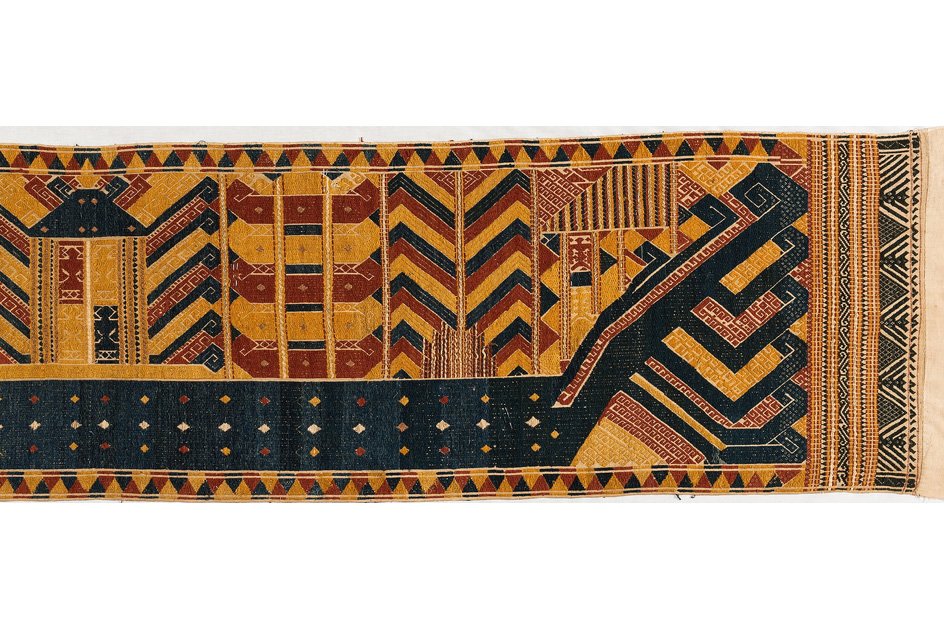
Ship cloth palepai. Woven cloth. 56 (high) x 245 (wide) cm. South-west Lampung Province, Sumatra, Indonesia, probably early twentieth century. Acquired from Vern Cork, 1977. AM Asian Collection. E074960.
Image: Stuart Humphreys © Australian MuseumAM Treasure Circle
Interested in supporting this treasure? Contact the Australian Museum Foundation to discover how.
Cloth painting of Sita's fire ordeal
This beautiful and intricate painting on cotton depicts a key scene from the Hindu epic the Ramayana. After a long period of captivity at the hands of the demonic king Rawana, the goddess Sita has been reunited with her husband Rama. However, he doubts that his wife has remained faithful throughout their long separation, and so, to demonstrate her fidelity, Sita jumps onto a burning pyre. Because of her purity, she does not perish, and the fire transforms her into a lotus – seen floating on a pool of water at the centre of the painting. Probably created by Kak Loui (Lui) (c1860–1930) in Kamasan, Bali, in the early twentieth century, this painting is one of a number of classical temple paintings in the collection of the Australian Museum. Collected by anthropologist Anthony Forge in the 1970s, they form one of the most important collections of this kind in the world.
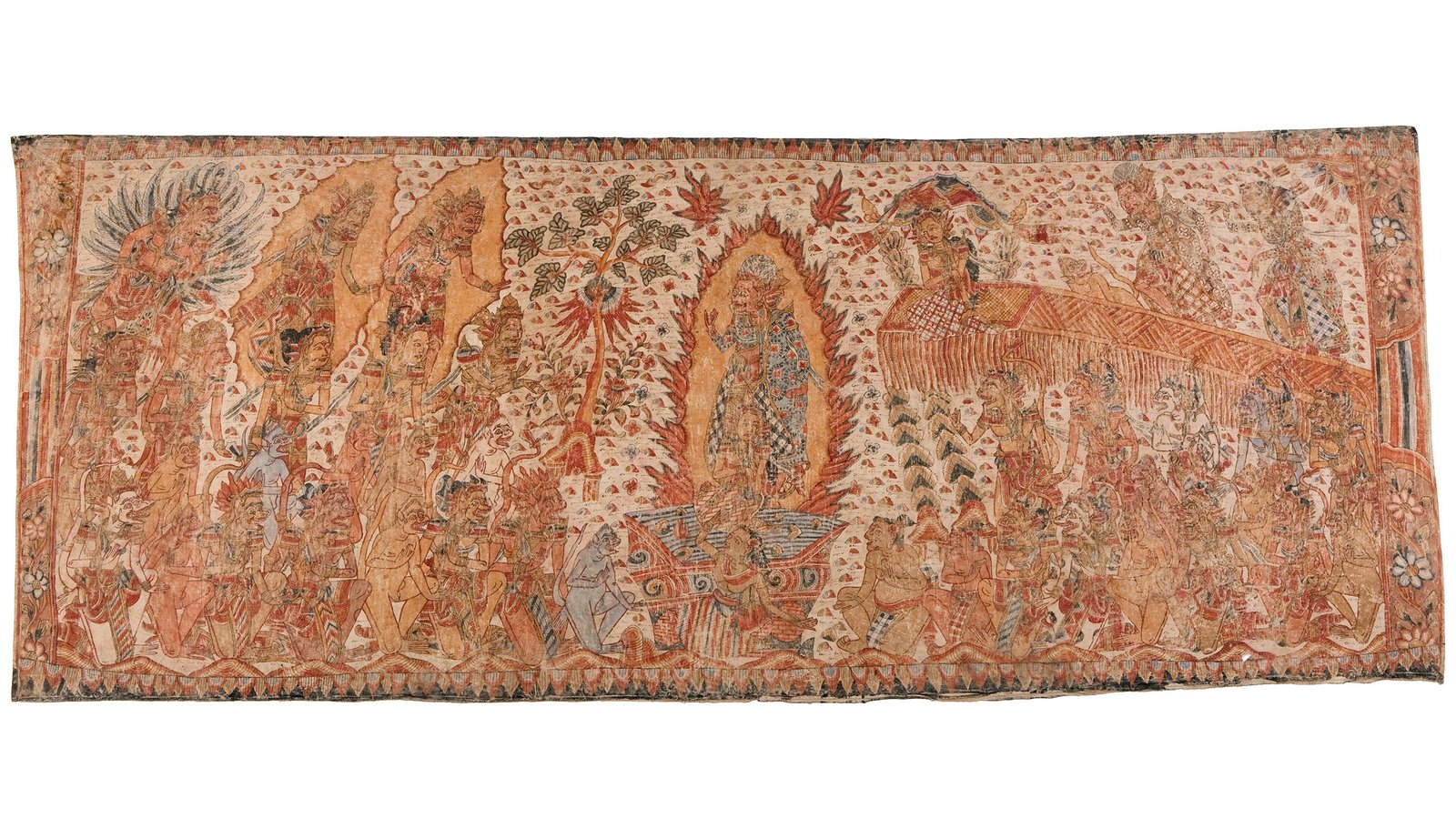
Cloth painting of Sita's fire ordeal. Paint on cloth. 93 (high) x 207 (wide) cm. Kamasan, Bali. Early twentieth century. Acquired 1976. AM Asian Collection. E074160.
Image: Emma Furno © Australian MuseumAM Treasure Circle
Interested in supporting this treasure? Contact the Australian Museum Foundation to discover how.
Dr. Francis Day’s fish collection
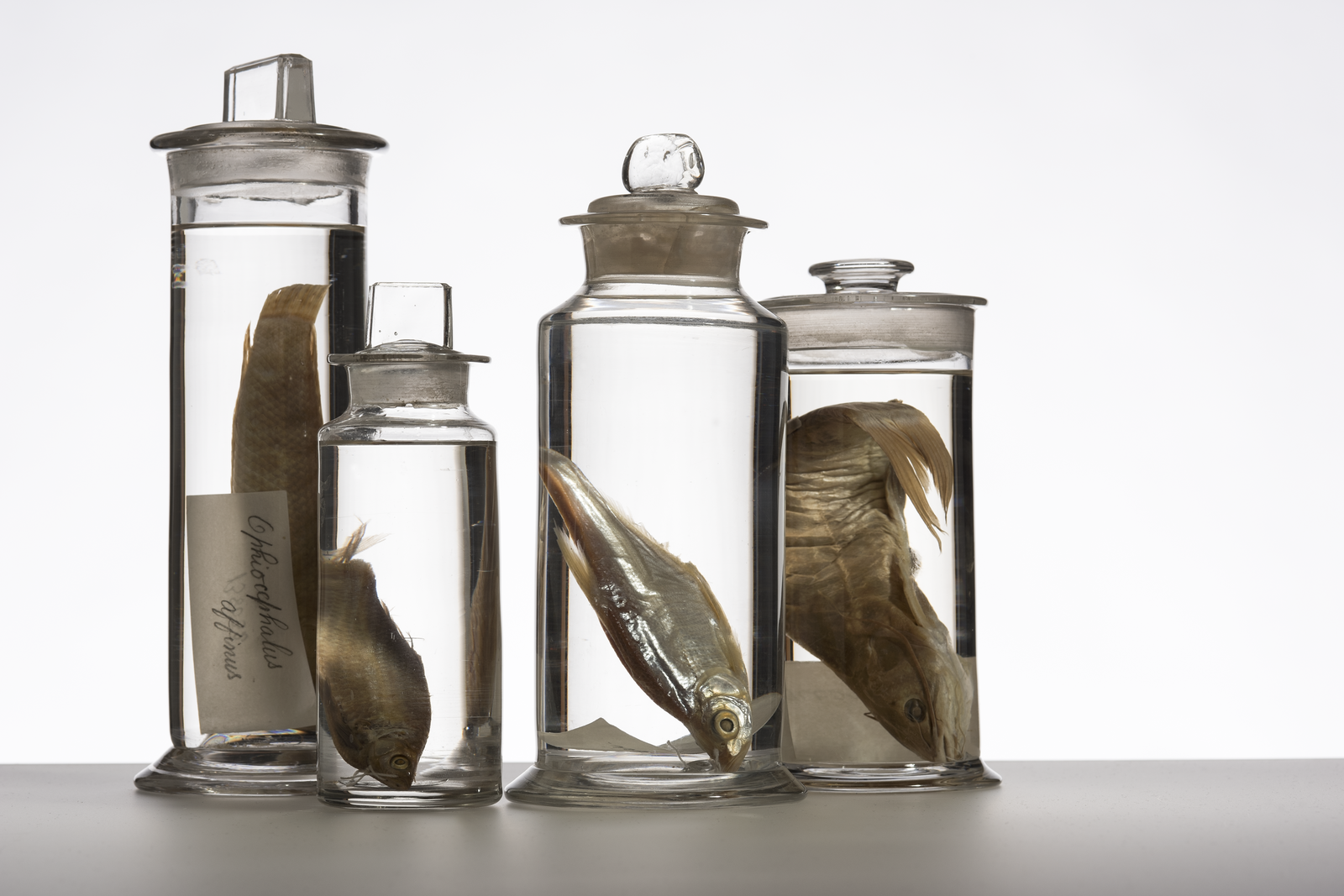
Dr. Francis Day’s fish collection. India, Pakistan, Afghanistan and Myanmar, 1865–83. Acquired 1884. Ichthyology Collection. B.7902, B.7911, B.8143, B.8032.
Image: Stuart Humphreys © Australian MuseumThese fishes (only a sample of which are displayed here) were collected by Englishman Dr. Francis Day, a pioneering ichthyologist, surgeon and Inspector General of Fishes in India and Burma in the 1880s. In 24 years of study, Day named 343 species of marine and freshwater fishes from an area extending from Afghanistan to Myanmar. Despite his English connections, Day offered part of the collection (for a price) to the Australian Museum instead of the British Museum. (Day strongly disliked Albert Günther, the curator of zoology at the British Museum, who had often criticised Day’s work).
AM Treasure Circle
Interested in supporting this treasure? Contact the Australian Museum Foundation to discover how.
Kenyah barkcloth jacket
This is a rare example of a nineteenth-century barkcloth jacket of the Kenyah people, the most powerful tribe from Kalimantan (the Indonesian part of the island of Borneo) at that time. The jacket is made of a versatile and beautifully textured cloth, produced by beating and gluing bark (usually from mulberry trees) to make thin cloth-like sheets. The Kenyah people wore bark clothing only on symbolic and special occasions, sometimes associated with mourning. Barkcloth is easily damaged through wear because the fibres of the cloth often lose their strength and cohesion when wet. Hence, it is very rare for a barkcloth jacket such as this to survive in such remarkable condition. The production of clothing made of bark gradually ceased across the region when textile weaving, and eventually factory-made fabrics, were introduced, initially via Chinese and Indian traders, and then by Europeans.
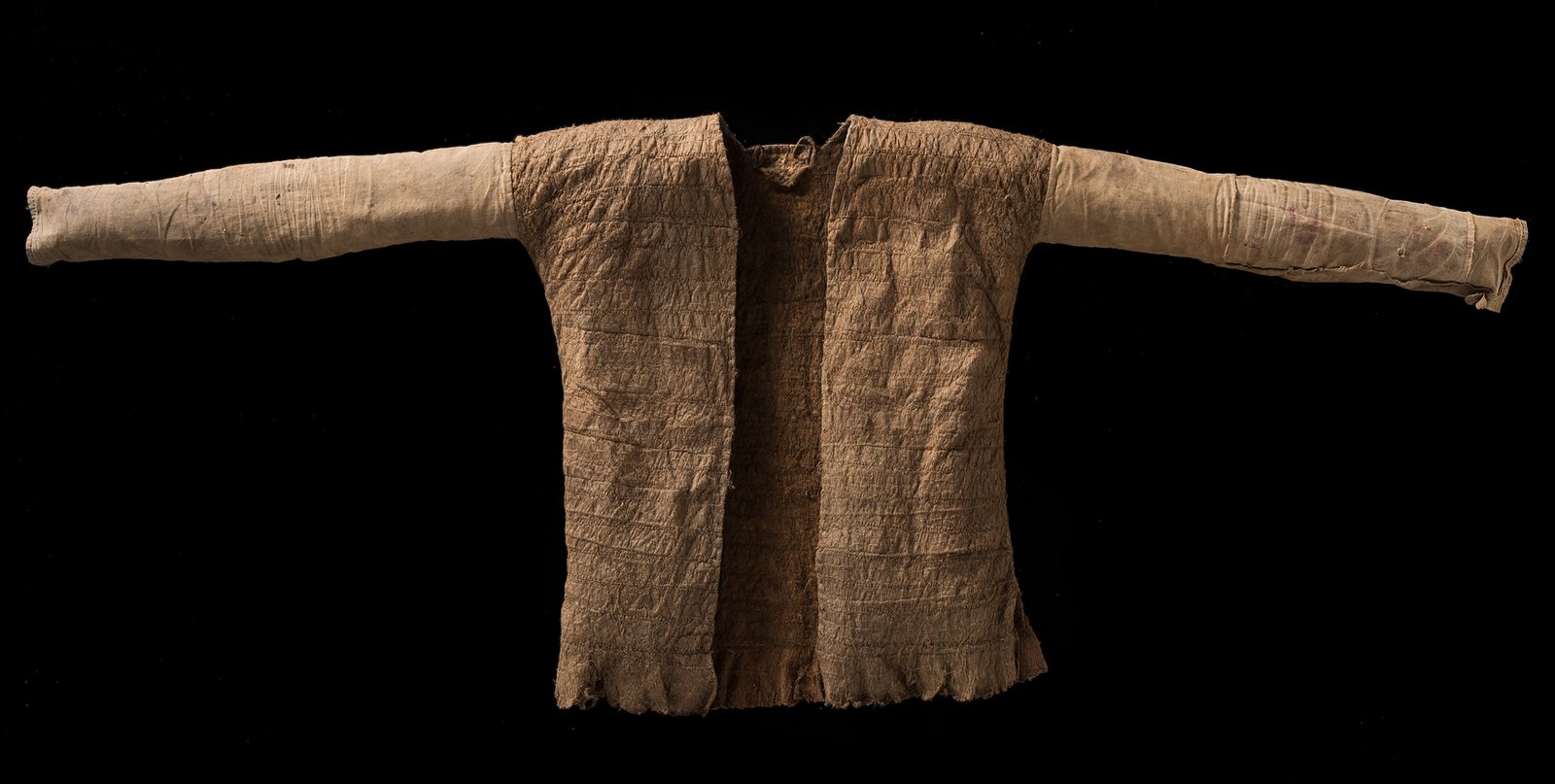
Kenyah barkcloth jacket. 58 (high) x 52–150 (wide) (shoulder to shoulder/arms extended) x 9 (deep) cm. Kenyah people, Kalimantan, Indonesia. Donated by Charles Seligman, 1899. AM Asian Collection. E08607.
Image: Australian Museum © Australian MuseumAM Treasure Circle
Interested in supporting this treasure? Contact the Australian Museum Foundation to discover how.