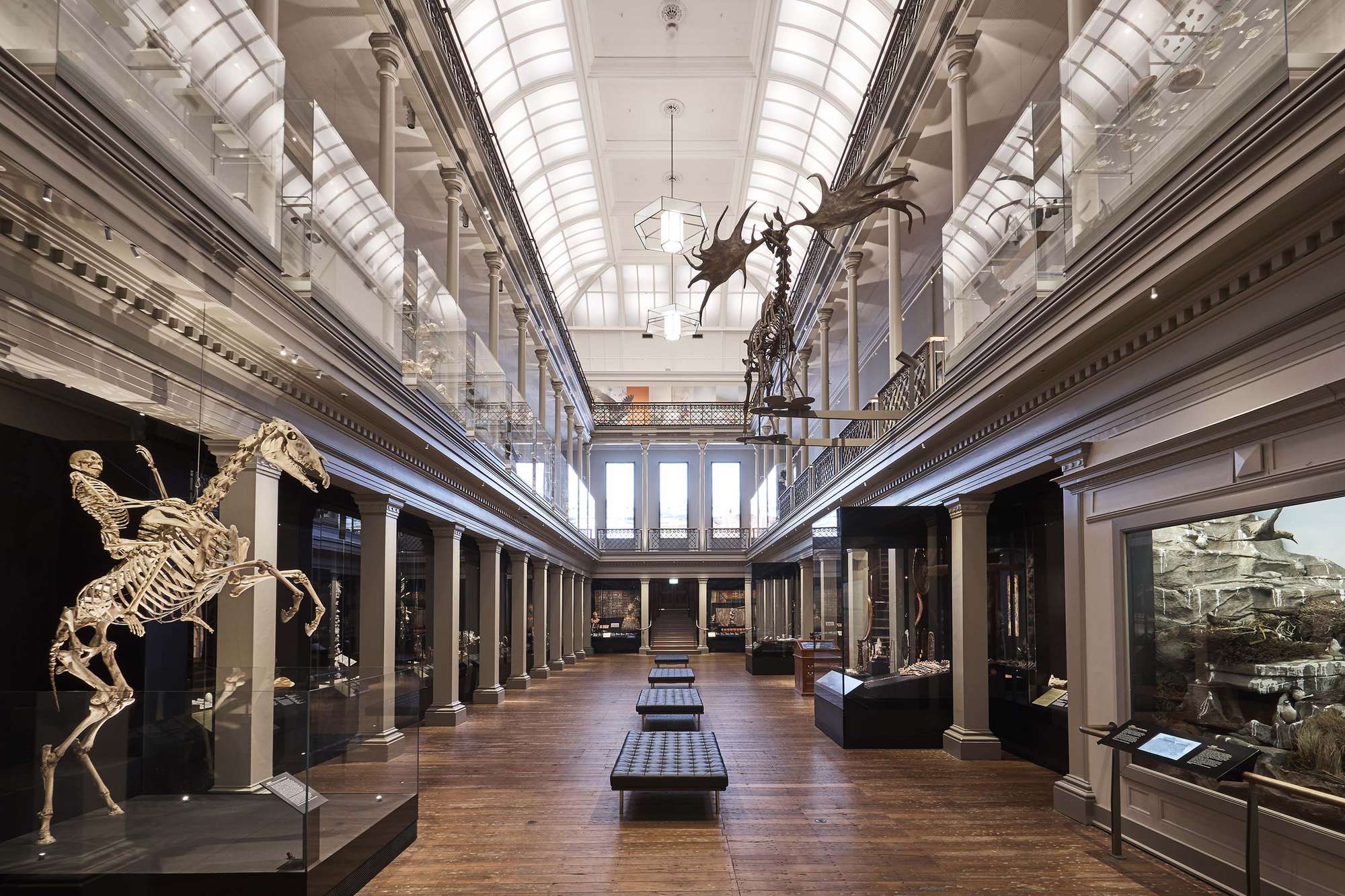
Theban Mummy and Coffin case
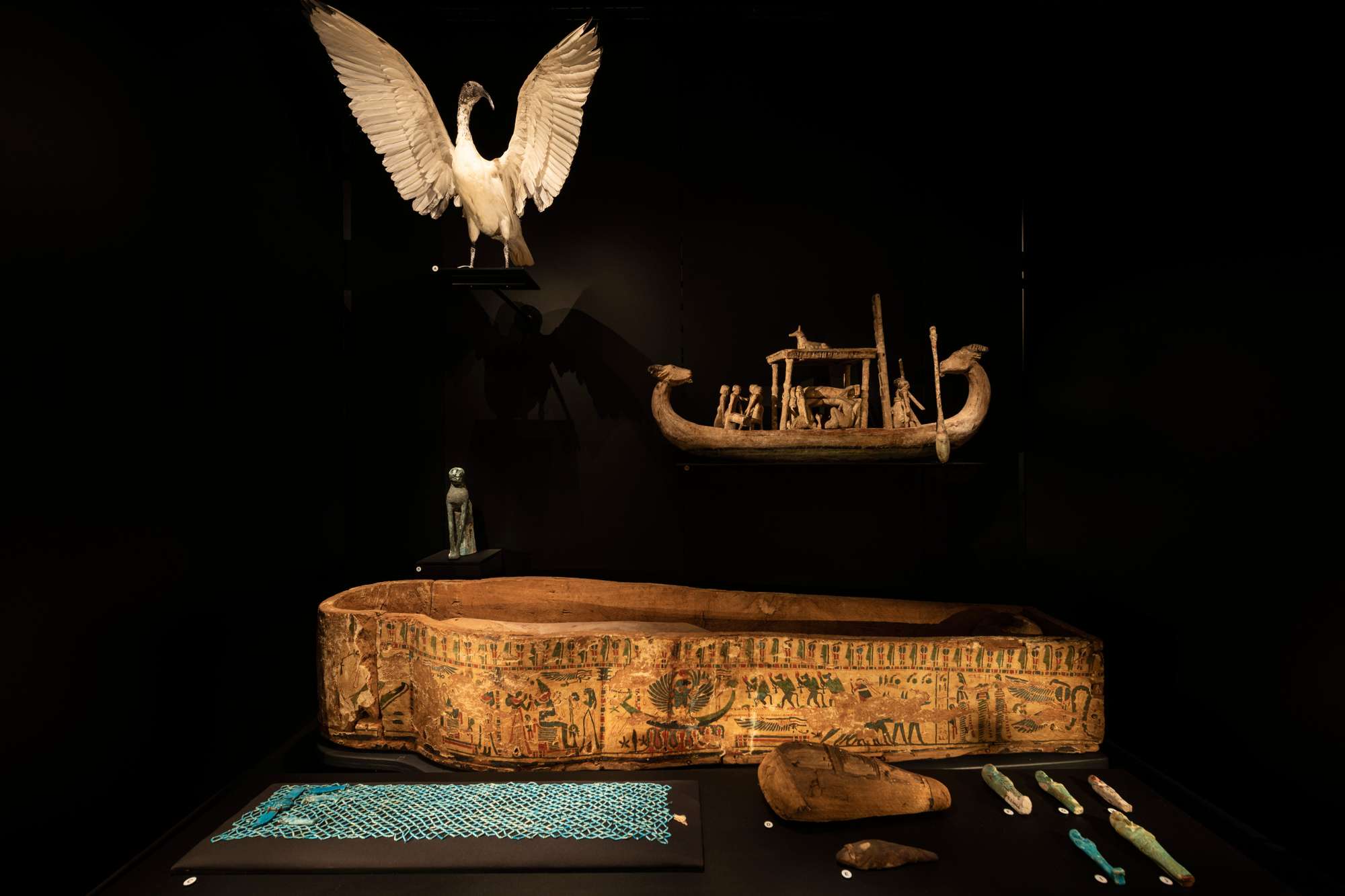
Ancient Egypt comes to life in this case, through a 2,800-year-old mummy, her painted coffin and a funerary boat placed in tombs to guide the dead on their journey to the afterlife.
Story of the case
Listen to the audio guide of the the Theban Mummy and Coffin case.
Audio Transcript
For Westerners, Egypt has long been a country steeped in mystery, classical imagination and archaeological adventure. This was reinforced in the early 20th century by spectacular rediscoveries of tombs laden with mummies and artefacts. Demand for these artefacts led to a thriving black market. A century later, new technologies from scans to genetic analysis have led to revisions in our understanding of Ancient Egyptian artefacts, and have even revealed some to be clever forgeries.
The Australian Museum has a significant Egyptian collection, most of which was acquired in the early 1900s.
This Egyptian mummy was excavated from a tomb in Thebes (now Luxor) and was originally thought to have been the body of a middle-aged man who died about 2500 years ago. In 2004, the mummy underwent CT scanning at nearby Royal Prince Alfred Hospital. The scan surprisingly revealed the body of a woman, who was mummified 300 years earlier than previously thought.
Above the mummy, a wooden funerary boat adds an intriguing chapter to this story.
Wooden boats were often placed in Egyptian tombs during the Middle Kingdom period, which lasted from 2055 to 1650 BCE. This boat had been considered an example of this funerary tradition since Museum trustee Ernest Wunderlich acquired it for his personal collection. But scholars noted that its form, style and colouring are not consistent with other funerary boats and its authenticity has been questioned. In an attempt to resolve the mystery, the Museum is employing technology to test the boat’s origins. Carbon-14 dating indicates that at least part of the object originated in the Middle Kingdom period, but more corroborative evidence is required
Theban Mummy in Coffin case
This ancient Egyptian mummy, wrapped in several hundred metres of fragile linen, is that of a middle-aged woman who died about 2800 years ago. Carbon dating of the linen indicates it belongs to the Third Intermediate Period (1069–664 BCE). Her preserved body was placed in a wooden coffin painted with mythological scenes. The hieroglyphs on the coffin show the deceased making offerings to Ancient Egyptian gods, including Osiris and Isis. It is unfortunate that the coffin is missing its lid, as the mummy’s identity would likely have been inscribed on it. Previously restricted primarily to the upper levels of Egyptian society, during the Third Intermediate Period mummification was becoming more common. This mummy was excavated in Thebes (modern-day Luxor) in 1900 when the West’s fascination with Ancient Egyptian civilisation resulted in numerous professional and amateur explorations, during which artefacts and mummies were acquired for public and private collections.
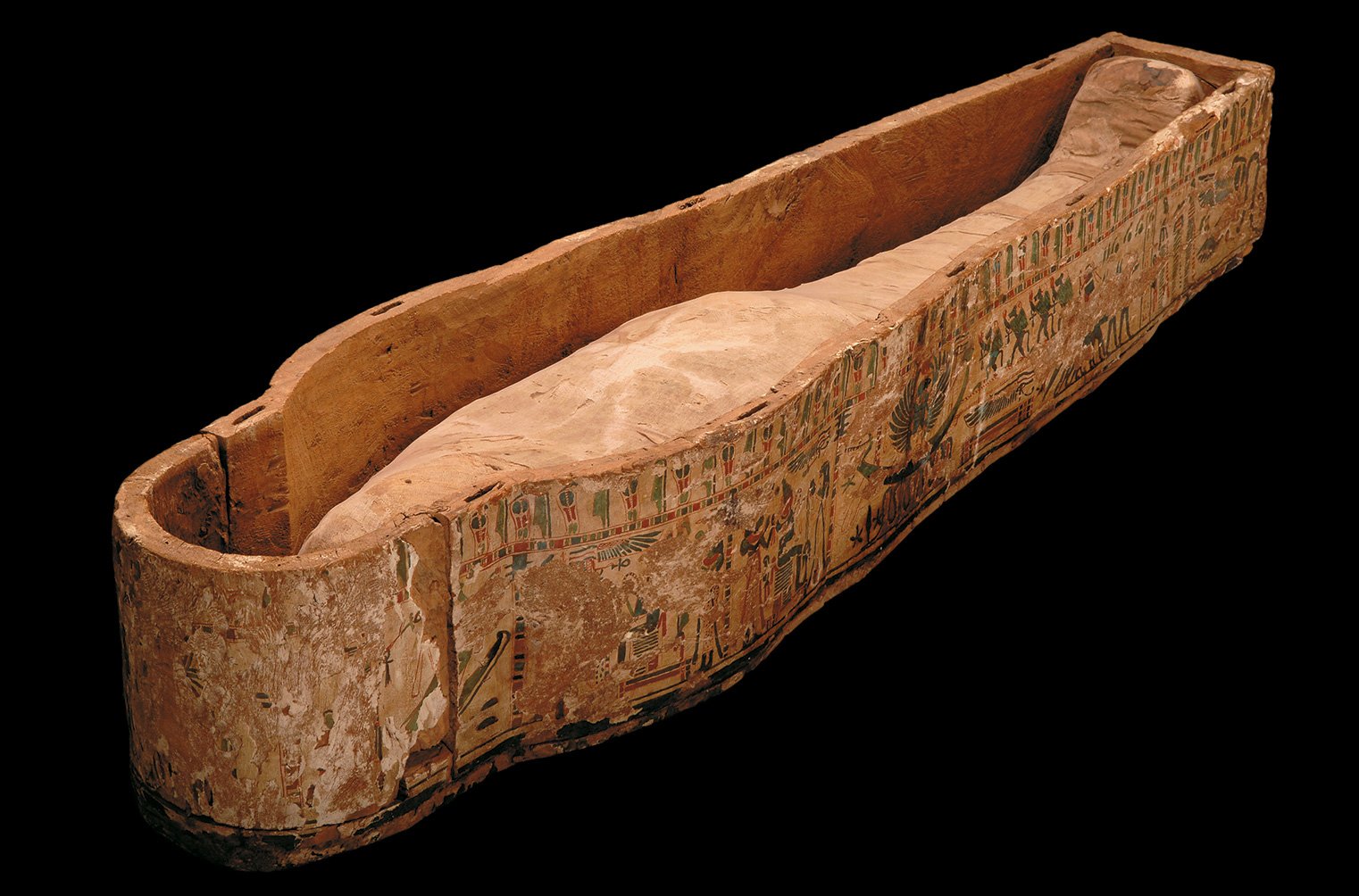
Theban mummy and coffin case. Wood, plaster, pigments, mummified human remains, linen. 194 (long) x 51 (wide) x 35 (deep) cm. Thebes, Egypt, Third Intermediate Period, 1069–664 BCE. Donated by Robert Lucas-Tooth, 1912. AM African Collection. E019466.
Image: Carl Bento © Australian MuseumAM Treasure Circle
Treasure supported by Virginia Judge and daughters Cecily, Theresa, Rebecca and Dr Patrick Tooth.
Model of a funerary boat
The Australian Museum has a significant Egyptian collection, a large part of which was assembled by Museum trustee Ernest Wunderlich in the late nineteenth and early twentieth centuries. At that time, spectacular discoveries of Egyptian antiquities were enticing treasure-hunters and collectors. Among the Museum’s outstanding pieces is this small funerary boat, acquired by Wunderlich probably from an artefact dealer (hence its specific provenance is unknown). Like many other boats of this kind, it belongs to the Middle Kingdom (2055–1650 BCE) of Egyptian history. At that time, funerary boats were popular and frequently placed in tombs, presumably to assist the soul of the departed person in their journey to the afterlife. The form and design of this boat stand out in contrast to other, more common examples. For this reason, over the years, scholars were unsure what to make of this intriguing artefact. An initial carbon-14 date indicates at least part of the object originated in the Middle Kingdom. More analysis is being done in an effort to resolve this mystery.

Model of a funerary boat. Wood, plaster, pigments. 105 (long) x 22 (wide) x 55 (deep) cm. Provenance unknown. Middle Kingdom (c2055–1650 BCE). Donated by the estate of E. Wunderlich, 1962. AM African Collection. E060381.
Image: Stuart Humphreys © Australian MuseumAM Treasure Circle
Treasure supported by Jennifer Crivelli.