For millennia, humans have turned to leeches when trying to treat illnesses. Before the early 1800s, particularly in Europe, many ailments were believed to be caused by an imbalance of the body’s four humours. One treatment to rebalance them was to drain blood, often by applying leeches and letting them feed; the practice was known as bloodletting.
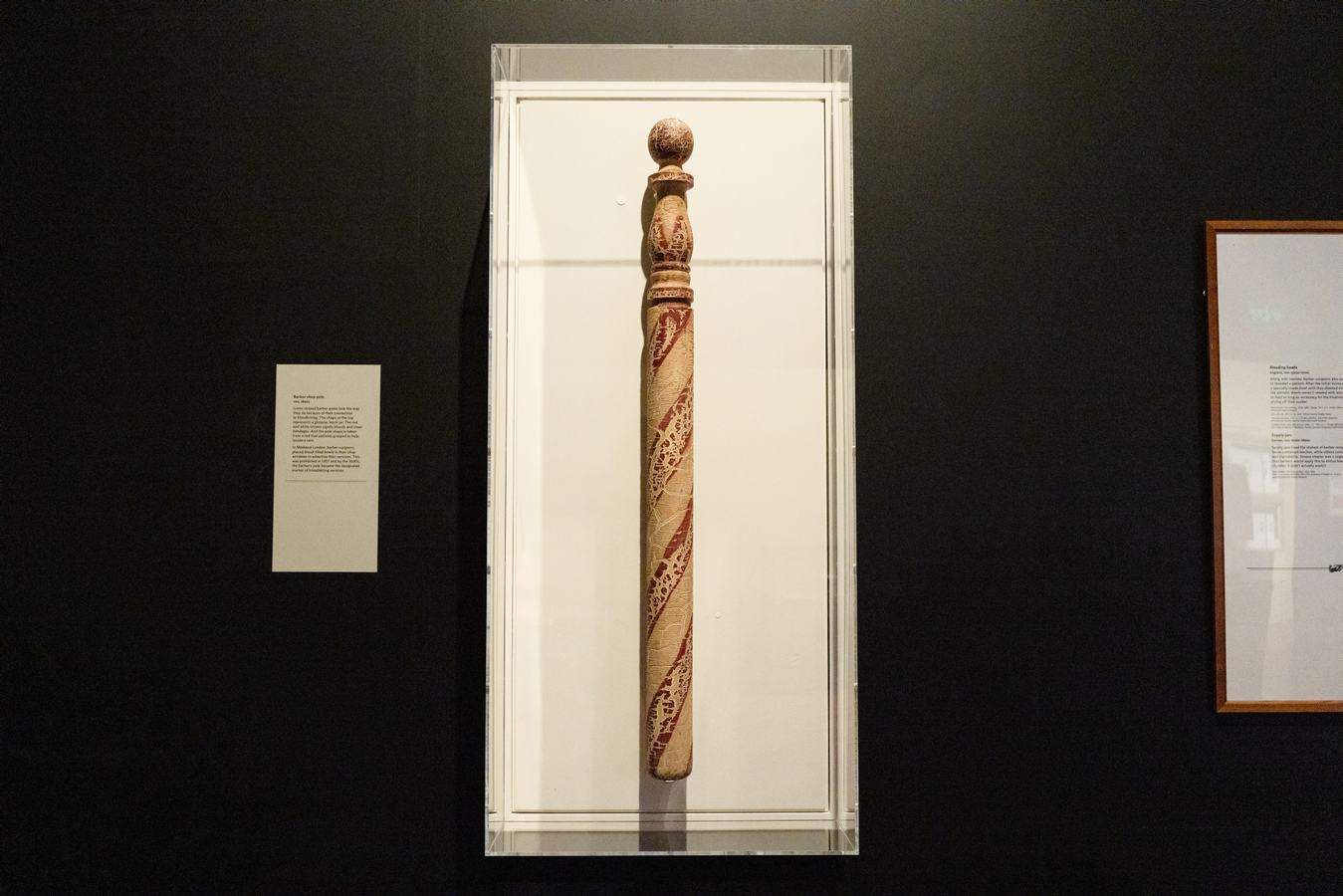
Displayed vertically inside a clear rectangular showcase is a barber shop pole from the USA, dating to the 1800s. The object is long and cylindrical, with a rounded lower end and a series of turned sections near the top. A spherical knob sits at the uppermost point above a bulb-shaped form and circular collars. The surface is painted with spiralling red bands wrapping around a white background. Areas of fading, wear and surface cracking are visible across the paint. The rounded form at the top represents a globular leech jar. The red and white colours signify bloody and clean bandages, and the pole’s shape is derived from a rod gripped by patients during bloodletting procedures.