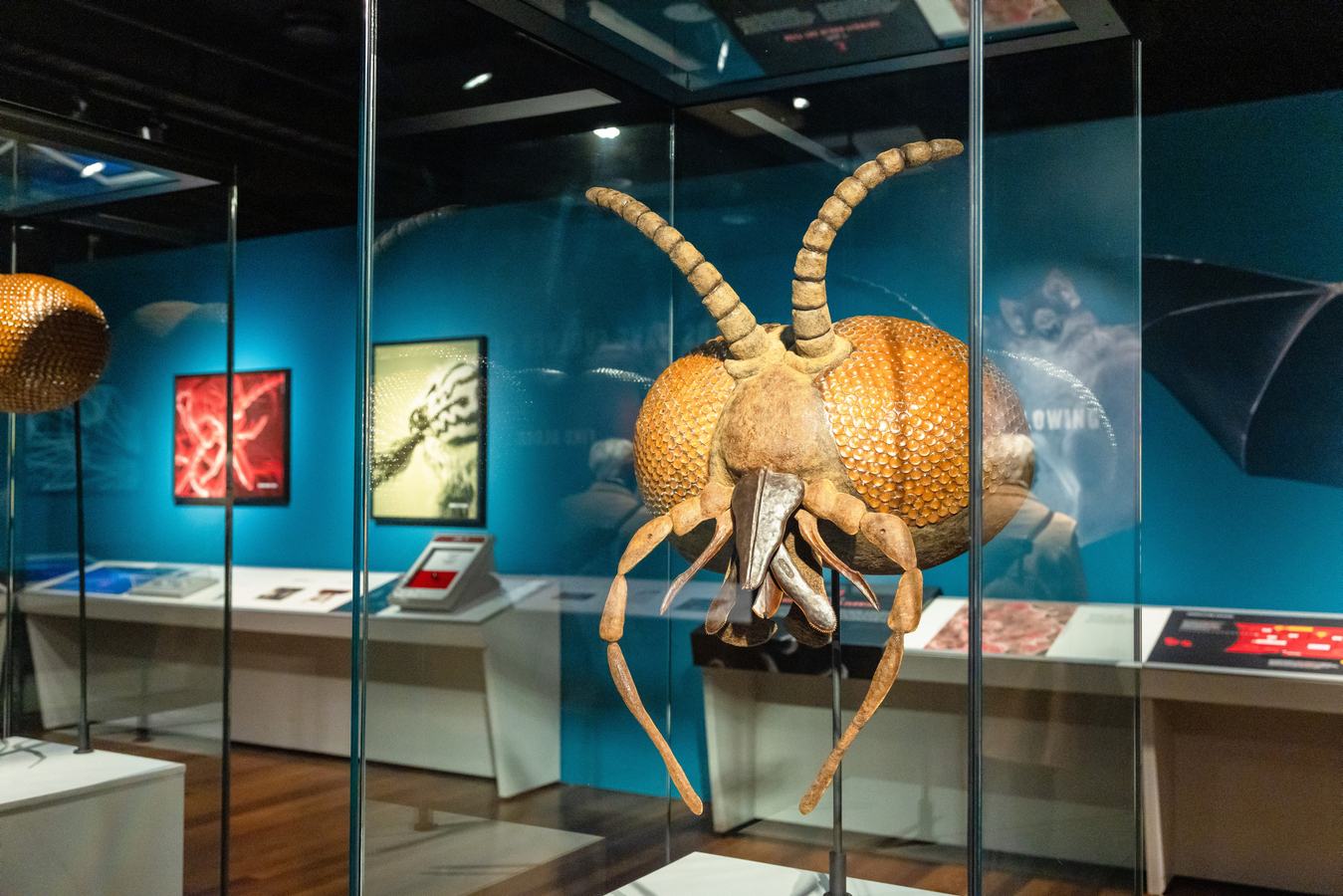
Blood-feeding animals have evolved innovative ways to seek out and find blood, get to the blood and then keep it flowing. This area of the exhibition explores several examples of adaptations and mechanisms used by these animals
Displayed within a large showcase is a model of a black fly head, enlarged to 1,000 times life size. Two large orange-brown compound eyes dominate either side of the head, their surfaces covered with dense repeating convex shaped pieces. Two segmented antennae rise from the top and curve outward and upward. Beneath the centre, several elongated mouthparts project downward and forward in a layered arrangement. These structures include the labrum, labium, maxillae, and mandibles. The mouthparts are narrow, blade-like and tube-like in form, extending below the eyes. The head is symmetrical in appearance, with the paired features arranged evenly on either side.