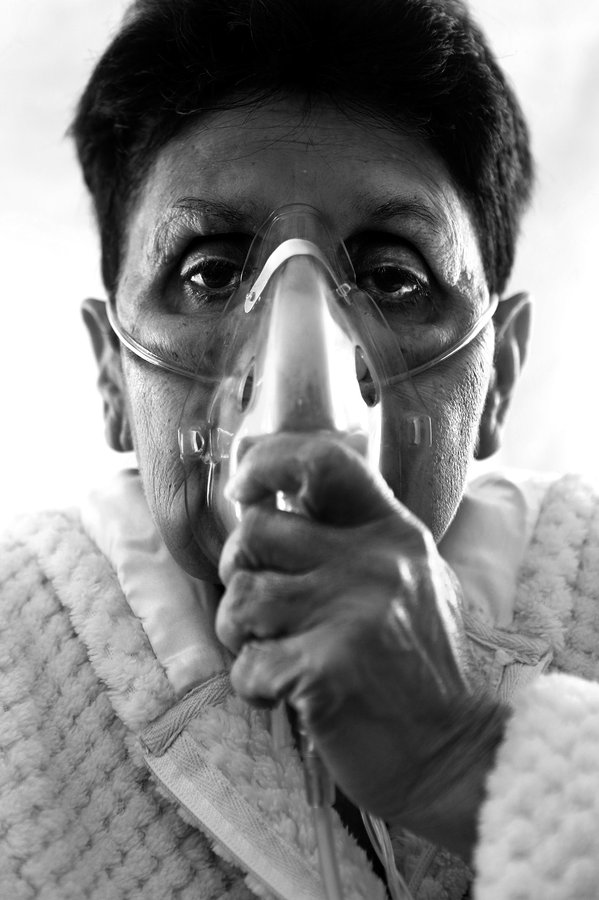
Gayle Kennedy: Patty Mundine, has passed away. Her portrait is called Baryulgil. Before she passed away, she said :
Patty Mundine: ‘I am from Baryulgil, where the asbestos mine is. Weekends we use to be up in the mines playing with the asbestos the dust and whatever. The problem I got now is my lungs: I can’t breathe. I only have a quarter of a lung on the left-hand side. I am on oxygen day and night, 24 hours. The thing is, because we’re Aboriginals, I feel we are left out of everything and doctors don’t want to recognise it … I have me little cries every day. So it doesn’t you know. I do it every day.’
Warren Mundine: Baryulgil was a small asbestos mine in northeast New South Wales which was worked by the Bundjalung/Banjalang people of the area. Dust permeated workers’ houses, and women and children were exposed. Tailings (mill residue) were spread around the community to settle the dust and provide material for roadworks. Children played in the tailings and on the mine site itself. Many members of the community, especially men, have died prematurely but it has been difficult for people to win workers’ compensation or compensation from James Hardie – because of the generally poor health status of the community and the prevalence of chronic bronchitis, pleurisy and pneumonia – although cases of asbestosis and asbestos-related lung cancer have been clearly identified.
Like Aunty Patty, my father, Roy Mundine, was from Baryulgil. In fact he is buried there with six of his brothers, most of whom died as a result of lung disease. He was one of the lucky ones, as he didn’t work at the mine, and so were we, as he moved our family, of 11 children, down to Sydney when I was 7 years old. It is very easy to become overwhelmed by Indigenous health statistics: not only the data itself but also the immensely complex interconnectedness of health problems, health risk factors and social issues. Indigenous people live these statistics every day and we experience the real impact – not just on individuals and their specific health problems, but also on our communities and families, who are being hollowed out by things like low life expectancy, chronic and communicable diseases, and mental health problems, alcohol-related disease and assaults, Foetal Alcohol Spectrum Disorder, suicide and child mortality. These problems have an ongoing social, cultural and psychological impact on communities and families. When it comes to Indigenous health policy and health services, the greatest challenge is bureaucracy, waste and red tape.
Of course, for Aboriginal and Torres Strait Islander people it’s not just about statistics; it’s about our family, friends and communities; it’s about our parents and our children and our own selves. To me it is a very simple proposition. The success of government service delivery in Indigenous health should be measured by the outcomes achieved. Its about the outcomes and results achieved for indigenous people.
Gayle Kennedy: Thank you to Warren Mundine. Warren is from the Bundjalung / Gumbaynggirr People and Managing Director, Nyunggablack. He is also the Chair of the Prime Ministers Indigenous Advisory Council.