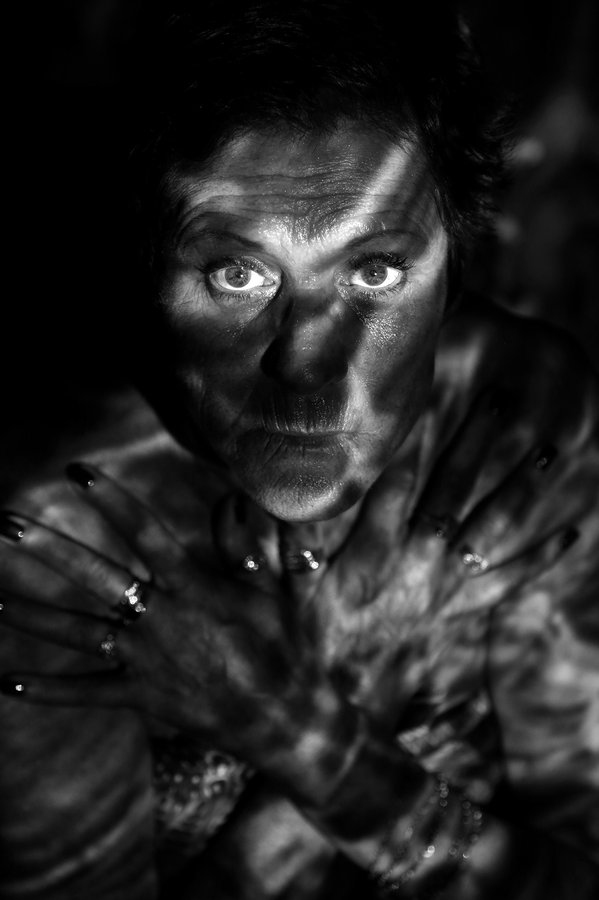
Gayle Kennedy: Kay Sadler is a Worimi Biripi Woman. She is a board member of the First Peoples Disability Network Australia. Her portrait is called Freshwater Saltwater and Kay says:
Kay Sadler: 'The Aboriginal communities, they have this thing too, which has been talked about on TV about who’s black and who’s blacker, who’s whiter than that oh I can get a taxi you can’t. Oh, come on, stop it. That is just like kids working out you’ve got three bits of candy and I only have two. Stop it. It’s about what you do with your life – if you identify as Aboriginal, that’s it. Why do you have to go and debate it? Why do you have to have a debate? Where does it get them? You have somebody opposing, you get into a debate, then you’re having an argument, and you’re back to square one. It doesn’t stop anything, I don’t know.’
Shelley Reys AO: Kay Sadler was unaware that she was Aboriginal until her early twenties, making her emotional journey to connect to culture as painful as her physical pain from Marfans Syndrome. This disability causes limbs to grow longer but spinal disintegration also occurs. She lives in two cultures in a place where the salt water and the fresh water meet. In this water she has found solace and relief from an internal and external pain. Kay Sadler is a Board Member of the First Peoples Disability Network and the Aboriginal Disability Network NSW. She is member of the Biripi Land Council and is completing her Diploma of Business (Governance) at Tranby College.
The definition of an Aboriginal person under federal laws such as the Aboriginal Land Rights Act 1983, is a person who is of Aboriginal descent, identifies as an Aboriginal person and is accepted by the Aboriginal community in which they live. All of these things must apply. A person’s physical appearance or the way they live are not requirements. Because of such definitions, government departments now require Aboriginal people to provide ‘proof of Aboriginality’ to be eligible for financial assistance or in other situations, such as public housing, education or employment. Aboriginal people can apply to their Local Aboriginal Land Council or an Aboriginal community organisation for a ‘Confirmation of Aboriginality’ or a ‘Certificate of Aboriginality’. These documents state that the person is known to identify as an Aboriginal person and is accepted by that community as an Aboriginal person. The Aboriginal and Torres Strait Islander Act also applies to people who identify as Torres Strait Islanders. These services and programs are intended to address the social, health and educational issues that Indigenous people often face as the result of past removal policies and inadequate educational, employment and health services. Requesting proof of Aboriginal or Torres Strait Islander heritage helps make sure that this intention is honoured.
Gayle Kennedy: Thank you Shelley Reys AO who is from the Djiribul people. She is the chair of the National Centre for Indigenous Excellence, and the Managing Director of Arrilla.