Warning: Aboriginal and Torres Strait Islander viewers should use caution when viewing, as it may contain images and names of deceased persons.
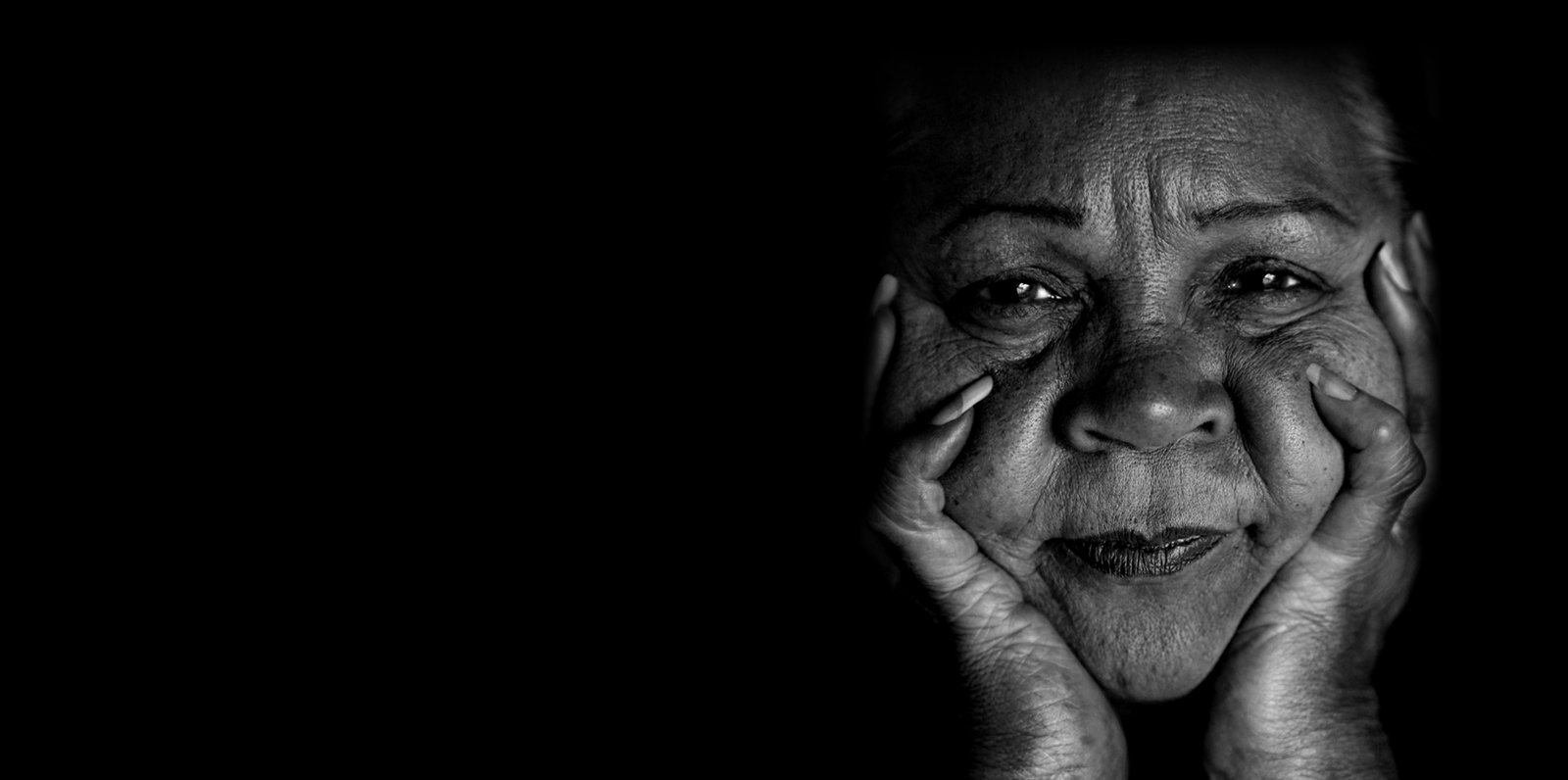
Gail Kennedy: Unfinished Business, a photographic exhibition featuring stories from Aboriginal and Torres Strait Islander Peoples with disabilities.
Belinda Mason: I would like to pay my respect to the traditional custodians of this land on which this project was conceived and realised and acknowledge their Elders past and present. The Unfinished Business project would not exist without the guidance and Cultural Knowledge of the Aboriginal and Torres Strait Islander People who have contributed to it.
Unfinished business reveals the stories of 30 people with disabilities from Australian Aboriginal and Torres Strait Islander communities through their involvement in the project, each participant draws much needed attention to the critical issues that impact on their lives. Each participant's story is complex and intertwined with Australia's political and social history, which has resulted in today's unacceptably high rates of disability in Aboriginal and Torres Strait Islander communities. The exhibition was launched in September 2013 at the Palais de nationals in Geneva by Mr. Tokayev, the then director of the United Nations Office in Geneva and Peter Woolcott, Australia's ambassador to the United Nations. The work was displayed to coincide with the 24th session of the Committee of the Rights of Persons with Disabilities, the CRPD, a body within the Office of the High Commissioner for Human Rights. The project was supported by the first peoples Disability Network and the Department of Foreign Affairs and Trade through the Australian mission in Geneva in December 2013 the exhibition was displayed at the World Health Organization headquarters in Geneva. The exhibition will be shown at the United Nations 2014 World Conference on indigenous people in New York. The narrators are predominantly high profile Australian Aboriginal and Torres Strait Islander people who have given their support to the participants and the concerns that they have expressed. All the narrators have contributed in their own right to improving the human rights and lives of all Australian Aboriginal and Torres Strait Islander peoples.
The exhibition consists of 30 3D lenticular, back lit photographic portraits of the participants, plus a narrative style video interview of each participant. The interviews were made by Dieter and Liam Knierim. This project also has an app which will enable people with sensory, cognitive and learning impairments to engage with the project, you cannot argue when someone says, I feel it's not our right. It's part of our own journey to learn empathy rather than compassion. Our own reaction exposes us to ourselves and reminds us that we all need the ability to listen when someone lays their naked soul in our path.
Gail Kennedy: And that was Belinda Mason speaking, the photographer of Unfinished Business. The forward of this book is by Damien Griffiths, the Chief Executive Officer of The First Peoples Disability Network Australia.
Damien Griffiths: By any measure, Aboriginal and Torres Strait Islander people with disabilities are amongst some of the most disadvantaged Australians. They often face multiple barriers to meaningful participation within their own communities and the wider community. Addressing the unmet needs of Aboriginal and Torres Strait Islander people with disabilities is one of the most critical social justice issues in Australia today. Unfinished Business powerfully exposes the injustices experienced by many Aboriginal and Torres Strait Islander people with disabilities. It also, importantly, shows us the power and dignity inherent in the participants. Each photograph also reminds us of the diversity of disability in Aboriginal and Torres Strait Islander communities. The First Peoples Disability Network, the national organisation representing Aboriginal and Torres Strait Islander people with disabilities and their families, is deeply proud of our association with this historic and groundbreaking exhibition. For too long the needs of Aboriginal and Torres Strait Islander people with disabilities have been largely overlooked. This is despite the fact that the prevalence of disability is significantly higher amongst Aboriginal and Torres Islanders than in the general Australian population. Until recently the prevalence of disability in Aboriginal and Torres Strait Islander communities has been only anecdotally reported. However, the 2011 Australian Census concluded that at least 50 per cent of Aboriginal people have some form of disability or long-term health condition. This may actually be a conservative figure, because it does not include a measure of the prevalence of psychosocial disability in Aboriginal and Torres Strait Islander communities. The high prevalence of disability, approximately twice that of the non-Indigenous population, occurs in Aboriginal and Torres Strait Islander communities for a range of social reasons, including poor health care, poor nutrition, and psychological trauma: for example, removal from family and community, as well as the breakdown of traditional community structures in some areas. Aboriginal people with disabilities are significantly over-represented on a population group basis, among homeless people, in the criminal and juvenile justice systems and in the care and protection system, both as parents and as children. Currently most Aboriginal and Torres Strait Islander people with disabilities remain at the periphery of the disability service system. This continues to occur for a range of reasons, some of which are well established. However, one factor that remains little understood is the reluctance of Aboriginal and Torres Strait Islander people with disabilities to identify as people with a disability. This too continues to occur for a range of reasons, including the fact that in traditional language there isn’t a comparable word for disability. This would suggest that disability was an accepted part of the human experience: that is, that people are not labelled.
Many parents are reluctant to identify their children as having a disability because they worry that they may be viewed as bad parents and as a consequence may have their children removed. It is still the case that Aboriginal children are significantly overrepresented in the out-of-home care system. Furthermore, some Aboriginal and Torres Strait Islander people with disabilities are reluctant to self-identify because they already experience discrimination based upon their Aboriginality and they do not want to be given another label perceived as negative. This preference to not identify presents a fundamental barrier to the equal participation of Aboriginal and Torres Strait Islander people with disabilities in Australian society. The First Peoples Disability Network argues passionately that for positive change to happen in the lives of Aboriginal and Torres Strait Islander people with disabilities, that change must be driven by the community itself. It cannot be imposed, implied, intervened or developed, even if with well-meaning intentions, by an external service system that the vast majority of Aboriginal and Torres Strait Islander people with disabilities have little or no experience of in the first place. In many communities across the country Aboriginal and Torres Strait Islanders with disabilities have been supported and accepted as members of their communities. However, it is the resources to support Aboriginal and Torres Strait Islanders with disabilities that many communities lack. Furthermore, the service system tends to operate from a ‘doing for’ as opposed to ‘doing with’ approach, which further disenfranchises communities because they simply do not feel that they can self-direct their future. It must be remembered that in many ways the social movement of Aboriginal and Torres Strait Islander people with disabilities is starting from an absolute baseline position. Unfinished Business acts as a powerful conduit for the consolidation of the emerging social movement of Aboriginal and Torres Strait Islander people with disabilities. All the participants in the exhibition are leaders in their own right. Unfinished Business provides a critical platform for the participants’ stories. We are very proud to be associated with Unfinished Business. We are very grateful to photographer Belinda Mason and thank her not only for the quality of her work but also for the respectful and dignified way in which she has portrayed each of the participants.
Belinda Mason: I would like to introduce you to the narrator of this book, Gail Kennedy. Gail Kennedy is a member of the Wongaiibon Clan of the Ngiyaampaa, speaking nation of South West New South Wales. She has had stories published in newspapers, magazines and broadcasts on radio, and was the indigenous issues writer and researcher for streetwise comics from 1995 to 1998 she's in demand at literary events and workshops, and has spoken in Australia and internationally on the issues of disability and culture. She has lived and worked in Sydney since 1973 her book Me, Ant Man and Flea Bag won the 2006 David Unaipon Award.
Gail Kennedy: I am a polio survivor who lives with the late effects of polio known as post polio syndrome. I lived a very active and mobile life, despite a limp, and was initially shocked and dismayed when I, like my fellow polio survivors, found out that the mobility we had taken for granted was to be severely compromised, to such an extent that from 2004 I found myself in a wheelchair full time as post polio syndrome progressed. I also found that I suffered from fatigue so debilitating I had to give up working full time and go to part time. It eventually progressed to the point where I had to give up work altogether. I went from someone who had never considered herself as having a disability to someone who clearly had and with all the incumbent difficulties, lack of access, lack of equity, frustration at dealing with bureaucrats that did not seem to listen or understand my needs. And finally, but most importantly, I seemed to become invisible. I joined the people with disability tribe, the shadow people, as a member of this group I see. Discovered that people without disabilities talked about around over and to the people who accompany us never to us. Our opinions are rarely sought, and when they are will often be ignored. We are told what we need, when we will get it, if at all, and how the services we need will be delivered. For the first time in my life, I felt disempowered spontaneity was not an option anymore. Now everything had to be researched, planned. I could not and still cannot accept invitations anywhere without first finding out if they have access and facilities. And I'm still amazed at the lack of access and equity in this country, I became depressed and grieved deeply for my old, free, willing, spontaneous life.
In spite of being constantly told that I had to buck up and get on with it, I allowed myself a time of grieving and eventually came up for air and rebuilt my life to what it is now, a rich and fulfilling one. When I started moving in circles where I met other people with disabilities, I found that on the whole and in spite of the barriers that society puts before us, they also lead great lives full of love, romance, travel, work and family. We know and understand that our disabilities are part of us, but they don't define us. It is society that has to learn to understand that one of the things that I and other people with disabilities are concerned about is how we are depicted across the whole of media spectrum. We are portrayed as noble victims trotted out on television to the rising strains of Wind Beneath My Wings, achieving things meant only for non disabled people. The message, though, is not one of achievement for its own sake, but rather is one that is a wake up call to non disabled people to stop whining and get on with it. If this poor so and so can achieve this, what gives you the right to carry on? Look at them and thank the powers that be that you are not in their situation. The media particularly loves a little mop topped smart mouth child with a disability to drive this message home. We people with disabilities call it inspirational porn. The thing I love about this book is that the subjects chose how they wanted to be portrayed. They provided their own text to accompany the photographs, approved all additional text and chose the narrators for the audio book. This is what gives it such quiet power. Not all the people in this book have a disability, but are advocates for those who do not all the people have visible disabilities. What these people all have in common is that they are all extraordinary, some for their achievements, some for sheer dogged persistence in the face of almost unbelievable obstacles, and others for the very act of survival against the odds. Their gifts and powers are all part of their DNA, part of the very fabric of their being, and they would achieve and survive in any circumstances, because it is who they are. This book brings people with disabilities, advocates and carers out of the shadow they are front and center and in your face right where they belong.